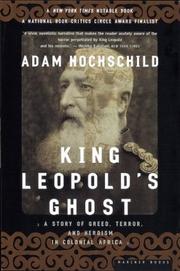
King Leopold's Ghost
How King Leopold II of Belgium seized the Congo as his own colony in the 1880s.
The Congo Free State as a privately owned extraction business, and the campaign that ended it.
Summary
Hochschild tells how, in the 1880s, as the European powers carved up Africa, King Leopold II of Belgium took for himself the vast territory around the Congo River. He plundered it, looting its rubber, brutalising its people and cutting its population by ten million, while carefully building a reputation as a great humanitarian. Efforts to expose these crimes led to the first great human rights movement of the twentieth century, joined by figures from Mark Twain to the Archbishop of Canterbury.
Hochschild portrays Leopold as a cunning, charming and cruel megalomaniac, and draws portraits of the missionaries, travellers and young idealists who went to Africa for work or adventure and found themselves witnesses to atrocity. Chief among them is Edmund Morel, a young British shipping agent who led the international campaign against Leopold. Others include the Irish patriot Roger Casement, who later died on a London gallows; two Black Americans, George Washington Williams and William Sheppard, who risked much to bring out evidence; and a young steamboat officer on the Congo River named Joseph Conrad.
Key takeaways 4
- Leopold II ran the Congo as a personal possession and extracted its rubber by terror.
- His regime cut the Congo's population by about ten million.
- He presented himself to Europe as a humanitarian while the killing went on.
- A campaign led by Edmund Morel became the first great human rights movement of the twentieth century.
Who should read it
Readers who want the history of the Congo Free State as a privately owned extraction business and of the campaign that ended it.
Similar books 6
Chosen by shared topics, the entries that hold them, and the people who recommended both.
Congo from the slave trade and King Leopold to Mobutu and the resource wars.
Modern Indonesia's history, guided by the life and writing of Pramoedya Ananta Toer.
A scholarly history of Singapore as a trading port from 1819 to 2005.

Thailand from the eighteenth century on: its state, its economy and its social order.
Thailand's royal succession and the political violence and censorship around it.
Essays on why a rich, well-endowed Argentina stagnated for so long.