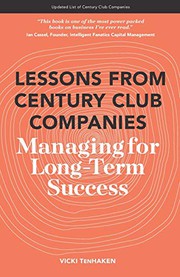
Lessons from Century Club Companies
What Japanese companies that have lasted over a century have in common.
What firms surviving a hundred years have in common
Summary
TenHaken, a management professor who had worked at Herman Miller, studied Japanese companies that had operated for more than one hundred years, of which Japan has an unusually large number, and identified what they had in common.
Her research covered surveys and interviews with long-surviving Japanese firms, most of them small and medium-sized rather than the large corporations that receive attention. The practices she reports include: maintaining relationships with employees, suppliers, customers and the local community over generations rather than transactionally; conservative financial management with low debt and substantial reserves held specifically to survive downturns without laying off staff; a stated corporate philosophy that predates the current management and constrains what the company will do; slow deliberate expansion within a defined competence rather than diversification; deliberate succession planning conducted over years, including the Japanese practice of adopting a capable successor into the family where no suitable heir exists; and treating the business as something held in trust for the next generation rather than owned outright by the current one.
She contrasts this with the American pattern of maximising current returns and treating relationships as transactions to be repriced.
The research is survey-based and the sample is selected on survival, so the practices identified are correlates rather than demonstrated causes. Japanese institutional conditions including bank relationships, employment norms and family structures differ enough that transferability is a real question, which TenHaken addresses briefly. The reference has not verified the specific research findings.
Key takeaways 7
- Japan contains an unusually large number of companies over one hundred years old, most of them small and medium-sized rather than large corporations.
- Long-surviving firms hold substantial financial reserves specifically to survive downturns without breaking employment relationships.
- Relationships with employees, suppliers and customers are maintained across generations rather than repriced transactionally at each opportunity.
- A stated corporate philosophy predating the current management constrains what the company will do and survives leadership changes.
- Expansion is slow and stays within a defined competence, which limits growth and removes the failure mode of diversification into unfamiliar businesses.
- Succession is planned over years, and the Japanese practice of adopting a capable successor into the family removes the constraint of biological inheritance.
- The sample is selected on survival, so the practices identified are correlates rather than demonstrated causes of longevity.
Who should read it
Owners of family and closely held businesses interested in longevity practices and succession, with the transferability question left open.
Who recommended it 1 · 1 direct
“Recently, I came across two books on long lived companies: ‘‘The Living Company, Habits for Survival in a Turbulent Business Environment’’ by Arie de Geus, and ‘‘Lessons from Century Club Companies, Managing for Long Term Success’’ by Vicki Tenhaken.”
Similar books 6
Chosen by shared topics, the entries that hold them, and the people who recommended both.
How corporate governance brought down Nortel Networks, the Canadian technology firm.
“You may understand why I say this if you read the recent book on Nortel’s bankruptcy ‘‘100 Days: The rush to judgment that killed Nortel’’, by James Bagnall.” — Prem Watsa
Source: Chairman's Letter to Shareholders 2013, page 6
Recommended by: Mohnish Pabrai, Prem Watsa

An eyewitness account of how Ford and the American car industry undid themselves.
Recommended by: Mohnish Pabrai

The story of the Walgreens drugstore chain and the American history around it.
Recommended by: Mohnish Pabrai

How Alan Mulally turned Ford around and saved it without bankruptcy.
Recommended by: Mohnish Pabrai
How General Motors succeeded in China: its people, decisions and breaks.
Recommended by: Mohnish Pabrai

Aldi's hard-discount method: radical simplicity as the way to keep costs low.