Updates

  1. Person pages list letters, writing, profiles and links as sortable tables with filters, and show each person's companies as links; Fund letters show each letter's description in its own column.
  2. Experts show a checked job title and a short description of each person; 30 more people have photographs.
  3. Every company, fund, university and publication the experts work for has a page listing the people there.
  4. Fund letters show each letter's thesis and filter by it; 225 person pages list the essays, columns and newsletter issues the person wrote.
  5. Person pages list every essay and newsletter issue a person wrote, and their own books as a table in List view.
  6. Recommends shows the five largest kinds of book and the rest under More; browse pictures load sooner.
  7. Podcasts and talks link the original episode, filter by Audio and video or Press, and list each publisher once.
  8. Pages are wider, Recommends has List and Grid, and a filter clicked again turns off.
  9. Book cards sit in a ruled grid with Open Library and Goodreads links and each book's one-line note.
  10. Funds is now Investors; each investor's styles are buttons that filter the table.
  11. Podcasts and talks on a person's page filter by year and publisher and show as a list or a grid of pictures.
  12. Quotes show only people's own words: 472 summaries written by list sites are gone.
  13. Country pages open from Browse again, and every link on the shelf lands on a page.
  14. Subject and person pages show their sections as tabs, and each book appears once on a person's page.
  15. Book cards show the quote, who said it and the source; grids show five cards to a row.
  16. On a phone, a menu holds the sections, search, Updates, Feedback and dark mode.
  17. Feedback takes a screenshot of the page with no browser prompt, opens a screenshot full size when you click it, and clears itself once sent.
  18. Book cards are centred, search names the topic each book sits in, and any text cut short shows whole on hover.
  19. Search groups its results by kind: people, companies, geographies, subjects, topics, books, funds, fund letters and papers.
  20. The Books table lists who recommended each book by name, and the browser tab names the section you are in.
  21. Feedback can take a screenshot of the page, or one you paste or choose, and opens in the corner beside Updates.
  22. Each rail button reopens its section where you left it, and Browse, Table and People show on every book and subject page.
  23. Filters grey out choices that hold nothing instead of hiding them, and Books › People filters by authors or recommenders.
  24. Feedback takes a subject line and up to three screenshots.
  25. Biographies are grouped by the person they are about: 41 new pages, from Abraham Lincoln to Lee Kuan Yew.
  26. Sport splits into 23 sports, and Religion into one topic per faith.
  27. Book lists show as cards: the cover, one recommendation quote and every recommender by name.
  28. Seventeen subjects that had two or three pages under different names now have one page each.
  29. Every page lists its Experts as authors and recommenders, with a link to them on the Experts tab.
  30. Economics, Financial history, Financial panics and Accounting are subjects of their own, with one page per financial crisis.
  31. Book, person and subject pages open inside the app, so the tabs stay in view.
  32. 996 more book covers, and photographs or logos for 227 more people and companies.
  33. Books › Browse shows every subject as cards, and the rail holds Fund letters, Papers, Experts, Books and Funds.
  34. Every topic over 150 books splits into narrower topics, each with a page of its own.

Send feedback

What is it?
Screenshots, up to 3 (optional)
or paste one with Ctrl+V

We use your email only to reply to you.

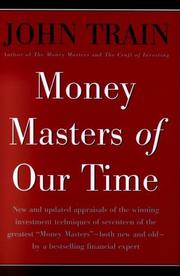
Money Masters of Our Time

Money Masters of Our Time

John Train
2000
T2 400 pages · about 6h 40m to read Open Librarygoodreads

Profiles of the great money managers and their differing methods.

Summary

John Train profiles investors he considers exceptional, updating and extending his earlier books The Money Masters and The New Money Masters. Each chapter covers one investor's background, method and characteristic holdings, based on interviews and on published records.

The subjects include Warren Buffett, George Soros, John Templeton, Benjamin Graham, Philip Fisher, Peter Lynch, T. Rowe Price, Michael Steinhardt, Ralph Wanger, Julian Robertson, Mark Lightbown, Paul Cabot, John Neff, Richard Rainwater and others. Train's method is to identify what each does that is distinctive rather than to extract a common formula, and the book's usefulness comes from the contrasts. Graham buys statistical cheapness and diversifies; Fisher buys quality and concentrates; Soros trades reflexive feedback between perception and fundamentals; Templeton searches internationally for the cheapest markets; Steinhardt takes contrary macro positions with high turnover.

Train writes as an experienced money manager and the profiles are informed, but the book has the survivorship problem of every collection of this kind: it profiles people whose methods worked over the period selected. It also stops in 2000, so the subsequent records of several subjects are missing, including Robertson's fund closure in that year. The chapters on Graham, Fisher and Price are the most useful as statements of investment philosophy, and Train's summaries of each method are unusually precise.

Key takeaways 7

  1. Successful investors use incompatible methods, which shows there is no single correct approach rather than that most of them are lucky.
  2. Graham's method requires statistical cheapness and wide diversification, while Fisher's requires business quality and concentration, and the two cannot be combined.
  3. Soros trades the feedback between market perceptions and the fundamentals those perceptions alter, which is a different activity from valuation.
  4. Templeton's edge came from searching markets other investors did not cover rather than from analysing securities better.
  5. Every subject describes an explicit selling discipline, and most describe it as the harder half of the process.
  6. Train argues that each investor's method fits their temperament, and that copying a method without the temperament fails.
  7. Concentration and diversification are both defensible, and the choice follows from how much can be known about a single position.

Who should read it

Investors surveying different approaches who want precise summaries of what distinguishes the major schools rather than a synthesis of them.

About John Train

American investment adviser who founded Train, Smith Counsel and wrote profiles of the era's leading money managers.

The Money Masters profiled Buffett, Graham, Templeton and Price while several were still working, setting out each manager's method in a few pages and establishing the format every later investor-profile book uses. Famous Financial Fiascos covers the reverse case, running through manias and frauds from the tulip trade onward.

Train, Smith Counsel

Similar books 6

Chosen by shared topics, the entries that hold them, and the people who recommended both.

John Train · 1980

The methods of nine great investors, including Buffett, Graham, Fisher and Templeton.

“all these people really were helpful in forming and getting me involved in investing” — Joel Greenblatt

Source: Masters in Business transcript: Joel Greenblatt (2018)

Recommended by: Joel Greenblatt, Mohnish Pabrai and 1 other

John Train · 1987

An early account of Buffett's investing method, from 1987.

Recommended by: Mohnish Pabrai

Bob Thompson · 2008

Interviews with twelve of Canada's top money managers on how they pick stocks.

Recommended by: Mohnish Pabrai

Philip L. Carret, Philip Carret · 1995

A fund manager of sixty years on investing, business and a long life.

Recommended by: Mohnish Pabrai

Where it sits in the reference 2

Journalists
Investment styles

Topics

InvestingBiography and MemoirInvestors, Traders and GamblersInvestor profiles and interviews