Updates

  1. Person pages list letters, writing, profiles and links as sortable tables with filters, and show each person's companies as links; Fund letters show each letter's description in its own column.
  2. Experts show a checked job title and a short description of each person; 30 more people have photographs.
  3. Every company, fund, university and publication the experts work for has a page listing the people there.
  4. Fund letters show each letter's thesis and filter by it; 225 person pages list the essays, columns and newsletter issues the person wrote.
  5. Person pages list every essay and newsletter issue a person wrote, and their own books as a table in List view.
  6. Recommends shows the five largest kinds of book and the rest under More; browse pictures load sooner.
  7. Podcasts and talks link the original episode, filter by Audio and video or Press, and list each publisher once.
  8. Pages are wider, Recommends has List and Grid, and a filter clicked again turns off.
  9. Book cards sit in a ruled grid with Open Library and Goodreads links and each book's one-line note.
  10. Funds is now Investors; each investor's styles are buttons that filter the table.
  11. Podcasts and talks on a person's page filter by year and publisher and show as a list or a grid of pictures.
  12. Quotes show only people's own words: 472 summaries written by list sites are gone.
  13. Country pages open from Browse again, and every link on the shelf lands on a page.
  14. Subject and person pages show their sections as tabs, and each book appears once on a person's page.
  15. Book cards show the quote, who said it and the source; grids show five cards to a row.
  16. On a phone, a menu holds the sections, search, Updates, Feedback and dark mode.
  17. Feedback takes a screenshot of the page with no browser prompt, opens a screenshot full size when you click it, and clears itself once sent.
  18. Book cards are centred, search names the topic each book sits in, and any text cut short shows whole on hover.
  19. Search groups its results by kind: people, companies, geographies, subjects, topics, books, funds, fund letters and papers.
  20. The Books table lists who recommended each book by name, and the browser tab names the section you are in.
  21. Feedback can take a screenshot of the page, or one you paste or choose, and opens in the corner beside Updates.
  22. Each rail button reopens its section where you left it, and Browse, Table and People show on every book and subject page.
  23. Filters grey out choices that hold nothing instead of hiding them, and Books › People filters by authors or recommenders.
  24. Feedback takes a subject line and up to three screenshots.
  25. Biographies are grouped by the person they are about: 41 new pages, from Abraham Lincoln to Lee Kuan Yew.
  26. Sport splits into 23 sports, and Religion into one topic per faith.
  27. Book lists show as cards: the cover, one recommendation quote and every recommender by name.
  28. Seventeen subjects that had two or three pages under different names now have one page each.
  29. Every page lists its Experts as authors and recommenders, with a link to them on the Experts tab.
  30. Economics, Financial history, Financial panics and Accounting are subjects of their own, with one page per financial crisis.
  31. Book, person and subject pages open inside the app, so the tabs stay in view.
  32. 996 more book covers, and photographs or logos for 227 more people and companies.
  33. Books › Browse shows every subject as cards, and the rail holds Fund letters, Papers, Experts, Books and Funds.
  34. Every topic over 150 books splits into narrower topics, each with a page of its own.

Send feedback

What is it?
Screenshots, up to 3 (optional)
or paste one with Ctrl+V

We use your email only to reply to you.

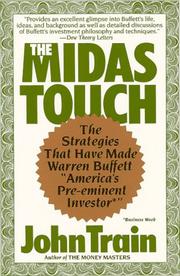
The Midas Touch

The Midas Touch

John Train
1987
T2 216 pages · about 3h 36m to read Open Librarygoodreads

Summary

Train, an investment manager and writer, produced one of the earliest book-length treatments of Warren Buffett's method, published in 1987 when Buffett was known to professionals but not yet a public figure. It is short.

Train organises Buffett's approach around a small number of principles: buy businesses rather than stocks, insist on a business you can understand, require a durable competitive position, demand honest and capable management, buy at a price that leaves a margin of safety, and hold indefinitely. He explains the transition from Graham-style statistical bargains to the purchase of high-quality franchises at fair prices, and credits Charlie Munger and the See's Candies purchase with the shift. He also covers the mechanics of using insurance float as investment capital, which is the structural feature that distinguishes Berkshire from a fund.

The material rests on Buffett's shareholder letters, on Train's own conversations, and on the public record of Berkshire's holdings up to the mid-1980s.

Everything here has since been covered in more detail by Hagstrom, Lowenstein, Schroeder and by the letters themselves, which are freely available. The book's value now is largely historical, as evidence of how Buffett's method was understood before the industry built a literature around it. The portfolio examples stop in 1986 and the treatment of Berkshire's operating businesses is thin.

Key takeaways 7

  1. Buffett buys businesses rather than securities, and the distinction changes which facts matter.
  2. A durable competitive position matters more to long-run returns than the purchase multiple.
  3. Insurance float supplies Berkshire with investment capital at negative cost when underwriting is profitable.
  4. Buffett moved away from Graham's statistical bargains toward paying fair prices for high-quality franchises.
  5. An investor should stay inside the set of businesses whose economics they can actually assess.
  6. Management quality is assessed by capital allocation decisions rather than by operating performance.
  7. Holding indefinitely defers tax and lets compounding run, which is a mechanical advantage over trading.

Who should read it

Readers interested in how Buffett's method was described before it became canonical, though newer books cover the same ground more thoroughly.

About John Train

American investment adviser who founded Train, Smith Counsel and wrote profiles of the era's leading money managers.

The Money Masters profiled Buffett, Graham, Templeton and Price while several were still working, setting out each manager's method in a few pages and establishing the format every later investor-profile book uses. Famous Financial Fiascos covers the reverse case, running through manias and frauds from the tulip trade onward.

Train, Smith Counsel

Who recommended it 1 · 1 direct

Similar books 6

Chosen by shared topics, the entries that hold them, and the people who recommended both.
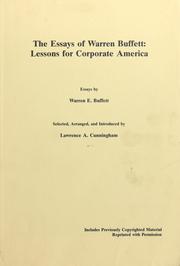
Warren Buffett, Lawrence A. Cunningham · 1997

Berkshire's shareholder letters arranged by topic: governance, valuation, mergers.

“The resource is as valuable as Larry Cunningham's The Essays of Warren Buffett, which similarly organizes by subject matter” — Christopher Bloomstran

Source: Semper Augustus 2024 Letter to Clients, 'Books and Tunes for Walking', p. 96

Recommended by: Christopher Bloomstran, Francois Rochon and 11 others
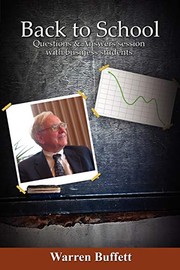
Andrew Kilpatrick · 1994

Sprawling, repeatedly expanded compendium of Buffett material.

Recommended by: Mohnish Pabrai
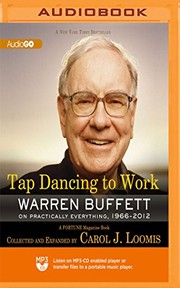
Carol J. Loomis · 2012

Fortune's articles by and about Buffett from 1966 to 2012, with commentary.

“I hope many people, even those who think they know Warren well, will read it cover to cover.” — Bill Gates

Source: Gates Notes review of Tap Dancing to Work

Recommended by: Bill Gates, Guy Spier, Mohnish Pabrai and 2 others
John Train · 1980

The methods of nine great investors, including Buffett, Graham, Fisher and Templeton.

“all these people really were helpful in forming and getting me involved in investing” — Joel Greenblatt

Source: Masters in Business transcript: Joel Greenblatt (2018)

Recommended by: Joel Greenblatt, Mohnish Pabrai and 1 other

Where it sits in the reference 3

Journalists
Investment styles
Biographies

Topics

InvestingBiography and MemoirInvestors, Traders and Gamblers