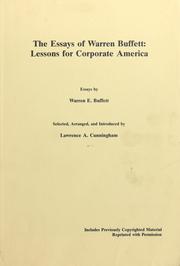
The Essays of Warren Buffett: Lessons for Corporate America
Buffett's own letters arranged by theme; he wrote no standalone book.
Summary
Cunningham takes Buffett's Berkshire Hathaway shareholder letters and rearranges the passages by subject rather than by year. The result is a thematic treatment of corporate governance, finance and investing, accounting, mergers, valuation and taxation, assembled entirely from Buffett's own words with Cunningham supplying an introduction and section framing.
The governance material is the part least available elsewhere. Buffett writes about what boards actually do, the failure of compensation committees, the difference between a manager who thinks like an owner and one who does not, and why he lets Berkshire's operating managers run their businesses without interference. The finance and investing sections cover Mr Market, margin of safety, circle of competence, the difference between price and value, and the argument that volatility is not risk.
The accounting section is unusually practical. Buffett explains owner earnings, why he distrusts EBITDA, how goodwill amortisation distorts economic reality, how option grants were hidden from income statements, and why restructuring charges deserve scepticism. He also states the case for and against share repurchases with the same precision he applies to acquisitions, which is the argument that a buyback creates value only below intrinsic value.
The organisation is the book's main advantage over reading the letters directly, and also its main limitation. Passages are removed from the year and the market conditions that produced them, so a reader loses the context of what Berkshire was doing at the time. The letters themselves are free, which makes this a convenience purchase. Later editions add material through the 2010s. The book does not cover Berkshire's operating history or Buffett's biography.
Key takeaways 8
- An investor should treat a stock purchase as buying a fractional interest in a business rather than as acquiring a security to be traded.
- Volatility is not risk, and risk is the probability of permanent loss of purchasing power.
- Managers should be evaluated by their capital allocation record, because retained earnings compound at whatever return the manager achieves on them.
- Reported earnings mislead, and owner earnings, defined as net income plus non-cash charges minus required capital expenditure, measure what a business actually produces.
- Share repurchases create value only when made below conservatively estimated intrinsic value, and destroy it above.
- Most acquisitions transfer value from the acquirer's shareholders to the target's, because acquiring managers overestimate synergies and enjoy running larger companies.
- Accounting conventions including EBITDA, restructuring charges and unexpensed options were designed or used to obscure economic reality.
- A business with a durable competitive advantage and honest, able management can be held indefinitely, which removes most of the work of investing.
Who should read it
Investors and directors who want Buffett's positions organised by subject, particularly the governance and accounting arguments that are hard to assemble from the annual letters.
About Warren Buffett
Chairman, Berkshire Hathaway; chief executive 1970-2025; earlier general partner, Buffett Partnership Ltd.
The Berkshire shareholder letters are a primary source in their own right, read and cited far beyond investing.
Who recommended it 13 · 7 direct
“The resource is as valuable as Larry Cunningham's The Essays of Warren Buffett, which similarly organizes by subject matter”
“By far, the best investor of all time is Warren Buffett. I have read everything I could find (past and present) about him.”
“I have read everything I could on Buffett. He is our business/investment role model.”
“I always assign that in my class which I just think is a great, great book”
“I think I have read almost everything Warren Buffett has written and I agree with more than 95% of his thinking.”
“The only book on Buffett endorsed by him. It's a good book to pick up after having read the last 20 years of letters to shareholders.”
Similar books 6
Chosen by shared topics, the entries that hold them, and the people who recommended both.

Every Berkshire annual letter since 1965, in order, as the company grew.
“…books I've recommended, highlighted to death, or forced on friends.” — Andrew Wilkinson
Source: Andrew Wilkinson's Bookshelf, neverenough.com
Recommended by: Andrew Wilkinson, Arnold Van Den Berg and 5 others
Eight CEOs who beat the market by allocating capital, not by running operations.
“…books I've recommended, highlighted to death, or forced on friends.” — Andrew Wilkinson
Source: Andrew Wilkinson's Bookshelf, neverenough.com
Recommended by: Andrew Wilkinson, Dan Loeb, Francois Rochon and 12 others

Buffett's life to 2008, written with full access to his files and his friends.
“…books I've recommended, highlighted to death, or forced on friends.” — Andrew Wilkinson
Source: Andrew Wilkinson's Bookshelf, neverenough.com
Recommended by: Andrew Wilkinson, Guy Spier, Mohnish Pabrai and 5 others

Fortune's articles by and about Buffett from 1966 to 2012, with commentary.
“I hope many people, even those who think they know Warren well, will read it cover to cover.” — Bill Gates
Source: Gates Notes review of Tap Dancing to Work
Recommended by: Bill Gates, Guy Spier, Mohnish Pabrai and 2 others
Berkshire as an operating company: its subsidiaries' culture and whether it lasts.
Recommended by: Mohnish Pabrai
Value is discounted future cash flow, not earnings per share or return on equity.
“I read that book and the light bulbs all went off for me personally.” — Michael Mauboussin
Source: The Tim Ferriss Show #659 — official transcript
Recommended by: Michael Mauboussin, Mohnish Pabrai
Where it sits in the reference 17
Topics