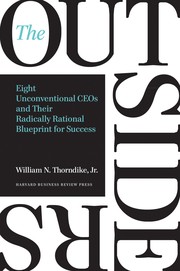
The Outsiders: Eight Unconventional CEOs and Their Radically Rational Blueprint for Success
Eight capital allocators who ran decentralised holding companies.
Summary
Thorndike studies eight CEOs whose companies produced extraordinary long-run shareholder returns and identifies what they had in common. The subjects are Tom Murphy at Capital Cities, Henry Singleton at Teledyne, Bill Anders at General Dynamics, John Malone at TCI, Katharine Graham at the Washington Post, Bill Stiritz at Ralston Purina, Dick Smith at General Cinema and Warren Buffett at Berkshire Hathaway. He measures each against both the S&P 500 and industry peers over their full tenure.
The argument is that capital allocation, not operations, determines long-run returns, and that a CEO has five sources of capital and five uses of it. The outsiders treated the decision analytically. They repurchased shares aggressively when the stock traded below intrinsic value and issued shares when it traded above. Singleton retired over ninety percent of Teledyne's shares. They preferred cash flow per share to reported earnings, avoided dividends where taxes made them inefficient, used leverage deliberately, and ran decentralised organisations with tiny head offices.
Thorndike's numerical work is the strength of the book. He gives compound annual returns for each CEO and for the relevant comparisons, which lets a reader check the claim rather than accept a narrative. The chapters are short and structurally identical, which makes the comparison across cases straightforward.
The method has an obvious selection problem. Thorndike chose eight winners and worked backwards, so the book cannot say how many CEOs used the same playbook and failed. Aggressive buybacks and leverage look different after a decade in which many firms repurchased stock at high valuations. The conditions of the 1970s and 1980s, including low valuations and high tax rates on dividends, favoured these tactics more than current conditions do.
Key takeaways 8
- Capital allocation, not operational management, drives long-run shareholder returns, and most CEOs are promoted for skills unrelated to it.
- A CEO who repurchases shares only when the price sits below conservatively estimated intrinsic value creates far more value than one who buys back on schedule.
- Cash flow per share matters and reported earnings per share does not, so managers should be willing to report low earnings while generating cash.
- Radical decentralisation of operations combined with centralised capital allocation produced results at every company in the study.
- Dividends were usually the worst use of cash under the tax regimes these managers faced, and the outsiders avoided them.
- Debt used deliberately against predictable cash flows amplified returns, and several of these CEOs ran leverage that peers considered reckless.
- Independent thinking, expressed as a willingness to act against industry practice and against Wall Street expectations, was the shared personal trait.
- Acquisitions should be judged against the alternative of repurchasing your own shares, which sets a hurdle most deals fail.
Who should read it
Investors assessing management quality and operators responsible for capital allocation, who want concrete return data rather than leadership generalities.
About William N. Thorndike Jr.
Founder of Housatonic Partners (1994); now Senior Advisor
One book, but The Outsiders is the reference text on CEO capital allocation and is cited constantly by investors and boards.
Who recommended it 15 · 8 direct
“…books I've recommended, highlighted to death, or forced on friends.”
“Of the two most consequential books that I read that had the most influence on me in quality investing, one would be The Outsiders.”
“The Outsiders is a terrific book by William Thorndike that profiles eight cases of terrific CEOs and their 'radically rational blueprint for success.' The book highlights the importance of capital…”
“A book like the Outsiders is a good example of what I like to read. It uses eight case studies to illustrate how unconventional managers can make a huge difference in creating per share value for…”
“The Outsiders, by William Thorndike, Jr., is an outstanding book about CEOs who excelled at capital allocation.”
Similar books 6
Chosen by shared topics, the entries that hold them, and the people who recommended both.
Berkshire's shareholder letters arranged by topic: governance, valuation, mergers.
“The resource is as valuable as Larry Cunningham's The Essays of Warren Buffett, which similarly organizes by subject matter” — Christopher Bloomstran
Source: Semper Augustus 2024 Letter to Clients, 'Books and Tunes for Walking', p. 96
Recommended by: Christopher Bloomstran, Francois Rochon and 11 others
Every Berkshire annual letter since 1965, in order, as the company grew.
“…books I've recommended, highlighted to death, or forced on friends.” — Andrew Wilkinson
Source: Andrew Wilkinson's Bookshelf, neverenough.com
Recommended by: Andrew Wilkinson, Arnold Van Den Berg and 5 others
Teledyne from the inside; the conglomerate that actually compounded.
“This is a great history of Henry Singleton and the conglomerate, Teledyne... I've recommended this several times as well.” — Christopher Bloomstran
Source: Semper Augustus 2023 Letter to Clients, 'Worldly Wisdom', p. 81
Recommended by: Christopher Bloomstran, Mohnish Pabrai
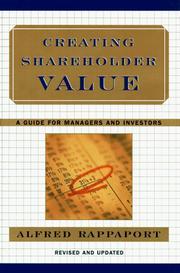
Value is discounted future cash flow, not earnings per share or return on equity.
“I read that book and the light bulbs all went off for me personally.” — Michael Mauboussin
Source: The Tim Ferriss Show #659 — official transcript
Recommended by: Michael Mauboussin, Mohnish Pabrai
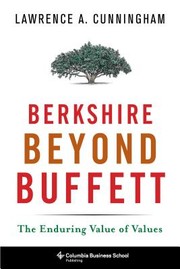
Berkshire as an operating company: its subsidiaries' culture and whether it lasts.
Recommended by: Mohnish Pabrai
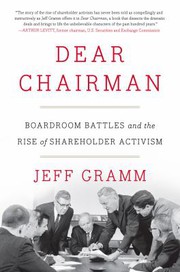
Eight activist letters over a century, from Graham in 1927, and what lay behind them.
Recommended by: Mohnish Pabrai
Where it sits in the reference 14
Topics