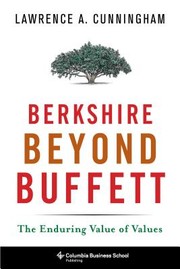
Berkshire Beyond Buffett
The operating subsidiaries and how the insurance core supports them.
Summary
Cunningham examines Berkshire Hathaway as an operating company rather than as an investment vehicle, and asks whether the culture and structure can survive Buffett. He interviewed subsidiary managers and family sellers and covers the businesses rather than the securities portfolio. His central argument is that Berkshire's subsidiaries share a set of traits that he groups under the acronym BERKSHIRE: budget-consciousness, earnestness, reputation, kinship, self-starters, hands-off management, investor savvy, rudimentary businesses, and eternity meaning permanence of ownership. He argues that these constitute a culture that the acquisition process selects for and that the ownership structure sustains.
The practical material concerns why families sell to Berkshire. Cunningham documents that sellers accept lower prices than private equity would pay in exchange for permanence, autonomy and the absence of resale, and that this constitutes a genuine competitive advantage in acquisitions that no leveraged buyer can match.
He covers specific subsidiaries in detail including GEICO, Nebraska Furniture Mart, Clayton Homes, Shaw Industries, Marmon, McLane, the Buffalo News and Benjamin Moore, showing the businesses and the terms. His succession argument is that the culture is embedded in the subsidiaries and the ownership structure rather than in Buffett personally, and that it can therefore survive him.
Cunningham has a long association with Buffett through the Essays compilation, and the book is sympathetic. The succession question remains unresolved and the argument that culture survives its founder is asserted more than demonstrated. The account of why sellers accept lower prices is the most transferable material.
Key takeaways 8
- Berkshire is an operating company with a large securities portfolio rather than an investment vehicle, and its subsidiaries produce most of its earnings.
- Families sell to Berkshire at lower prices than private equity would pay in exchange for permanence, autonomy and the absence of resale.
- The promise never to resell a business is a genuine competitive advantage in acquisitions that no leveraged buyer can offer.
- Subsidiary managers operate with almost no interference, and the head office performs capital allocation rather than management.
- The acquisition criteria select for businesses that are simple, established and already well managed rather than for turnaround opportunities.
- A tiny head office relative to the size of the organisation is possible because operating decisions are not made centrally.
- Cunningham argues that the culture is embedded in the subsidiaries and the ownership structure rather than in Buffett personally.
- The succession question remains unresolved, and the claim that the culture survives its founder is asserted more than demonstrated.
Who should read it
Investors and acquirers interested in how a permanent-capital acquirer competes against leveraged buyers on terms rather than on price.
About Lawrence A. Cunningham
Corporate-governance scholar and longtime George Washington University law professor; edits The Essays of Warren Buffett and writes on Berkshire and quality investing.
The Essays of Warren Buffett reorganises decades of Berkshire shareholder letters by subject - governance, accounting, mergers, valuation - turning scattered annual commentary into a usable manual. The later books extend the analysis to Berkshire's decentralised structure and to the traits that make a business durable enough to hold for decades.
University of Delaware, Quality Shareholders Group, George Washington University
Who recommended it 1 · 1 direct
Similar books 6
Chosen by shared topics, the entries that hold them, and the people who recommended both.
Berkshire's shareholder letters arranged by topic: governance, valuation, mergers.
“The resource is as valuable as Larry Cunningham's The Essays of Warren Buffett, which similarly organizes by subject matter” — Christopher Bloomstran
Source: Semper Augustus 2024 Letter to Clients, 'Books and Tunes for Walking', p. 96
Recommended by: Christopher Bloomstran, Francois Rochon and 11 others
Buffett, Munger and scholars discuss governance and investing at a 1996 symposium.
Recommended by: Mohnish Pabrai
Eight CEOs who beat the market by allocating capital, not by running operations.
“…books I've recommended, highlighted to death, or forced on friends.” — Andrew Wilkinson
Source: Andrew Wilkinson's Bookshelf, neverenough.com
Recommended by: Andrew Wilkinson, Dan Loeb, Francois Rochon and 12 others
How Berkshire runs on trust instead of the controls other large firms use.
Recommended by: Warren Buffett
How AIG became the world's largest insurer, and its builder's account of his ouster.
Recommended by: Mohnish Pabrai

Where it sits in the reference 6
Topics