The Buffett Essays Symposium: A 20th Anniversary Annotated Transcript
Summary
Cunningham organised a symposium in 1996 at which Warren Buffett, Charlie Munger and a group of academics, lawyers and investors discussed corporate governance, investing and the ideas in Buffett's shareholder letters. This volume is the annotated transcript, published for the twentieth anniversary.
The discussion covers the topics the Essays organise: what a corporation owes its shareholders and how that differs from what boards actually do; whether shares should be treated as ownership of a business or as instruments to be traded; accounting questions including option expensing, goodwill and pension assumptions; the case against diversification for informed investors; the role of the board and what independence means in practice; and market efficiency, on which Buffett and Munger argue against the academic position with the participants who hold it in the room.
The format's value is that Buffett and Munger are being questioned by people who disagree with them, which is unusual. Most Buffett material is written or spoken to sympathetic audiences.
The reference has not verified this volume's specific contents. It is a niche publication for readers already familiar with the Essays, and Cunningham's annotations connect the 1996 discussion to what followed. Readers new to the material should read The Essays of Warren Buffett first, which organises the letters by topic and is the substantive work this symposium discusses.
Key takeaways 7
- The symposium records Buffett and Munger being questioned by academics and practitioners who disagree with them, which is unusual in the Buffett literature.
- The discussion covers what a corporation owes shareholders and how that differs from what boards actually do.
- Buffett and Munger argue against the academic efficient markets position with its proponents present.
- Accounting questions including option expensing, goodwill treatment and pension assumptions were contested at the symposium and were later resolved in the directions argued.
- Diversification is treated as appropriate for uninformed investors and as a dilution of returns for informed ones.
- Board independence in practice depends on how directors are selected rather than on any formal criterion.
- The reference has not verified this volume's specific contents, and The Essays of Warren Buffett is the substantive work it discusses.
Who should read it
Readers already familiar with the Buffett Essays who want the symposium discussion, with the Essays themselves as the starting point.
About Lawrence A. Cunningham
Corporate-governance scholar and longtime George Washington University law professor; edits The Essays of Warren Buffett and writes on Berkshire and quality investing.
The Essays of Warren Buffett reorganises decades of Berkshire shareholder letters by subject - governance, accounting, mergers, valuation - turning scattered annual commentary into a usable manual. The later books extend the analysis to Berkshire's decentralised structure and to the traits that make a business durable enough to hold for decades.
University of Delaware, Quality Shareholders Group, George Washington University
Who recommended it 1 · 1 direct
Similar books 6
Chosen by shared topics, the entries that hold them, and the people who recommended both.
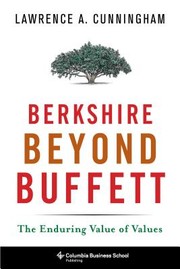
Berkshire as an operating company: its subsidiaries' culture and whether it lasts.
Recommended by: Mohnish Pabrai
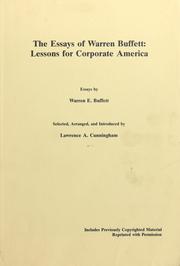
Berkshire's shareholder letters arranged by topic: governance, valuation, mergers.
“The resource is as valuable as Larry Cunningham's The Essays of Warren Buffett, which similarly organizes by subject matter” — Christopher Bloomstran
Source: Semper Augustus 2024 Letter to Clients, 'Books and Tunes for Walking', p. 96
Recommended by: Christopher Bloomstran, Francois Rochon and 11 others
How Berkshire runs on trust instead of the controls other large firms use.
Recommended by: Warren Buffett
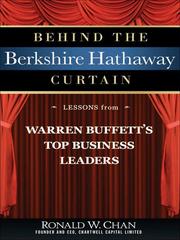
Recommended by: Mohnish Pabrai
Recommended by: Mohnish Pabrai

Every Berkshire annual letter since 1965, in order, as the company grew.
“…books I've recommended, highlighted to death, or forced on friends.” — Andrew Wilkinson
Source: Andrew Wilkinson's Bookshelf, neverenough.com
Recommended by: Andrew Wilkinson, Arnold Van Den Berg and 5 others
Where it sits in the reference 3
Topics