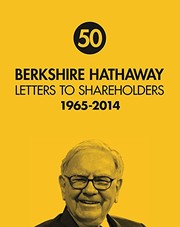
Berkshire Hathaway Letters to Shareholders
Compiled reprint of the annual letters, not separately written.
Summary
This volume collects Buffett's annual letters to Berkshire Hathaway shareholders in chronological order, from 1965 onward, without editorial rearrangement. Reading them in sequence gives something the thematic compilations cannot: the record of what Buffett said before outcomes were known, and the change in his approach as Berkshire grew.
The early letters cover the textile operations and the first insurance acquisitions in plain terms, including the difficulty of the textile business and the reasons Buffett kept it running longer than the economics justified. The 1970s and 1980s letters contain the clearest exposition of insurance float, of inflation's effect on business value, of the difference between accounting earnings and economic earnings, and of goodwill. The 1990s and 2000s letters cover derivatives, the technology bubble, corporate governance failures and the 2008 crisis in real time.
Several letters function as standalone essays. The 1977 letter on inflation and equities, the 1983 appendix on goodwill, the 1984 discussion of dividend policy and share repurchases, the 2002 warning about derivatives as financial weapons of mass destruction, and the 2014 fiftieth anniversary letters by both Buffett and Munger are the ones most often cited.
The letters are free on Berkshire's website, so the value of a bound edition is convenience. Reading them in full is a substantial commitment and much is repetition, since Buffett restates principles annually for new shareholders. The commentary on specific holdings is dated. What survives is the recorded reasoning about capital allocation, accounting and market behaviour across sixty years, checkable against what happened.
Key takeaways 8
- Insurance float provides capital at a cost below zero when underwriting is disciplined, and that structure explains much of Berkshire's compounding.
- Accounting earnings frequently misrepresent economic reality, and Buffett gives owner earnings and look-through earnings as corrections.
- Inflation acts as a tax on capital that damages businesses requiring heavy reinvestment far more than those that do not.
- A company should retain earnings only if each retained dollar produces more than a dollar of market value, and should otherwise distribute them.
- Derivatives create counterparty exposures that neither party can fully measure, which Buffett described publicly in 2002 before the 2008 crisis.
- Managers should be evaluated on return on capital employed rather than on growth in earnings, because earnings can be grown by retaining capital at poor returns.
- Boards and compensation committees systematically fail to act as agents of shareholders, and Buffett names the mechanisms by which they fail.
- Buffett states his mistakes explicitly in the letters, including Berkshire itself, Dexter Shoe and the airline investment, which makes the record testable.
Who should read it
Investors willing to read six decades of primary source material and check the reasoning against what subsequently happened.
About Warren Buffett
Chairman, Berkshire Hathaway; chief executive 1970-2025; earlier general partner, Buffett Partnership Ltd.
The Berkshire shareholder letters are a primary source in their own right, read and cited far beyond investing.
Who recommended it 7 · 7 direct
“…books I've recommended, highlighted to death, or forced on friends.”
“Going back and reading Berkshire Hathaway annual reports is worth the time.”
“In my opinion, Warren Buffett's group of annual letters is the best teaching anyone could find in the history of business.”
“You should read the Berkshire Hathaway 'Letters to Shareholders' which are on the Berkshire website so they are free. That will be a great start.”
“I started reading [Buffett's shareholder letters etc.] and I've read over the years, just about everything, I think, Warren's put out there.”
“I actually think by reading Berkshire's reports, you should be able to get more — I would think you'd get more of our philosophy than in any other manner.”
Similar books 6
Chosen by shared topics, the entries that hold them, and the people who recommended both.
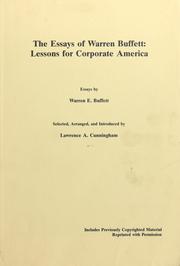
Berkshire's shareholder letters arranged by topic: governance, valuation, mergers.
“The resource is as valuable as Larry Cunningham's The Essays of Warren Buffett, which similarly organizes by subject matter” — Christopher Bloomstran
Source: Semper Augustus 2024 Letter to Clients, 'Books and Tunes for Walking', p. 96
Recommended by: Christopher Bloomstran, Francois Rochon and 11 others
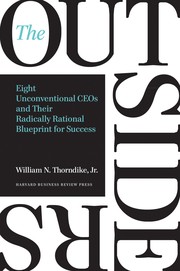
Eight CEOs who beat the market by allocating capital, not by running operations.
“…books I've recommended, highlighted to death, or forced on friends.” — Andrew Wilkinson
Source: Andrew Wilkinson's Bookshelf, neverenough.com
Recommended by: Andrew Wilkinson, Dan Loeb, Francois Rochon and 12 others
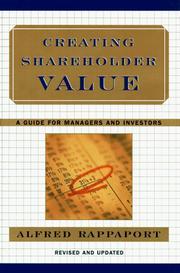
Value is discounted future cash flow, not earnings per share or return on equity.
“I read that book and the light bulbs all went off for me personally.” — Michael Mauboussin
Source: The Tim Ferriss Show #659 — official transcript
Recommended by: Michael Mauboussin, Mohnish Pabrai

Buffett's life to 2008, written with full access to his files and his friends.
“…books I've recommended, highlighted to death, or forced on friends.” — Andrew Wilkinson
Source: Andrew Wilkinson's Bookshelf, neverenough.com
Recommended by: Andrew Wilkinson, Guy Spier, Mohnish Pabrai and 5 others
Buffett's life from Omaha and Graham's class to building Berkshire Hathaway.
“…books I've recommended, highlighted to death, or forced on friends.” — Andrew Wilkinson
Source: Andrew Wilkinson's Bookshelf, neverenough.com
Recommended by: Andrew Wilkinson, Christopher Bloomstran and 12 others
Where it sits in the reference 11
Topics