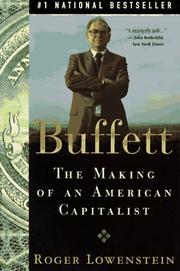
Buffett: The Making of an American Capitalist
The pre-Snowball standard
Summary
Lowenstein wrote the first serious biography of Buffett, published in 1995 without Buffett's cooperation, though many associates spoke to him. It traces the Omaha childhood, the Columbia period under Graham, Buffett Partnership Ltd from 1956 to 1969, the acquisition of Berkshire Hathaway, and the transformation from cigar-butt buying into the insurance-funded acquisition of quality businesses.
The book is strongest on the partnership years and the mechanics of the early deals. Lowenstein covers the Sanborn Map campaign, Dempster Mill, American Express after the salad oil scandal, and the decision to close the partnership in 1969 when Buffett could no longer find value. He explains the insurance float mechanism clearly, showing how National Indemnity and later GEICO gave Berkshire capital with a negative cost. The Salomon Brothers crisis of 1991, where Buffett took over as interim chairman after the Treasury auction scandal, is covered in detail.
Lowenstein is a financial journalist and writes for readers who want the reasoning behind the transactions. He also documents the personal side, including the arrangement with Susan Buffett and Astrid Menks and Buffett's distance from his children, without turning the book into psychology.
The main limitation is date. The book ends in the mid-1990s, so it misses the technology bubble, the 2008 crisis interventions, the Apple position and the succession question. Alice Schroeder's The Snowball is longer, authorised and more personal. Lowenstein remains the better book on the investment reasoning and on the partnership-era arithmetic. Readers wanting Buffett's own words should use the shareholder letters instead.
Key takeaways 8
- Buffett's early returns came from concentrated positions in mispriced small companies, several of which required activist pressure to realise value.
- Insurance float provided capital at negative cost, and that structure rather than stock selection explains a large part of Berkshire's compounding.
- Buffett closed his partnership in 1969 because he could not find securities meeting his criteria, choosing to return capital rather than lower his standards.
- Buying Berkshire Hathaway, a declining textile business, was a mistake Buffett acknowledges, and its value came from redirecting its cash rather than from the operations.
- Munger's influence moved Buffett from buying statistically cheap assets to paying fair prices for durable businesses.
- Buffett bought American Express during a scandal because he verified that customers were still using the cards, which is fieldwork rather than analysis of statements.
- Concentration in a small number of positions, not diversification, produced the partnership's results.
- Buffett's intervention at Salomon Brothers showed that reputational damage can destroy a financial firm faster than trading losses can.
Who should read it
Investors who want the transaction-level reasoning behind Buffett's record up to the mid-1990s, particularly the partnership years and the float mechanism.
About Roger Lowenstein
Financial journalist and author; Wall Street Journal reporter for over a decade
Buffett: The Making of an American Capitalist and When Genius Failed are the standard reference accounts of Buffett's rise and of the LTCM collapse.
Who recommended it 14 · 7 direct
“…books I've recommended, highlighted to death, or forced on friends.”
“To this day, if there's one book about Warren Buffett to read, this is it.”
“In Roger Lowenstein's excellent book on Warren Buffett, the author recounts the exchange between Buffett and the newly appointed president of Berkshire Hathaway”
“There are a few books - really not that many which I believe are indispensable reading for every serious investor: Buffett: The Making of an American Capitalist by Roger Lowenstein.”
Similar books 6
Chosen by shared topics, the entries that hold them, and the people who recommended both.
Berkshire's shareholder letters arranged by topic: governance, valuation, mergers.
“The resource is as valuable as Larry Cunningham's The Essays of Warren Buffett, which similarly organizes by subject matter” — Christopher Bloomstran
Source: Semper Augustus 2024 Letter to Clients, 'Books and Tunes for Walking', p. 96
Recommended by: Christopher Bloomstran, Francois Rochon and 11 others

Every Berkshire annual letter since 1965, in order, as the company grew.
“…books I've recommended, highlighted to death, or forced on friends.” — Andrew Wilkinson
Source: Andrew Wilkinson's Bookshelf, neverenough.com
Recommended by: Andrew Wilkinson, Arnold Van Den Berg and 5 others

Fortune's articles by and about Buffett from 1966 to 2012, with commentary.
“I hope many people, even those who think they know Warren well, will read it cover to cover.” — Bill Gates
Source: Gates Notes review of Tap Dancing to Work
Recommended by: Bill Gates, Guy Spier, Mohnish Pabrai and 2 others

Buffett's life to 2008, written with full access to his files and his friends.
“…books I've recommended, highlighted to death, or forced on friends.” — Andrew Wilkinson
Source: Andrew Wilkinson's Bookshelf, neverenough.com
Recommended by: Andrew Wilkinson, Guy Spier, Mohnish Pabrai and 5 others

Buffett's method as tests of the business, its managers, its finances and price.
Recommended by: Mohnish Pabrai, Bill Ackman, Howard Marks and 1 other
The only full biography; written with Munger's cooperation.
“The two I'd recommend that I thoroughly enjoyed are Damn Right: Behind the Scenes with Berkshire Hathaway Billionaire Charlie Munger by Janet Lowe” — Christopher Bloomstran
Source: Semper Augustus 2023 Letter to Clients, 'Worldly Wisdom', p. 81
Recommended by: Christopher Bloomstran, Mohnish Pabrai
Where it sits in the reference 5
Topics