
The Warren Buffett Way
Method book
Summary
Hagstrom, a portfolio manager, was the first to systematise Buffett's approach into a set of stated criteria, and the book was a bestseller in 1994 and has been revised twice. It reconstructs the method from Berkshire's public disclosures, the shareholder letters and Buffett's public statements rather than from access.
The framework organises the criteria into four categories. Business tenets require a business that is simple and understandable, has a consistent operating history and favourable long-term prospects. Management tenets require rationality in capital allocation, candour with shareholders, and resistance to what Buffett calls the institutional imperative, meaning the tendency to imitate peers. Financial tenets require focus on return on equity rather than earnings per share, calculation of owner earnings, high profit margins and the requirement that each dollar retained create at least a dollar of market value. Market tenets require determining the value of the business and buying at a significant discount.
Hagstrom also traces the intellectual lineage from Graham, Fisher and Munger, and covers the case studies including Washington Post, GEICO, Coca-Cola, Capital Cities and General Dynamics with the numbers Buffett would have seen.
The book is derivative by construction, since everything in it comes from public sources and Buffett states the same principles more precisely himself. The later editions add material on Buffett's approach to focus investing and to probability. The reconstruction of the case studies with contemporaneous figures is the part that adds something the original letters do not, since it shows the arithmetic at the time of purchase.
Key takeaways 8
- Buffett's approach can be reduced to twelve stated criteria across business quality, management, financial performance and price.
- A business must be simple and understandable to the investor, which is a constraint on the investor rather than a property of the business.
- Return on equity rather than growth in earnings per share is the measure of business performance, since earnings can be grown by retaining capital at poor returns.
- Owner earnings, defined as net income plus non-cash charges minus required capital expenditure, measure what the business actually produces for its owner.
- Every dollar of retained earnings must create at least one dollar of market value, which is the test of management's capital allocation.
- Management candour when results disappoint is a testable trait and a requirement for ownership.
- The institutional imperative causes managers to imitate peers regardless of the economics, and resisting it is the distinguishing management quality.
- Concentration in a small number of thoroughly understood businesses produces better results than diversification for an investor who does the work.
Who should read it
Investors who want Buffett's criteria organised into a checklist with contemporaneous case arithmetic, understanding that everything derives from public sources.
About Robert G. Hagstrom
American portfolio manager who ran Legg Mason's Focus Trust and later served as chief investment strategist at EquityCompass.
The Warren Buffett Way was the first book to reconstruct Buffett's purchases as a repeatable set of business, management, financial and valuation tests, and it set the template later Buffett books follow. Latticework and Investing: The Last Liberal Art carry the same argument into physics, biology and psychology as sources of investment models.
Who recommended it 4 · 1 direct
Similar books 6
Chosen by shared topics, the entries that hold them, and the people who recommended both.
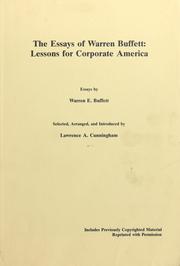
Berkshire's shareholder letters arranged by topic: governance, valuation, mergers.
“The resource is as valuable as Larry Cunningham's The Essays of Warren Buffett, which similarly organizes by subject matter” — Christopher Bloomstran
Source: Semper Augustus 2024 Letter to Clients, 'Books and Tunes for Walking', p. 96
Recommended by: Christopher Bloomstran, Francois Rochon and 11 others

The amateur's edge argument from the Magellan record.
“One book that probably made the biggest impact on my career in those early formidable years back in the day was Peter Lynch's 'One Up on Wall Street.'” — David Rolfe
Source: Rolfe on the book that most shaped his early career
Recommended by: David Rolfe, Francisco Garcia Parames and 9 others

Fortune's articles by and about Buffett from 1966 to 2012, with commentary.
“I hope many people, even those who think they know Warren well, will read it cover to cover.” — Bill Gates
Source: Gates Notes review of Tap Dancing to Work
Recommended by: Bill Gates, Guy Spier, Mohnish Pabrai and 2 others

Every Berkshire annual letter since 1965, in order, as the company grew.
“…books I've recommended, highlighted to death, or forced on friends.” — Andrew Wilkinson
Source: Andrew Wilkinson's Bookshelf, neverenough.com
Recommended by: Andrew Wilkinson, Arnold Van Den Berg and 5 others

Buffett's approach set out as tenets for judging businesses, managers and prices.
“I recommend all of Hagstrom's books on Buffett.” — Mohnish Pabrai
Source: Mohnish's Bookshelf — Books on Investing & Capital Allocation, entry 225
Recommended by: Mohnish Pabrai
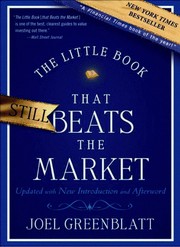
The magic formula: buy cheap stocks with high returns on capital, mechanically.
Recommended by: Mohnish Pabrai and 2 others
Where it sits in the reference 6
Topics