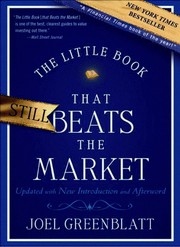
The Little Book That Still Beats the Market
Revised and updated edition of the 2005 book.
Summary
Greenblatt presents what he calls the magic formula, a mechanical stock selection method using two variables: return on capital, calculated as earnings before interest and taxes divided by net working capital plus net fixed assets, and earnings yield, calculated as earnings before interest and taxes divided by enterprise value. Companies are ranked on each measure separately, the ranks are combined, and the top-ranked companies are purchased.
The reasoning is that return on capital identifies good businesses and earnings yield identifies cheap ones, and that buying good businesses at cheap prices produces returns above the market. He reports backtested returns of around thirty percent annually from 1988 to 2004 against a market return around twelve percent.
The book is written for a non-professional reader in deliberately simple language, and Greenblatt explains why the method should continue to work: it underperforms for extended periods, sometimes several years in a row, which causes most investors to abandon it, and this is what prevents the returns from being competed away. He includes specific implementation instructions covering how many positions to hold, the annual turnover, the tax treatment of gains and losses, and the exclusion of financial companies and utilities where the calculations do not apply.
The backtested results have been challenged on survivorship bias, on the treatment of small companies with limited liquidity, and on transaction costs. Live results since publication have been substantially weaker than the backtest. The two-factor combination is a version of quality and value factors that academic finance had already documented. The argument about why a mechanical method survives, because investors will not hold it through underperformance, is the most durable part.
Key takeaways 8
- The method ranks companies on return on capital and on earnings yield, combines the ranks and buys the top-ranked names.
- Return on capital identifies businesses that convert capital into earnings efficiently, and earnings yield identifies businesses priced cheaply relative to those earnings.
- Buying good businesses at cheap prices is the whole of the argument, stated mechanically so that judgment is removed.
- The method underperforms for years at a time, which is what causes investors to abandon it and what prevents the returns from being arbitraged away.
- Enterprise value rather than market capitalisation is the correct denominator, because it accounts for debt and cash.
- Financial companies and utilities must be excluded, since the calculations do not apply to their balance sheets.
- A mechanical approach held consistently outperforms discretionary decisions for investors who cannot do sustained fundamental work.
- Live results since publication have been substantially weaker than the reported backtest, which readers should weigh against the historical figures.
Who should read it
Individual investors wanting a mechanical value method they can apply without fundamental analysis, with the backtest treated sceptically.
About Joel Greenblatt
Founder of Gotham Capital (1985) and Managing Principal of Gotham Asset Management; long-time adjunct professor at Columbia Business School
You Can Be a Stock Market Genius is the standard text on special-situations investing, and the Magic Formula books turned quantitative value into a method ordinary investors can follow.
Who recommended it 3 · 2 direct
Similar books 6
Chosen by shared topics, the entries that hold them, and the people who recommended both.
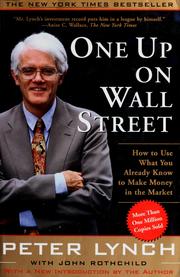
The amateur's edge argument from the Magellan record.
“One book that probably made the biggest impact on my career in those early formidable years back in the day was Peter Lynch's 'One Up on Wall Street.'” — David Rolfe
Source: Rolfe on the book that most shaped his early career
Recommended by: David Rolfe, Francisco Garcia Parames and 9 others
Buffett's method as tests of the business, its managers, its finances and price.
Recommended by: Mohnish Pabrai, Bill Ackman, Howard Marks and 1 other
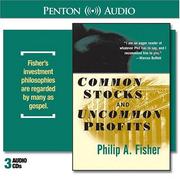
Buy a few outstanding growth companies, research them by scuttlebutt, and hold.
“The late Philip Fisher wrote several books that are very good [including] Common Stocks and Uncommon Profits.” — Arnold Van Den Berg
Source: Van Den Berg on Fisher's books
Recommended by: Arnold Van Den Berg, Bill Stewart and 10 others
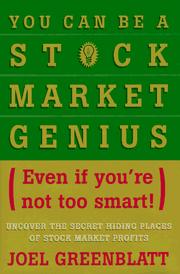
Where to find mispriced stocks: spinoffs, mergers, bankruptcies and restructurings.
“Joel Greenblatt wrote probably the best book ever 'You can be a Stock Market Genius'.” — Dan Loeb
Source: Loeb calling it probably the best book ever written on investing
Recommended by: Dan Loeb, Guy Spier, Mohnish Pabrai and 6 others
Traces the method from Graham through Icahn to the acquirer's multiple.
Recommended by: Mohnish Pabrai, Patrick O'Shaughnessy
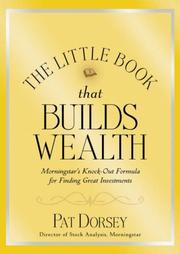
How to spot a durable economic moat from public information, and what isn't one.
Recommended by: Mohnish Pabrai
Where it sits in the reference 5
Topics