
One Up on Wall Street
The amateur's edge argument from the Magellan record.
Summary
Lynch argues that individual investors hold advantages over professionals and should use them. He ran Fidelity's Magellan Fund from 1977 to 1990, compounding at about twenty-nine percent a year, and the book explains the approach in terms aimed at a non-professional audience.
His central practical claim is that ordinary people encounter promising companies through their work and their shopping long before Wall Street analysts cover them, and that this observation is the starting point for research rather than the conclusion. He is explicit that noticing a product is not a reason to buy the stock, and that the observation must be followed by examining earnings, debt, inventories and the price to earnings ratio relative to growth.
Lynch classifies stocks into six categories, slow growers, stalwarts, fast growers, cyclicals, turnarounds and asset plays, and argues that each requires a different expectation and a different exit rule. He gives lists of attributes that make a company attractive, including a dull name, a boring or disagreeable business, a spinoff, low institutional ownership, insider buying and company share repurchases. He also lists warning signs, including hot stocks in hot industries, diworsification through unrelated acquisitions, and dependence on a single customer.
The book is dated in its data sources, since it assumes annual reports, brokerage research and library work rather than online screening. The retail advantage it describes has narrowed with universal information access. Lynch's own record ran through an exceptional bull market with a fund that grew from twenty million to fourteen billion dollars, which raises questions about attribution. The category framework and the discipline of doing the work after the observation remain useful.
Key takeaways 8
- Individual investors can find companies before professionals do because they encounter products and services in daily life and at work.
- Noticing a good product is the beginning of research, not a reason to buy, and the company's financial statements must confirm the observation.
- Stocks fall into six categories with different expected returns and different selling rules, and confusing a cyclical with a growth company is a standard and expensive error.
- The price to earnings ratio should be compared with the growth rate, and a company growing faster than its multiple is attractive on that measure.
- Companies with dull names, unglamorous businesses and low institutional ownership are more likely to be mispriced.
- An investor should be able to explain the reason for owning a stock in a few sentences to someone with no financial background.
- Predicting the economy or the direction of the market is useless, and time spent on it should go to analysing companies.
- Diversification into unrelated businesses by a successful company usually destroys value and should be treated as a sell signal.
Who should read it
Individual investors picking their own stocks who want a workable classification system and a discipline for turning everyday observation into research.
About Peter Lynch
Manager, Fidelity Magellan Fund 1977-1990
A documented 29% annualized record at Magellan plus three books that outlived their news cycle and put 'buy what you know' into general use.
Who recommended it 11 · 6 direct
“One book that probably made the biggest impact on my career in those early formidable years back in the day was Peter Lynch's 'One Up on Wall Street.'”
“I still remember when the book came out in 1989, and I read a review in BusinessWeek. I went out and bought it, and it changed my life forever.”
“In 1992, I bought the book 'One Up on Wall Street' by Peter Lynch. I read it in a few hours and it was an unforgettable night. With 'The Intelligent Investor' this book is likely one of the best…”
“I still think 'One Up on Wall Street', even written thirty years ago, is a hugely valuable book.”
“I strongly recommend all of Peter Lynch's book esp. this one and One up on Wall Street.”
Similar books 6
Chosen by shared topics, the entries that hold them, and the people who recommended both.
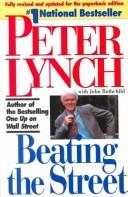
Lynch's stock-by-stock walkthrough of how he picked them.
“Peter Lynch's books have some great insights [and] would be great for anyone to read.” — Julian Robertson
Source: Robertson on Peter Lynch's books
Recommended by: Julian Robertson, Mohnish Pabrai and 3 others
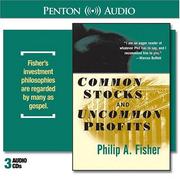
Buy a few outstanding growth companies, research them by scuttlebutt, and hold.
“The late Philip Fisher wrote several books that are very good [including] Common Stocks and Uncommon Profits.” — Arnold Van Den Berg
Source: Van Den Berg on Fisher's books
Recommended by: Arnold Van Den Berg, Bill Stewart and 10 others

Buffett's method as tests of the business, its managers, its finances and price.
Recommended by: Mohnish Pabrai, Bill Ackman, Howard Marks and 1 other
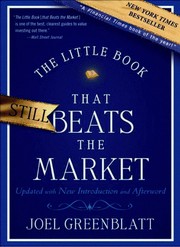
The magic formula: buy cheap stocks with high returns on capital, mechanically.
Recommended by: Mohnish Pabrai and 2 others

Subtitled Stocks That Return 100-to-1 and How to Find Them; expanded edition 2025.
Recommended by: Mohnish Pabrai
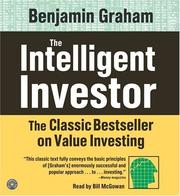
Treat stocks as parts of businesses and buy only with a margin of safety.
“I have been accused of telling all my secrets. I have written a number of books, and I reveal them all in these books.” — Benjamin Graham
Source: Graham on revealing everything he knows in his books
Recommended by: Benjamin Graham, Christopher Bloomstran and 27 others
Where it sits in the reference 8
Topics