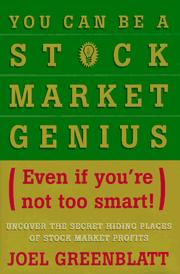
You Can Be a Stock Market Genius
Spin-offs, merger securities and event-driven special situations.
Summary
Greenblatt argues that individual investors should look in the places institutions cannot go, and gives a category-by-category guide to special situations. He ran Gotham Capital, which compounded at about fifty percent annually before fees for a decade, using exactly these methods with a concentrated portfolio.
The categories are spinoffs, merger securities, risk arbitrage, bankruptcy and restructuring, recapitalisations and stub stocks, options, and LEAPs. For each, he explains why the situation creates mispricing. Spinoffs get sold indiscriminately by institutional holders who received shares they did not choose and cannot hold, often because the new company is too small for their mandate. Rights offerings are ignored because they require action. Bankruptcy claims are avoided because of the process complexity and because many institutions cannot hold defaulted securities.
Greenblatt works through real cases in detail with the actual numbers, including Marriott's split into Host Marriott and Marriott International, Strattec, Wells Fargo LEAPs and General Dynamics. He shows the filings to read, particularly the Form 10 for spinoffs, and what to look for in management incentives, which he treats as the single most predictive element.
He argues explicitly for concentration, holding five to eight positions, on the grounds that a person who has done the work should not dilute it. This is unusual advice and carries obvious risk for anyone who has not done the work. The book is from 1997 and the specific inefficiencies have narrowed. Spinoff situations are now well followed and index funds change the mechanics. The general principle, that returns come from places where institutional constraints prevent participation, still holds. The tone is jokey in a way some readers find irritating, and the arithmetic requires attention.
Key takeaways 8
- Returns concentrate in situations institutions cannot participate in because of mandate, size or process constraints rather than because of analytical difficulty.
- Spinoffs are systematically mispriced at separation because the receiving shareholders did not choose the security and frequently must sell it.
- Management incentives in the new entity, disclosed in the Form 10, predict spinoff performance better than the business description does.
- A stub, meaning the residual equity after a recapitalisation, offers leveraged exposure that most investors will not analyse because the arithmetic looks unfamiliar.
- An investor who has genuinely done the work should hold five to eight positions rather than diversify away their advantage.
- Merger securities distributed as part of a deal are often sold by recipients who want cash, which creates predictable selling pressure.
- Reading the primary filings, rather than summaries or analyst coverage, is what makes these situations analysable at all.
- Small situations are the individual investor's structural advantage, because size prevents institutions from competing there.
Who should read it
Individual investors with the time to read filings, who want a specific catalogue of situations where institutional constraints create mispricing.
About Joel Greenblatt
Founder of Gotham Capital (1985) and Managing Principal of Gotham Asset Management; long-time adjunct professor at Columbia Business School
You Can Be a Stock Market Genius is the standard text on special-situations investing, and the Magic Formula books turned quantitative value into a method ordinary investors can follow.
Who recommended it 9 · 5 direct
“Joel Greenblatt wrote probably the best book ever 'You can be a Stock Market Genius'.”
“Joel Greenblatt's 'You Can be a Stock Market Genius' is tactical and includes some very specific and interesting strategies.”
Similar books 6
Chosen by shared topics, the entries that hold them, and the people who recommended both.

Modern manual covering deal types, financing risk and hedging.
Interviews with the leading arbitrageurs on process and risk.
The mechanics of merger arbitrage as practised by a family arbitrage firm.
Treat stocks as parts of businesses and buy only with a margin of safety.
“I have been accused of telling all my secrets. I have written a number of books, and I reveal them all in these books.” — Benjamin Graham
Source: Graham on revealing everything he knows in his books
Recommended by: Benjamin Graham, Christopher Bloomstran and 27 others
The magic formula: buy cheap stocks with high returns on capital, mechanically.
Recommended by: Mohnish Pabrai and 2 others
How to read financial statements sceptically and value bonds and stocks.
“I've spent more time with all of the editions of Benjamin Graham and David Dodd's Security Analysis than with any other book” — Christopher Bloomstran
Source: Semper Augustus 2024 Letter to Clients, 'Books and Tunes for Walking', p. 95
Recommended by: Christopher Bloomstran, Howard Marks and 11 others
Where it sits in the reference 5
Topics