Updates

  1. Person pages list letters, writing, profiles and links as sortable tables with filters, and show each person's companies as links; Fund letters show each letter's description in its own column.
  2. Experts show a checked job title and a short description of each person; 30 more people have photographs.
  3. Every company, fund, university and publication the experts work for has a page listing the people there.
  4. Fund letters show each letter's thesis and filter by it; 225 person pages list the essays, columns and newsletter issues the person wrote.
  5. Person pages list every essay and newsletter issue a person wrote, and their own books as a table in List view.
  6. Recommends shows the five largest kinds of book and the rest under More; browse pictures load sooner.
  7. Podcasts and talks link the original episode, filter by Audio and video or Press, and list each publisher once.
  8. Pages are wider, Recommends has List and Grid, and a filter clicked again turns off.
  9. Book cards sit in a ruled grid with Open Library and Goodreads links and each book's one-line note.
  10. Funds is now Investors; each investor's styles are buttons that filter the table.
  11. Podcasts and talks on a person's page filter by year and publisher and show as a list or a grid of pictures.
  12. Quotes show only people's own words: 472 summaries written by list sites are gone.
  13. Country pages open from Browse again, and every link on the shelf lands on a page.
  14. Subject and person pages show their sections as tabs, and each book appears once on a person's page.
  15. Book cards show the quote, who said it and the source; grids show five cards to a row.
  16. On a phone, a menu holds the sections, search, Updates, Feedback and dark mode.
  17. Feedback takes a screenshot of the page with no browser prompt, opens a screenshot full size when you click it, and clears itself once sent.
  18. Book cards are centred, search names the topic each book sits in, and any text cut short shows whole on hover.
  19. Search groups its results by kind: people, companies, geographies, subjects, topics, books, funds, fund letters and papers.
  20. The Books table lists who recommended each book by name, and the browser tab names the section you are in.
  21. Feedback can take a screenshot of the page, or one you paste or choose, and opens in the corner beside Updates.
  22. Each rail button reopens its section where you left it, and Browse, Table and People show on every book and subject page.
  23. Filters grey out choices that hold nothing instead of hiding them, and Books › People filters by authors or recommenders.
  24. Feedback takes a subject line and up to three screenshots.
  25. Biographies are grouped by the person they are about: 41 new pages, from Abraham Lincoln to Lee Kuan Yew.
  26. Sport splits into 23 sports, and Religion into one topic per faith.
  27. Book lists show as cards: the cover, one recommendation quote and every recommender by name.
  28. Seventeen subjects that had two or three pages under different names now have one page each.
  29. Every page lists its Experts as authors and recommenders, with a link to them on the Experts tab.
  30. Economics, Financial history, Financial panics and Accounting are subjects of their own, with one page per financial crisis.
  31. Book, person and subject pages open inside the app, so the tabs stay in view.
  32. 996 more book covers, and photographs or logos for 227 more people and companies.
  33. Books › Browse shows every subject as cards, and the rail holds Fund letters, Papers, Experts, Books and Funds.
  34. Every topic over 150 books splits into narrower topics, each with a page of its own.

Send feedback

What is it?
Screenshots, up to 3 (optional)
or paste one with Ctrl+V

We use your email only to reply to you.

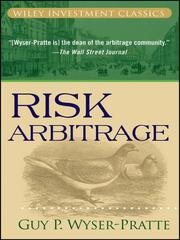
Risk Arbitrage

Risk Arbitrage

Guy P. Wyser-Pratte
1971
T2 88 pages · about 1h 28m to read Open Librarygoodreads

The founding practitioner text on deal spread analysis.

Summary

Wyser-Pratte wrote this from his family's arbitrage business and from academic study, and it became the reference on risk arbitrage practice for a generation. It began as graduate work at New York University and was published as a short monograph.

The content covers the mechanics of the trade as practised before modern deal protection and disclosure rules. Wyser-Pratte defines risk arbitrage as taking positions in securities of companies subject to announced corporate events, distinguishing it from classical arbitrage in simultaneous offsetting positions. He covers the event types: cash tender offers, exchange offers, mergers, liquidations, recapitalisations and reorganisations, and for each explains what determines the payoff and what determines the probability of completion.

The analytical framework is expected value with explicit probability estimation. The arbitrageur estimates the gain if the deal completes, the loss if it breaks, which is generally the difference between the current price and the pre-announcement price, and the probability of completion, then sizes accordingly. Wyser-Pratte also develops the annualised return calculation given expected timing, which makes deals with different durations comparable, and covers the treatment of proration in partial tender offers.

The book is short and dated in its specifics. It predates the Williams Act's full effect, the modern hostile takeover era, the development of merger agreement deal protections, current antitrust practice and the electronic markets in which the strategy now operates. Wyser-Pratte himself moved to activism in later decades. Kirchner's Merger Arbitrage, also in this reference, covers the current practice. This remains worth reading as the original statement of the analytical framework, which has not changed.

Key takeaways 7

  1. Risk arbitrage means taking positions in securities subject to announced corporate events, which is distinct from simultaneous offsetting arbitrage.
  2. The trade is an expected value calculation combining the gain on completion, the loss on failure and the probability of each.
  3. The loss on a broken deal is approximately the return of the security to its pre-announcement price, which sets the downside.
  4. Annualising the expected return by the expected time to completion makes deals of different durations comparable.
  5. Partial tender offers require proration analysis, because the arbitrageur is left holding the untendered stub.
  6. Probability estimation rather than valuation is the arbitrageur's central skill.
  7. Position sizing must reflect the asymmetry, since one broken deal can eliminate the gains from many completed ones.

Who should read it

Event-driven investors who want the original statement of the arbitrage framework, supplemented by a modern text for current deal practice.

Similar books 6

Chosen by shared topics, the entries that hold them, and the people who recommended both.

Thomas Kirchner · 2009

Modern manual covering deal types, financing risk and hedging.

Kate Welling, Mario Gabelli · 2018

Interviews with the leading arbitrageurs on process and risk.

Joel Greenblatt · 1997

Where to find mispriced stocks: spinoffs, mergers, bankruptcies and restructurings.

“Joel Greenblatt wrote probably the best book ever 'You can be a Stock Market Genius'.” — Dan Loeb

Source: Loeb calling it probably the best book ever written on investing

Recommended by: Dan Loeb, Guy Spier, Mohnish Pabrai and 6 others

Brian J. Stark · 1983

Hedging, arbitrage and liquidations practised together as one investing discipline.

Joseph Calandro · 2009

Valuation methods applied case by case to specific corporate events.

Stuart C. Gilson · 2001

Harvard case studies in bankruptcy and workout situations.

Where it sits in the reference 3

Business models
Investment styles
Investment styles

Topics

Investing