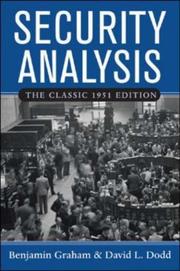
Security Analysis
Editions 1934, 1940, 1951, 1962, 1988, 2008, 2023.
Summary
Graham and Dodd wrote the first systematic treatment of security valuation, published in 1934 after the market collapse that destroyed the speculative approach it replaced. The book defines investment against speculation, sets out how to read financial statements sceptically, and gives valuation methods for bonds, preferred stock and common stock in that order of emphasis.
The bond material occupies more space than modern readers expect, because Graham considered fixed income the appropriate default for most investors. His tests for bond safety, including earnings coverage ratios over full cycles and asset protection, established the analytical form that credit analysis still uses. The common stock chapters introduce net current asset value, the practice of buying companies below liquidation value, and the requirement that earnings power be assessed across a full cycle rather than from a single year.
The most durable section concerns the analysis of income statements and balance sheets. Graham and Dodd document how managements shift charges between periods, use reserves to smooth earnings, capitalise costs that should be expensed, and revalue assets to produce desired results. They insist on averaging earnings across seven to ten years and on treating reported figures as claims to be verified.
The book is long, technical and dated. Accounting standards, disclosure rules and the composition of the economy have all changed, and the specific screens produce almost nothing in developed markets today. Net current asset bargains were plentiful in 1934 and are nearly absent now. Intangible-heavy businesses do not fit the framework. Later editions differ substantially, and the 1940 second edition is the one most professionals recommend. Read it as the foundation of the discipline and as an education in scepticism about reported numbers.
Key takeaways 8
- An investment operation must be based on thorough analysis, promise safety of principal and offer an adequate return, and everything else is speculation.
- Earnings power should be measured as an average across a full business cycle, never from a single year's reported figure.
- Reported earnings can be manipulated within accounting rules, and an analyst must reconstruct the numbers rather than accept the statements.
- A common stock should be analysed as a claim on a business, applying the same discipline used to assess a bond.
- Securities purchased below net current asset value provide protection independent of any forecast about the business.
- The margin of safety, meaning the gap between price and conservatively estimated value, is the central concept of investment.
- Market prices reflect popularity and sentiment in the short run and approximate value only over long periods.
- Analysis works best on securities where the analyst can establish a value range, and is useless where the outcome depends entirely on future events nobody can assess.
Who should read it
Serious analysts who want the origin of financial statement scepticism and valuation discipline, with the recognition that the specific screens no longer produce candidates.
About Benjamin Graham
Co-founder, Graham-Newman Corporation; lecturer in finance, Columbia Business School 1928-1956
Security Analysis and The Intelligent Investor are the founding texts of value investing and remain the primary source every later value investor argues from.
Who recommended it 13 · 9 direct
“I've spent more time with all of the editions of Benjamin Graham and David Dodd's Security Analysis than with any other book”
“I started reading everything I could about what he had written, both security analysis and the intelligent investor”
“All my stock picking is 100% based on the concept of a margin of safety, as introduced to the world in the book "Security Analysis," which Graham co-authored with David Dodd.”
“And I thought I got it from reading Security Analysis by Ben Graham!!”
“We opened our investment partnerships for business in early 1983, a fledgling firm with an investment philosophy adopted straight from Graham and Dodd. We have stuck to the bedrock principles of…”
Similar books 6
Chosen by shared topics, the entries that hold them, and the people who recommended both.
Treat stocks as parts of businesses and buy only with a margin of safety.
“I have been accused of telling all my secrets. I have written a number of books, and I reveal them all in these books.” — Benjamin Graham
Source: Graham on revealing everything he knows in his books
Recommended by: Benjamin Graham, Christopher Bloomstran and 27 others

Wiley published it in 2020.
“George has also written a book on value investing, From Theory to Practice, which I highly recommend.” — Prem Watsa
Source: Fairfax Financial 2021 Shareholders' Letter, p. 35
Recommended by: Mohnish Pabrai, Prem Watsa, Joel Greenblatt and 1 other
Berkshire's shareholder letters arranged by topic: governance, valuation, mergers.
“The resource is as valuable as Larry Cunningham's The Essays of Warren Buffett, which similarly organizes by subject matter” — Christopher Bloomstran
Source: Semper Augustus 2024 Letter to Clients, 'Books and Tunes for Walking', p. 96
Recommended by: Christopher Bloomstran, Francois Rochon and 11 others
Avoid permanent loss: buy well below value and aim for absolute returns.
“Seth Klarman's 'Margin of Safety' is a good book about risk.” — Arnold Van Den Berg
Source: Van Den Berg on Margin of Safety as a book about risk
Recommended by: Arnold Van Den Berg, Frank Martin, Guy Spier and 6 others

Buy a few outstanding growth companies, research them by scuttlebutt, and hold.
“The late Philip Fisher wrote several books that are very good [including] Common Stocks and Uncommon Profits.” — Arnold Van Den Berg
Source: Van Den Berg on Fisher's books
Recommended by: Arnold Van Den Berg, Bill Stewart and 10 others
Traces the method from Graham through Icahn to the acquirer's multiple.
Recommended by: Mohnish Pabrai, Patrick O'Shaughnessy
Where it sits in the reference 11
Topics