Updates

  1. Person pages list letters, writing, profiles and links as sortable tables with filters, and show each person's companies as links; Fund letters show each letter's description in its own column.
  2. Experts show a checked job title and a short description of each person; 30 more people have photographs.
  3. Every company, fund, university and publication the experts work for has a page listing the people there.
  4. Fund letters show each letter's thesis and filter by it; 225 person pages list the essays, columns and newsletter issues the person wrote.
  5. Person pages list every essay and newsletter issue a person wrote, and their own books as a table in List view.
  6. Recommends shows the five largest kinds of book and the rest under More; browse pictures load sooner.
  7. Podcasts and talks link the original episode, filter by Audio and video or Press, and list each publisher once.
  8. Pages are wider, Recommends has List and Grid, and a filter clicked again turns off.
  9. Book cards sit in a ruled grid with Open Library and Goodreads links and each book's one-line note.
  10. Funds is now Investors; each investor's styles are buttons that filter the table.
  11. Podcasts and talks on a person's page filter by year and publisher and show as a list or a grid of pictures.
  12. Quotes show only people's own words: 472 summaries written by list sites are gone.
  13. Country pages open from Browse again, and every link on the shelf lands on a page.
  14. Subject and person pages show their sections as tabs, and each book appears once on a person's page.
  15. Book cards show the quote, who said it and the source; grids show five cards to a row.
  16. On a phone, a menu holds the sections, search, Updates, Feedback and dark mode.
  17. Feedback takes a screenshot of the page with no browser prompt, opens a screenshot full size when you click it, and clears itself once sent.
  18. Book cards are centred, search names the topic each book sits in, and any text cut short shows whole on hover.
  19. Search groups its results by kind: people, companies, geographies, subjects, topics, books, funds, fund letters and papers.
  20. The Books table lists who recommended each book by name, and the browser tab names the section you are in.
  21. Feedback can take a screenshot of the page, or one you paste or choose, and opens in the corner beside Updates.
  22. Each rail button reopens its section where you left it, and Browse, Table and People show on every book and subject page.
  23. Filters grey out choices that hold nothing instead of hiding them, and Books › People filters by authors or recommenders.
  24. Feedback takes a subject line and up to three screenshots.
  25. Biographies are grouped by the person they are about: 41 new pages, from Abraham Lincoln to Lee Kuan Yew.
  26. Sport splits into 23 sports, and Religion into one topic per faith.
  27. Book lists show as cards: the cover, one recommendation quote and every recommender by name.
  28. Seventeen subjects that had two or three pages under different names now have one page each.
  29. Every page lists its Experts as authors and recommenders, with a link to them on the Experts tab.
  30. Economics, Financial history, Financial panics and Accounting are subjects of their own, with one page per financial crisis.
  31. Book, person and subject pages open inside the app, so the tabs stay in view.
  32. 996 more book covers, and photographs or logos for 227 more people and companies.
  33. Books › Browse shows every subject as cards, and the rail holds Fund letters, Papers, Experts, Books and Funds.
  34. Every topic over 150 books splits into narrower topics, each with a page of its own.

Send feedback

What is it?
Screenshots, up to 3 (optional)
or paste one with Ctrl+V

We use your email only to reply to you.

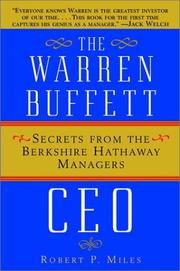
The Warren Buffett CEO

The Warren Buffett CEO

Robert P. Miles
2002
T4 432 pages · about 7h 12m to read Open Librarygoodreads

Interviews with Berkshire subsidiary managers.

Summary

Miles interviewed roughly twenty chief executives of Berkshire Hathaway operating subsidiaries and built the book around what they said about running businesses under Buffett's ownership. The subjects include managers at See's Candies, Nebraska Furniture Mart, Borsheims, GEICO, General Re, Executive Jet, Star Furniture, Justin Industries, Shaw Industries and others.

The consistent finding is about what Berkshire does not do. Subsidiary chief executives report no budget submissions to headquarters, no strategic planning process, no head office staff functions, no imposed capital expenditure approvals below large thresholds, and no interference in hiring, pricing or product decisions. What they do report is a requirement to send cash to Omaha rather than reinvest it, direct access to Buffett by telephone, and compensation arrangements negotiated individually and tied to the specific economics of their business rather than to Berkshire's share price.

Miles draws the conclusion that Berkshire's structure works because it selects managers who would run their businesses the same way whether or not they were being watched, and then removes the reasons such people leave. Several subjects had sold family businesses and stayed on for decades afterward, which is the evidence he emphasises.

The book is admiring and the access was granted, so it has the limitations of authorised material. It reports no failures, and Berkshire has had them. The interviews are also now more than twenty years old and many of the subjects have died or retired, though the structural description of how the holding company operates remains accurate.

Key takeaways 7

  1. Berkshire subsidiaries submit no budgets, no strategic plans and no routine reports to head office.
  2. The single obligation placed on subsidiary chief executives is to send excess cash to Omaha rather than reinvest it locally.
  3. Compensation at each subsidiary is tied to that business's own economics rather than to Berkshire's share price.
  4. Buffett selects for managers who already behave like owners, then removes the bureaucratic reasons such managers leave.
  5. Berkshire's head office employs a very small number of people relative to the size of the company it oversees.
  6. Autonomy functions as compensation, which is why founders who sold their companies stayed for decades afterward.
  7. Centralising capital allocation while decentralising everything else is the specific division of authority that makes the structure work.

Who should read it

Operators and acquirers of businesses who want a concrete description of how a decentralised holding company actually divides authority.

Who recommended it 1 · 1 direct

Similar books 6

Chosen by shared topics, the entries that hold them, and the people who recommended both.

Warren Buffett · 2015

Every Berkshire annual letter since 1965, in order, as the company grew.

“…books I've recommended, highlighted to death, or forced on friends.” — Andrew Wilkinson

Source: Andrew Wilkinson's Bookshelf, neverenough.com

Recommended by: Andrew Wilkinson, Arnold Van Den Berg and 5 others
Warren Buffett, Lawrence A. Cunningham · 1997

Berkshire's shareholder letters arranged by topic: governance, valuation, mergers.

“The resource is as valuable as Larry Cunningham's The Essays of Warren Buffett, which similarly organizes by subject matter” — Christopher Bloomstran

Source: Semper Augustus 2024 Letter to Clients, 'Books and Tunes for Walking', p. 96

Recommended by: Christopher Bloomstran, Francois Rochon and 11 others

Lawrence A. Cunningham · 2014

Berkshire as an operating company: its subsidiaries' culture and whether it lasts.

Recommended by: Mohnish Pabrai

Where it sits in the reference 3

Biographies
Business themes
Business themes

Topics

InvestingBusiness and ManagementLeadership