Margin of Trust
Berkshire's trust-based management model, examined by Buffett's long-time editor
Summary
Cunningham, who edits The Essays of Warren Buffett, and Cuba examine Berkshire Hathaway as a management system rather than as an investment record. Their thesis is that Berkshire substitutes trust for the control mechanisms that other large corporations use, and that this produces a real cost advantage.
The specific practices they document are the substance. Berkshire's head office has around two dozen people managing a company with hundreds of thousands of employees. Subsidiary managers receive no instructions on operations, no budgets from the centre, and no requirement to consult on decisions other than capital allocation above a threshold. Acquisitions are made without auction processes, without extensive due diligence, and frequently on a handshake followed by a short contract. Compensation is set individually for each subsidiary based on what that business can actually control, rather than on a corporate scheme or on Berkshire's share price.
The authors argue the cost savings are large and measurable: no corporate staff, no consultants, no investment bankers on most acquisitions, minimal legal expense, and no compliance apparatus beyond what regulation requires. They also argue trust attracts a specific kind of seller, namely family owners who care where their business ends up, which gives Berkshire access to deals at prices auctions would not produce.
The obvious question, which the book addresses but does not settle, is whether this is replicable or depends on Buffett personally, on Berkshire's permanent capital and on its reputation. The authors are sympathetic and the failures, including several subsidiary problems and the Precision Castparts write-down, get less attention than the successes.
Key takeaways 7
- Berkshire operates a company with hundreds of thousands of employees from a head office of around two dozen people, which is a measurable cost advantage over conventional corporate structures.
- Subsidiary managers receive no operating instructions or budgets from the centre and consult only on capital allocation above a threshold.
- Trust-based management is cheaper than control-based management because monitoring, compliance and staff functions are genuine costs that produce no output.
- Acquiring companies without auctions, extensive diligence or investment banks gives access to sellers who care where their business ends up and will accept a lower price for certainty.
- Compensation should be based on what a manager actually controls, which means each subsidiary needs its own scheme rather than a corporate one.
- Trust requires accepting that some managers will abuse it, and the cost of those cases must be weighed against the cost of controlling everyone.
- Permanent capital and the absence of quarterly pressure are preconditions for the system, which limits how far it transfers to other corporate structures.
Who should read it
Executives and investors interested in the cost economics of decentralisation and in Berkshire's management system rather than its portfolio.
About Lawrence A. Cunningham
Corporate-governance scholar and longtime George Washington University law professor; edits The Essays of Warren Buffett and writes on Berkshire and quality investing.
The Essays of Warren Buffett reorganises decades of Berkshire shareholder letters by subject - governance, accounting, mergers, valuation - turning scattered annual commentary into a usable manual. The later books extend the analysis to Berkshire's decentralised structure and to the traits that make a business durable enough to hold for decades.
University of Delaware, Quality Shareholders Group, George Washington University
Who recommended it 1 · 1 direct
Similar books 6
Chosen by shared topics, the entries that hold them, and the people who recommended both.
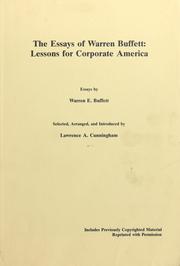
Berkshire's shareholder letters arranged by topic: governance, valuation, mergers.
“The resource is as valuable as Larry Cunningham's The Essays of Warren Buffett, which similarly organizes by subject matter” — Christopher Bloomstran
Source: Semper Augustus 2024 Letter to Clients, 'Books and Tunes for Walking', p. 96
Recommended by: Christopher Bloomstran, Francois Rochon and 11 others

Every Berkshire annual letter since 1965, in order, as the company grew.
“…books I've recommended, highlighted to death, or forced on friends.” — Andrew Wilkinson
Source: Andrew Wilkinson's Bookshelf, neverenough.com
Recommended by: Andrew Wilkinson, Arnold Van Den Berg and 5 others
Berkshire as an operating company: its subsidiaries' culture and whether it lasts.
Recommended by: Mohnish Pabrai
Buffett, Munger and scholars discuss governance and investing at a 1996 symposium.
Recommended by: Mohnish Pabrai
Eight CEOs who beat the market by allocating capital, not by running operations.
“…books I've recommended, highlighted to death, or forced on friends.” — Andrew Wilkinson
Source: Andrew Wilkinson's Bookshelf, neverenough.com
Recommended by: Andrew Wilkinson, Dan Loeb, Francois Rochon and 12 others

Where it sits in the reference 4
Topics