Updates

  1. Person pages list letters, writing, profiles and links as sortable tables with filters, and show each person's companies as links; Fund letters show each letter's description in its own column.
  2. Experts show a checked job title and a short description of each person; 30 more people have photographs.
  3. Every company, fund, university and publication the experts work for has a page listing the people there.
  4. Fund letters show each letter's thesis and filter by it; 225 person pages list the essays, columns and newsletter issues the person wrote.
  5. Person pages list every essay and newsletter issue a person wrote, and their own books as a table in List view.
  6. Recommends shows the five largest kinds of book and the rest under More; browse pictures load sooner.
  7. Podcasts and talks link the original episode, filter by Audio and video or Press, and list each publisher once.
  8. Pages are wider, Recommends has List and Grid, and a filter clicked again turns off.
  9. Book cards sit in a ruled grid with Open Library and Goodreads links and each book's one-line note.
  10. Funds is now Investors; each investor's styles are buttons that filter the table.
  11. Podcasts and talks on a person's page filter by year and publisher and show as a list or a grid of pictures.
  12. Quotes show only people's own words: 472 summaries written by list sites are gone.
  13. Country pages open from Browse again, and every link on the shelf lands on a page.
  14. Subject and person pages show their sections as tabs, and each book appears once on a person's page.
  15. Book cards show the quote, who said it and the source; grids show five cards to a row.
  16. On a phone, a menu holds the sections, search, Updates, Feedback and dark mode.
  17. Feedback takes a screenshot of the page with no browser prompt, opens a screenshot full size when you click it, and clears itself once sent.
  18. Book cards are centred, search names the topic each book sits in, and any text cut short shows whole on hover.
  19. Search groups its results by kind: people, companies, geographies, subjects, topics, books, funds, fund letters and papers.
  20. The Books table lists who recommended each book by name, and the browser tab names the section you are in.
  21. Feedback can take a screenshot of the page, or one you paste or choose, and opens in the corner beside Updates.
  22. Each rail button reopens its section where you left it, and Browse, Table and People show on every book and subject page.
  23. Filters grey out choices that hold nothing instead of hiding them, and Books › People filters by authors or recommenders.
  24. Feedback takes a subject line and up to three screenshots.
  25. Biographies are grouped by the person they are about: 41 new pages, from Abraham Lincoln to Lee Kuan Yew.
  26. Sport splits into 23 sports, and Religion into one topic per faith.
  27. Book lists show as cards: the cover, one recommendation quote and every recommender by name.
  28. Seventeen subjects that had two or three pages under different names now have one page each.
  29. Every page lists its Experts as authors and recommenders, with a link to them on the Experts tab.
  30. Economics, Financial history, Financial panics and Accounting are subjects of their own, with one page per financial crisis.
  31. Book, person and subject pages open inside the app, so the tabs stay in view.
  32. 996 more book covers, and photographs or logos for 227 more people and companies.
  33. Books › Browse shows every subject as cards, and the rail holds Fund letters, Papers, Experts, Books and Funds.
  34. Every topic over 150 books splits into narrower topics, each with a page of its own.

Send feedback

What is it?
Screenshots, up to 3 (optional)
or paste one with Ctrl+V

We use your email only to reply to you.

Dear Chairman: Boardroom Battles and the Ris

Dear Chairman: Boardroom Battles and the Rise of Shareholder Activism

Jeff Gramm
2016
T2 146 pages · about 2h 26m to read Open Librarygoodreads

Places Icahn's own letters in the century-long activist tradition.

Summary

Gramm, who runs a fund and teaches at Columbia, structures the book around eight shareholder letters spanning nearly a century, reproducing each and explaining the situation that produced it.

The cases include Benjamin Graham's 1927 campaign against Northern Pipeline, which held railroad bonds worth more than its market capitalisation and refused to distribute them; Robert Young's proxy fight for the New York Central; Warren Buffett's letter to American Express during the salad oil scandal and his early activist positions; Ross Perot's conflict with General Motors after the Electronic Data Systems acquisition; Carl Icahn's letter to Phillips Petroleum; Karla Scherer's fight against her own father's company; Daniel Loeb's public letters at Third Point; and BKF Capital, where activism destroyed the firm it targeted.

Gramm's analytical thread is the changing balance between managers and shareholders. He shows that the arguments have not changed in a century, that the tactics have, and that the results depend heavily on the specific facts rather than on any general principle about which side is right. His treatment of the BKF case is the most useful because it shows activism producing destruction rather than value, which the activist literature generally omits.

Gramm is an investor and writes sympathetically toward well-conducted activism while being direct about its failures. The book is short and each case is compressed. The reproduction of the primary letters is what distinguishes it, since the reasoning is available in the participants' own words rather than through summary.

Key takeaways 8

  1. Graham's 1927 campaign against Northern Pipeline established the template of a shareholder demanding that excess assets be distributed.
  2. The arguments between managers and shareholders have not changed in a century, while the tactics available to each side have.
  3. Activism succeeds or fails on the specific facts rather than on any general principle about which side has the better case.
  4. A public letter is a tactic for reaching other shareholders rather than for persuading the board, which has already refused privately.
  5. Activism can destroy the target, which the BKF case demonstrates and which the activist literature generally omits.
  6. Boards and managers have consistently resisted returning capital that a business cannot deploy at adequate returns.
  7. Reading the primary letters shows the reasoning in the participants' own words, which summaries systematically distort.
  8. The balance of power between managers and shareholders has shifted repeatedly rather than moving in one direction.

Who should read it

Investors and directors who want the primary documents of shareholder activism across a century, including a case where it destroyed the target.

Who recommended it 1 · 1 direct

Similar books 6

Chosen by shared topics, the entries that hold them, and the people who recommended both.

Warren Buffett, Lawrence A. Cunningham · 1997

Berkshire's shareholder letters arranged by topic: governance, valuation, mergers.

“The resource is as valuable as Larry Cunningham's The Essays of Warren Buffett, which similarly organizes by subject matter” — Christopher Bloomstran

Source: Semper Augustus 2024 Letter to Clients, 'Books and Tunes for Walking', p. 96

Recommended by: Christopher Bloomstran, Francois Rochon and 11 others

William N. Thorndike Jr. · 2012

Eight CEOs who beat the market by allocating capital, not by running operations.

“…books I've recommended, highlighted to death, or forced on friends.” — Andrew Wilkinson

Source: Andrew Wilkinson's Bookshelf, neverenough.com

Recommended by: Andrew Wilkinson, Dan Loeb, Francois Rochon and 12 others

David Sadtler · 1997

The case for demerger argued from the parent company's side.

Lawrence A. Cunningham · 2014

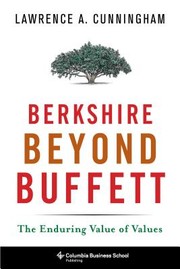
Berkshire as an operating company: its subsidiaries' culture and whether it lasts.

Recommended by: Mohnish Pabrai

Where it sits in the reference 6

Biographies
Business themes
Investment philosophy
Investment styles
Investment styles
Business themes

Topics

InvestingBusiness and ManagementFinancial History