Updates

  1. Person pages list letters, writing, profiles and links as sortable tables with filters, and show each person's companies as links; Fund letters show each letter's description in its own column.
  2. Experts show a checked job title and a short description of each person; 30 more people have photographs.
  3. Every company, fund, university and publication the experts work for has a page listing the people there.
  4. Fund letters show each letter's thesis and filter by it; 225 person pages list the essays, columns and newsletter issues the person wrote.
  5. Person pages list every essay and newsletter issue a person wrote, and their own books as a table in List view.
  6. Recommends shows the five largest kinds of book and the rest under More; browse pictures load sooner.
  7. Podcasts and talks link the original episode, filter by Audio and video or Press, and list each publisher once.
  8. Pages are wider, Recommends has List and Grid, and a filter clicked again turns off.
  9. Book cards sit in a ruled grid with Open Library and Goodreads links and each book's one-line note.
  10. Funds is now Investors; each investor's styles are buttons that filter the table.
  11. Podcasts and talks on a person's page filter by year and publisher and show as a list or a grid of pictures.
  12. Quotes show only people's own words: 472 summaries written by list sites are gone.
  13. Country pages open from Browse again, and every link on the shelf lands on a page.
  14. Subject and person pages show their sections as tabs, and each book appears once on a person's page.
  15. Book cards show the quote, who said it and the source; grids show five cards to a row.
  16. On a phone, a menu holds the sections, search, Updates, Feedback and dark mode.
  17. Feedback takes a screenshot of the page with no browser prompt, opens a screenshot full size when you click it, and clears itself once sent.
  18. Book cards are centred, search names the topic each book sits in, and any text cut short shows whole on hover.
  19. Search groups its results by kind: people, companies, geographies, subjects, topics, books, funds, fund letters and papers.
  20. The Books table lists who recommended each book by name, and the browser tab names the section you are in.
  21. Feedback can take a screenshot of the page, or one you paste or choose, and opens in the corner beside Updates.
  22. Each rail button reopens its section where you left it, and Browse, Table and People show on every book and subject page.
  23. Filters grey out choices that hold nothing instead of hiding them, and Books › People filters by authors or recommenders.
  24. Feedback takes a subject line and up to three screenshots.
  25. Biographies are grouped by the person they are about: 41 new pages, from Abraham Lincoln to Lee Kuan Yew.
  26. Sport splits into 23 sports, and Religion into one topic per faith.
  27. Book lists show as cards: the cover, one recommendation quote and every recommender by name.
  28. Seventeen subjects that had two or three pages under different names now have one page each.
  29. Every page lists its Experts as authors and recommenders, with a link to them on the Experts tab.
  30. Economics, Financial history, Financial panics and Accounting are subjects of their own, with one page per financial crisis.
  31. Book, person and subject pages open inside the app, so the tabs stay in view.
  32. 996 more book covers, and photographs or logos for 227 more people and companies.
  33. Books › Browse shows every subject as cards, and the rail holds Fund letters, Papers, Experts, Books and Funds.
  34. Every topic over 150 books splits into narrower topics, each with a page of its own.

Send feedback

What is it?
Screenshots, up to 3 (optional)
or paste one with Ctrl+V

We use your email only to reply to you.

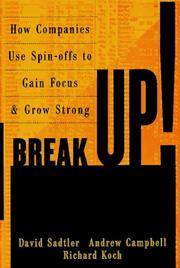
Breakup!

Breakup!

David Sadtler
1997
T3 257 pages · about 4h 17m to read Open Librarygoodreads

The case for demerger argued from the parent company's side.

Summary

The reference has not verified this book in detail; the summary states only what the title, author and subject establish.

Sadtler, Campbell and Koch, associated with Ashridge Strategic Management Centre, argued that many multi-business companies destroy value by holding businesses together and should break themselves up.

The reference has not verified the book's detailed contents. The argument as the Ashridge group developed it rests on the concept of parenting advantage. A corporate parent adds value to a business only if it can do something for that business that other potential owners cannot do as well: supplying capital on better terms, providing capabilities the business lacks, imposing better governance, or creating linkages with other businesses in the portfolio. If the parent cannot do this, its overhead and its constraints subtract value, and the business would be worth more owned by someone else or standing alone.

The practical test they propose is to ask, for each business in a portfolio, whether the parent is the best owner. The answer is frequently no, and the authors argue that conglomerates persist because breaking up destroys the corporate centre's own position rather than because the structure creates value.

The evidence in this literature includes the diversification discount, meaning that multi-business firms trade at lower valuations than the sum of comparable standalone businesses, and the returns to announced demergers and spin-offs, which have generally been positive.

The argument was made during a period of active corporate restructuring in the 1990s. The conclusion is contested: the diversification discount may reflect selection, since firms that diversify may be those with poor prospects in their core, and internal capital markets have advantages in settings where external financing is expensive. The subsequent decades produced both continued breakups and the growth of technology conglomerates that appear to contradict the argument. Readers should verify the book's specific evidence.

Key takeaways 7

  1. A corporate parent adds value only if it can do something for a business that other potential owners cannot do as well.
  2. Where a parent has no such advantage, its overhead and constraints subtract value from the business it owns.
  3. The practical test for every business in a portfolio is whether the current parent is the best available owner.
  4. Multi-business firms have generally traded at a discount to the sum of comparable standalone businesses.
  5. Announced demergers and spin-offs have generally produced positive returns, which supports the breakup argument empirically.
  6. Conglomerates persist because breaking up eliminates the corporate centre's own position rather than because the structure creates value.
  7. Internal capital markets have advantages where external financing is expensive, which is the strongest argument against general breakup.

Who should read it

Directors and investors assessing whether a multi-business company should be broken up, who should verify the book's specific evidence.

Similar books 6

Chosen by shared topics, the entries that hold them, and the people who recommended both.
Jeff Gramm · 2016

Eight activist letters over a century, from Graham in 1927, and what lay behind them.

Recommended by: Mohnish Pabrai
Alfred Rappaport · 1986

Value is discounted future cash flow, not earnings per share or return on equity.

“I read that book and the light bulbs all went off for me personally.” — Michael Mauboussin

Source: The Tim Ferriss Show #659 — official transcript

Recommended by: Michael Mauboussin, Mohnish Pabrai
Robert F. Bruner · 2005

Why mergers fail; the break risk an arbitrageur underwrites.
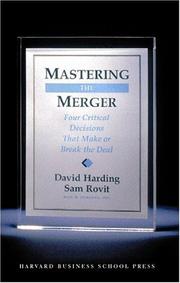
David Harding, Sam Rovit · 2004

Bain's evidence that frequent small deals beat occasional large ones.
Where it sits in the reference 3

Business themes
Investment styles
Business themes

Topics

Business and ManagementFinance and Markets