Updates

  1. Person pages list letters, writing, profiles and links as sortable tables with filters, and show each person's companies as links; Fund letters show each letter's description in its own column.
  2. Experts show a checked job title and a short description of each person; 30 more people have photographs.
  3. Every company, fund, university and publication the experts work for has a page listing the people there.
  4. Fund letters show each letter's thesis and filter by it; 225 person pages list the essays, columns and newsletter issues the person wrote.
  5. Person pages list every essay and newsletter issue a person wrote, and their own books as a table in List view.
  6. Recommends shows the five largest kinds of book and the rest under More; browse pictures load sooner.
  7. Podcasts and talks link the original episode, filter by Audio and video or Press, and list each publisher once.
  8. Pages are wider, Recommends has List and Grid, and a filter clicked again turns off.
  9. Book cards sit in a ruled grid with Open Library and Goodreads links and each book's one-line note.
  10. Funds is now Investors; each investor's styles are buttons that filter the table.
  11. Podcasts and talks on a person's page filter by year and publisher and show as a list or a grid of pictures.
  12. Quotes show only people's own words: 472 summaries written by list sites are gone.
  13. Country pages open from Browse again, and every link on the shelf lands on a page.
  14. Subject and person pages show their sections as tabs, and each book appears once on a person's page.
  15. Book cards show the quote, who said it and the source; grids show five cards to a row.
  16. On a phone, a menu holds the sections, search, Updates, Feedback and dark mode.
  17. Feedback takes a screenshot of the page with no browser prompt, opens a screenshot full size when you click it, and clears itself once sent.
  18. Book cards are centred, search names the topic each book sits in, and any text cut short shows whole on hover.
  19. Search groups its results by kind: people, companies, geographies, subjects, topics, books, funds, fund letters and papers.
  20. The Books table lists who recommended each book by name, and the browser tab names the section you are in.
  21. Feedback can take a screenshot of the page, or one you paste or choose, and opens in the corner beside Updates.
  22. Each rail button reopens its section where you left it, and Browse, Table and People show on every book and subject page.
  23. Filters grey out choices that hold nothing instead of hiding them, and Books › People filters by authors or recommenders.
  24. Feedback takes a subject line and up to three screenshots.
  25. Biographies are grouped by the person they are about: 41 new pages, from Abraham Lincoln to Lee Kuan Yew.
  26. Sport splits into 23 sports, and Religion into one topic per faith.
  27. Book lists show as cards: the cover, one recommendation quote and every recommender by name.
  28. Seventeen subjects that had two or three pages under different names now have one page each.
  29. Every page lists its Experts as authors and recommenders, with a link to them on the Experts tab.
  30. Economics, Financial history, Financial panics and Accounting are subjects of their own, with one page per financial crisis.
  31. Book, person and subject pages open inside the app, so the tabs stay in view.
  32. 996 more book covers, and photographs or logos for 227 more people and companies.
  33. Books › Browse shows every subject as cards, and the rail holds Fund letters, Papers, Experts, Books and Funds.
  34. Every topic over 150 books splits into narrower topics, each with a page of its own.

Send feedback

What is it?
Screenshots, up to 3 (optional)
or paste one with Ctrl+V

We use your email only to reply to you.

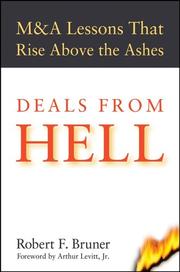
Deals from Hell

Deals from Hell

Robert F. Bruner
2005
T3 432 pages · about 7h 12m to read Open Librarygoodreads

Why mergers fail; the break risk an arbitrageur underwrites.

Summary

Bruner studies mergers and acquisitions that destroyed large amounts of value, including AT&T and NCR, Sony and Columbia Pictures, Quaker Oats and Snapple, the Pennsylvania and New York Central railroad merger, Renault and Volvo, Tyco, and the AOL Time Warner combination. Each case gets a reconstruction of the decision process, the price paid, the integration attempt and the eventual write-off.

The analytical claim is that acquisition failure is rarely caused by a single bad judgement. Bruner treats deal failure as a systems problem, in which a complex business environment, tightly coupled execution, cognitive bias in the acquiring executives, and weak governance combine so that a shock which a simpler deal would absorb instead cascades. He explicitly borrows Charles Perrow's normal accident theory, arguing that certain deal structures are accident-prone by design. He also pushes back on the popular claim that most M&A destroys value, arguing the aggregate evidence shows target shareholders gain, acquirer shareholders roughly break even on average, and the losses are concentrated in a recognisable minority of deals.

For acquirers and their boards the practical output is a set of markers that predict trouble: paying with overvalued stock, bidding in a contested auction against a strategic rival, buying outside the core, integrating two organisations of similar size, and closing under time pressure. The academic literature Bruner surveys is now two decades old and the event-study evidence has been refined since, but the case reconstructions remain the strongest part and have not been superseded.

Key takeaways 7

  1. Most acquisitions do not destroy value on average, but the losses are heavily concentrated in a minority of deals that share identifiable structural features.
  2. Deal disasters result from the interaction of several individually survivable problems, not from one large mistake.
  3. Paying with stock that the acquirer's own management believes is overvalued predicts poor long-run returns for acquirer shareholders.
  4. Mergers of roughly equal-sized firms fail more often than clear acquisitions because no one has unambiguous authority to make integration decisions.
  5. Competitive auctions push winning bidders past the point where the synergy assumptions can be met.
  6. Boards that lack independent valuation advice and adequate time systematically approve prices that cannot be justified.
  7. Executive hubris shows up concretely as revenue synergy estimates that are never tested against a base case.

Who should read it

Board members, corporate development teams and investors assessing whether a proposed acquisition carries the structural markers of the deals that fail.

Similar books 6

Chosen by shared topics, the entries that hold them, and the people who recommended both.
David Harding, Sam Rovit · 2004

Bain's evidence that frequent small deals beat occasional large ones.
Mark L. Sirower · 1997

Why acquirers overpay: the premium is a promise of gains most never deliver.

William N. Thorndike Jr. · 2012

Eight CEOs who beat the market by allocating capital, not by running operations.

“…books I've recommended, highlighted to death, or forced on friends.” — Andrew Wilkinson

Source: Andrew Wilkinson's Bookshelf, neverenough.com

Recommended by: Andrew Wilkinson, Dan Loeb, Francois Rochon and 12 others
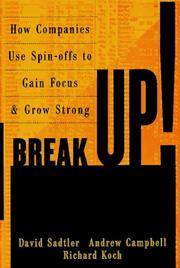
David Sadtler · 1997

The case for demerger argued from the parent company's side.

Alfred Rappaport · 1986

Value is discounted future cash flow, not earnings per share or return on equity.

“I read that book and the light bulbs all went off for me personally.” — Michael Mauboussin

Source: The Tim Ferriss Show #659 — official transcript

Recommended by: Michael Mauboussin, Mohnish Pabrai
Where it sits in the reference 5

Business models
Business themes
Business themes
Investment styles
Business themes

Topics

Finance and MarketsBusiness and Management