Updates

  1. Person pages list letters, writing, profiles and links as sortable tables with filters, and show each person's companies as links; Fund letters show each letter's description in its own column.
  2. Experts show a checked job title and a short description of each person; 30 more people have photographs.
  3. Every company, fund, university and publication the experts work for has a page listing the people there.
  4. Fund letters show each letter's thesis and filter by it; 225 person pages list the essays, columns and newsletter issues the person wrote.
  5. Person pages list every essay and newsletter issue a person wrote, and their own books as a table in List view.
  6. Recommends shows the five largest kinds of book and the rest under More; browse pictures load sooner.
  7. Podcasts and talks link the original episode, filter by Audio and video or Press, and list each publisher once.
  8. Pages are wider, Recommends has List and Grid, and a filter clicked again turns off.
  9. Book cards sit in a ruled grid with Open Library and Goodreads links and each book's one-line note.
  10. Funds is now Investors; each investor's styles are buttons that filter the table.
  11. Podcasts and talks on a person's page filter by year and publisher and show as a list or a grid of pictures.
  12. Quotes show only people's own words: 472 summaries written by list sites are gone.
  13. Country pages open from Browse again, and every link on the shelf lands on a page.
  14. Subject and person pages show their sections as tabs, and each book appears once on a person's page.
  15. Book cards show the quote, who said it and the source; grids show five cards to a row.
  16. On a phone, a menu holds the sections, search, Updates, Feedback and dark mode.
  17. Feedback takes a screenshot of the page with no browser prompt, opens a screenshot full size when you click it, and clears itself once sent.
  18. Book cards are centred, search names the topic each book sits in, and any text cut short shows whole on hover.
  19. Search groups its results by kind: people, companies, geographies, subjects, topics, books, funds, fund letters and papers.
  20. The Books table lists who recommended each book by name, and the browser tab names the section you are in.
  21. Feedback can take a screenshot of the page, or one you paste or choose, and opens in the corner beside Updates.
  22. Each rail button reopens its section where you left it, and Browse, Table and People show on every book and subject page.
  23. Filters grey out choices that hold nothing instead of hiding them, and Books › People filters by authors or recommenders.
  24. Feedback takes a subject line and up to three screenshots.
  25. Biographies are grouped by the person they are about: 41 new pages, from Abraham Lincoln to Lee Kuan Yew.
  26. Sport splits into 23 sports, and Religion into one topic per faith.
  27. Book lists show as cards: the cover, one recommendation quote and every recommender by name.
  28. Seventeen subjects that had two or three pages under different names now have one page each.
  29. Every page lists its Experts as authors and recommenders, with a link to them on the Experts tab.
  30. Economics, Financial history, Financial panics and Accounting are subjects of their own, with one page per financial crisis.
  31. Book, person and subject pages open inside the app, so the tabs stay in view.
  32. 996 more book covers, and photographs or logos for 227 more people and companies.
  33. Books › Browse shows every subject as cards, and the rail holds Fund letters, Papers, Experts, Books and Funds.
  34. Every topic over 150 books splits into narrower topics, each with a page of its own.

Send feedback

What is it?
Screenshots, up to 3 (optional)
or paste one with Ctrl+V

We use your email only to reply to you.

Distant Force: A Memoir of the Teledyne Corp

Distant Force: A Memoir of the Teledyne Corporation and the Man Who Created It

George A. Roberts
2007
T3 316 pages · about 5h 16m to read Open Librarygoodreads

Teledyne from the inside; the conglomerate that actually compounded.

Summary

This is the full-title entry for George Roberts' privately published memoir of Teledyne Corporation and its founder Henry Singleton, the same work catalogued elsewhere in this reference under the shorter title.

Roberts was president of Teledyne and writes from inside the company. The book covers Singleton's founding of Teledyne in 1960, the conglomerate assembly of roughly one hundred and thirty businesses through the 1960s using highly valued Teledyne shares as acquisition currency, the abrupt halt to acquisitions when the share multiple fell, the decentralised operating structure with a very small head office, and the share repurchase programme that retired roughly ninety percent of outstanding shares between 1972 and 1984.

Singleton was a mathematician who had worked on inertial guidance systems before founding the company, and Roberts describes a chief executive who spent very little time on operations and almost all of it on capital allocation, which is the reverse of the normal division and is the reason investors study the record.

The reference has not verified the specific figures and episodes in this account, which is a privately published memoir written by a participant decades after the events. Roberts describes what happened rather than analysing why it worked. The Teledyne chapter in William Thorndike's The Outsiders provides the quantified analysis of the same record and is the better starting point for an investor.

Key takeaways 7

  1. Singleton spent most of his attention on capital allocation and very little on operations, which reverses the normal chief executive division of time.
  2. Teledyne used its own highly rated shares as acquisition currency and stopped acquiring entirely once the multiple no longer supported it.
  3. The share repurchase programme retired roughly ninety percent of outstanding shares over twelve years at prices management judged below value.
  4. The company operated as a decentralised group with a very small corporate staff and no pursuit of operating synergies between businesses.
  5. Insurance float from the group's insurance subsidiaries funded a concentrated equity portfolio managed at the corporate level.
  6. A conglomerate can create value when the corporate centre allocates capital well and does nothing else, which is the opposite of the usual conglomerate defence.
  7. The reference has not verified the specific figures in this privately published participant memoir.

Who should read it

Investors studying capital allocation who want the insider Teledyne account, with Thorndike's The Outsiders as the analytical treatment.

Who recommended it 2 · 2 direct

“This is a great history of Henry Singleton and the conglomerate, Teledyne... I've recommended this several times as well.”

Similar books 6

Chosen by shared topics, the entries that hold them, and the people who recommended both.
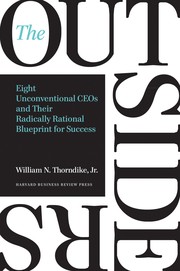
William N. Thorndike Jr. · 2012

Eight CEOs who beat the market by allocating capital, not by running operations.

“…books I've recommended, highlighted to death, or forced on friends.” — Andrew Wilkinson

Source: Andrew Wilkinson's Bookshelf, neverenough.com

Recommended by: Andrew Wilkinson, Dan Loeb, Francois Rochon and 12 others
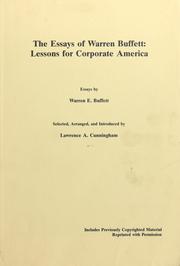
Warren Buffett, Lawrence A. Cunningham · 1997

Berkshire's shareholder letters arranged by topic: governance, valuation, mergers.

“The resource is as valuable as Larry Cunningham's The Essays of Warren Buffett, which similarly organizes by subject matter” — Christopher Bloomstran

Source: Semper Augustus 2024 Letter to Clients, 'Books and Tunes for Walking', p. 96

Recommended by: Christopher Bloomstran, Francois Rochon and 11 others
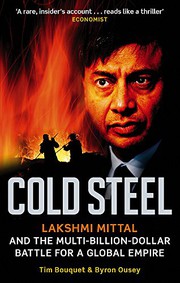
Tim Bouquet, Byron Ousey · 2009

Mittal Steel's 2006 hostile takeover of Arcelor, creating the largest steelmaker.

Recommended by: Mohnish Pabrai
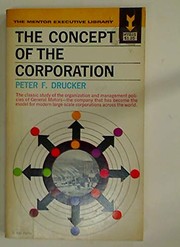
Peter F. Drucker · 1946

Eighteen months inside General Motors: the large corporation as a social institution.
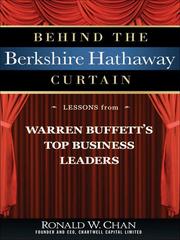
Lawrence A. Cunningham · 2014

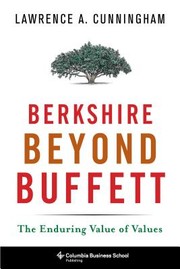
Berkshire as an operating company: its subsidiaries' culture and whether it lasts.

Recommended by: Mohnish Pabrai

Where it sits in the reference 4

Companies
Business models
Business themes
Business themes

Topics

Company HistoriesBusiness and Management