Updates

  1. Person pages list letters, writing, profiles and links as sortable tables with filters, and show each person's companies as links; Fund letters show each letter's description in its own column.
  2. Experts show a checked job title and a short description of each person; 30 more people have photographs.
  3. Every company, fund, university and publication the experts work for has a page listing the people there.
  4. Fund letters show each letter's thesis and filter by it; 225 person pages list the essays, columns and newsletter issues the person wrote.
  5. Person pages list every essay and newsletter issue a person wrote, and their own books as a table in List view.
  6. Recommends shows the five largest kinds of book and the rest under More; browse pictures load sooner.
  7. Podcasts and talks link the original episode, filter by Audio and video or Press, and list each publisher once.
  8. Pages are wider, Recommends has List and Grid, and a filter clicked again turns off.
  9. Book cards sit in a ruled grid with Open Library and Goodreads links and each book's one-line note.
  10. Funds is now Investors; each investor's styles are buttons that filter the table.
  11. Podcasts and talks on a person's page filter by year and publisher and show as a list or a grid of pictures.
  12. Quotes show only people's own words: 472 summaries written by list sites are gone.
  13. Country pages open from Browse again, and every link on the shelf lands on a page.
  14. Subject and person pages show their sections as tabs, and each book appears once on a person's page.
  15. Book cards show the quote, who said it and the source; grids show five cards to a row.
  16. On a phone, a menu holds the sections, search, Updates, Feedback and dark mode.
  17. Feedback takes a screenshot of the page with no browser prompt, opens a screenshot full size when you click it, and clears itself once sent.
  18. Book cards are centred, search names the topic each book sits in, and any text cut short shows whole on hover.
  19. Search groups its results by kind: people, companies, geographies, subjects, topics, books, funds, fund letters and papers.
  20. The Books table lists who recommended each book by name, and the browser tab names the section you are in.
  21. Feedback can take a screenshot of the page, or one you paste or choose, and opens in the corner beside Updates.
  22. Each rail button reopens its section where you left it, and Browse, Table and People show on every book and subject page.
  23. Filters grey out choices that hold nothing instead of hiding them, and Books › People filters by authors or recommenders.
  24. Feedback takes a subject line and up to three screenshots.
  25. Biographies are grouped by the person they are about: 41 new pages, from Abraham Lincoln to Lee Kuan Yew.
  26. Sport splits into 23 sports, and Religion into one topic per faith.
  27. Book lists show as cards: the cover, one recommendation quote and every recommender by name.
  28. Seventeen subjects that had two or three pages under different names now have one page each.
  29. Every page lists its Experts as authors and recommenders, with a link to them on the Experts tab.
  30. Economics, Financial history, Financial panics and Accounting are subjects of their own, with one page per financial crisis.
  31. Book, person and subject pages open inside the app, so the tabs stay in view.
  32. 996 more book covers, and photographs or logos for 227 more people and companies.
  33. Books › Browse shows every subject as cards, and the rail holds Fund letters, Papers, Experts, Books and Funds.
  34. Every topic over 150 books splits into narrower topics, each with a page of its own.

Send feedback

What is it?
Screenshots, up to 3 (optional)
or paste one with Ctrl+V

We use your email only to reply to you.

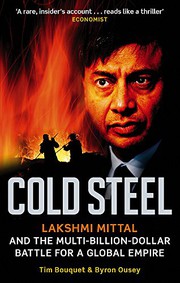
Cold Steel: The Multi-Billion-Dollar Battle

Cold Steel: The Multi-Billion-Dollar Battle for a Global Empire

Tim Bouquet, Byron Ousey
2009
T4 352 pages · about 5h 52m to read Open Librarygoodreads

Summary

Bouquet and Ousey reconstruct the 2006 contested acquisition of Arcelor by Mittal Steel, which created the world's largest steel company and which was the largest hostile cross-border takeover attempted in Europe at the time.

The transaction had commercial and political dimensions in roughly equal measure. Lakshmi Mittal had built Mittal Steel by acquiring distressed and state-owned steel plants across Eastern Europe, Central Asia, Africa and the United States and turning them around, which had made him one of the world's wealthiest people while leaving the company regarded as an outsider by the European industry. Arcelor was the product of a merger between French, Luxembourgish and Spanish producers and had close relationships with the governments involved.

The defence was substantially political. Arcelor's management characterised Mittal Steel as culturally incompatible and as a company of Indian origin despite its Dutch domicile, and the governments of France and Luxembourg intervened publicly. The board pursued a defensive merger with Severstal that would have handed control to a Russian shareholder, which shareholders rejected. Bouquet and Ousey document the shareholder pressure that eventually forced the board to negotiate.

The reporting draws on access to both sides. The book is written as a narrative rather than an analysis and does not assess whether the combination created value, which subsequent results make a fair question. It is a useful case in cross-border hostile takeovers and in the limits of political defence when institutional shareholders want a deal.

Key takeaways 7

  1. Mittal built its steel business by acquiring distressed and state-owned plants across several continents and turning them around, which no established European producer had attempted.
  2. Arcelor's defence was substantially political, invoking national interest and cultural incompatibility rather than valuation arguments.
  3. The board's attempt to merge with Severstal as a defensive measure would have transferred control to a Russian shareholder without a shareholder vote on the merits.
  4. Institutional shareholders forced the board to negotiate, which demonstrates that political defence fails when the owners want the transaction.
  5. Cross-border hostile takeovers in Europe face obstacles that are governmental rather than legal, and the obstacles operate through public pressure rather than through rules.
  6. Steel industry consolidation was driven by the need for scale in raw material purchasing and in negotiations with automotive customers.
  7. The book does not assess whether the combination created value, which the subsequent record makes a legitimate question.

Who should read it

Investors and corporate development teams interested in cross-border hostile takeovers and the limits of political defence.

Who recommended it 1 · 1 direct

Similar books 6

Chosen by shared topics, the entries that hold them, and the people who recommended both.

George A. Roberts · 2007

Teledyne from the inside; the conglomerate that actually compounded.

“This is a great history of Henry Singleton and the conglomerate, Teledyne... I've recommended this several times as well.” — Christopher Bloomstran

Source: Semper Augustus 2023 Letter to Clients, 'Worldly Wisdom', p. 81

Recommended by: Christopher Bloomstran, Mohnish Pabrai
William N. Thorndike Jr. · 2012

Eight CEOs who beat the market by allocating capital, not by running operations.

“…books I've recommended, highlighted to death, or forced on friends.” — Andrew Wilkinson

Source: Andrew Wilkinson's Bookshelf, neverenough.com

Recommended by: Andrew Wilkinson, Dan Loeb, Francois Rochon and 12 others
Lawrence A. Cunningham · 2014

Berkshire as an operating company: its subsidiaries' culture and whether it lasts.

Recommended by: Mohnish Pabrai

Where it sits in the reference 3

Business themes
Industries
Business themes

Topics

Company HistoriesBusiness and Management