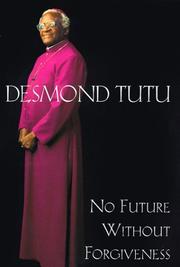
No Future Without Forgiveness
The chairman of South Africa's Truth and Reconciliation Commission on its lessons.
Summary
Archbishop Desmond Tutu, whom President Nelson Mandela named chairman of South Africa's Truth and Reconciliation Commission, reflects on what he learned leading it. He wrote after the commission's final report was published, in 1999. The commission was a new kind of international event: no country had tried to move from despotism to democracy both by exposing the atrocities of the past and by reconciling with its former oppressors.
Tutu argues that true reconciliation cannot come from denying the past, yet that reconciling is hard when a nation "looks the beast in the eye". Instead of repeating platitudes about forgiveness, he sets out a spirituality that faces the horrors people inflict on one another and keeps an idealism about reconciliation. He draws on decades of experience to show how a society can move forward with honesty and compassion toward a more humane world. The Open Library record files the book under reconciliation, forgiveness, race relations and Christianity.
Key takeaways 4
- South Africa's commission joined public truth-telling about atrocities with reconciliation.
- Tutu argues that reconciliation requires facing the past, not denying it.
- Forgiveness, in his account, is demanding work rather than a platitude.
- A nation can move from despotism to democracy without a cycle of revenge.
Who should read it
Readers interested in transitional justice, forgiveness and South Africa's move to democracy.
Who recommended it 1 · 1 direct
Similar books 6
Chosen by shared topics, the entries that hold them, and the people who recommended both.
Nelson Mandela's own story, from childhood to prison and the end of apartheid.
Recommended by: Jim Collins, Mohnish Pabrai, Richard Branson
The battle for Nigeria's oil, and the corruption and conflict it brings to the Delta.

Paul Kagame, a refugee who came home, and Rwanda's rebuilding.
Recommended by: Patrick Collison
A challenge to donor orthodoxy on how African economies should develop.
What South Africa faced as white minority rule came to an end.
How Western aid sustains authoritarian governments in Africa, Ethiopia among them.