Updates

  1. Fund letters lists 118 more letters, each with its own page: 44 weekly commentaries by Jeremy Siegel from 2026, 31 issues of Van Tharp's newsletter from 2018, 23 Pabrai Investment Funds letters from 2021 to Q3 2026, 13 Efficient Frontier essays by William Bernstein, Oakmark's three 3Q 2026 commentaries, two Lindsell Train reports, a John Hussman comment and Third Point's Q3 2026 letter.
  2. 2,027 more books carry a one-line description in the Books table and on their pages; 7,067 of 7,715 have one, every tier 1, 2 and 3 book among them.
  3. Fund letters lists 187 more letters from 19 firms, among them Permanent Equity, Social Capital, Lux Capital, Square Peg, Bestinver, Cobas, Sequoia Fund, Marketfield and EquityCompass; each shows on its investor's page and has a page of its own.
  4. 2,928 more books carry a one-line description in the Books table and on their pages, so every tier 1, 2 and 3 book has one; 5,040 in all.
  5. Every publication on Newsletters has its own page: its writing, its writers, its staff and who recommends it. Investor pages have a Management tab; a company's Experts tab now leaves out its own people, who list under Management. Tabs on a phone move sideways only.
  6. Every fund letter and research paper has its own page: the thesis, the PDF, the companies and books it names, and for 176 letters and 24 papers so far a summary, key insights and quotes with their page.
  7. 99 books that no page listed now sit under their topics in Books, among them Caste, American Prometheus and Pale Blue Dot.
  8. Newsletters lists every newspaper, magazine, investment newsletter, journal and blog the reference holds, 442 in all, with the people who write there. The search box keeps your last 20 searches. You can create an account.
  9. 283 books that fund managers recommend in their letters are on the shelf, each with the letter's own words and page; investor pages have a Recommends tab.
  10. Person, company, investor and show pages link their own accounts on X, Threads, Instagram, LinkedIn, YouTube and Substack: 275 people, 552 companies and organisations, 88 investors and 478 shows.
  11. 716 more book recommendations name their source: the person's own reading list, letter, blog post, speech or interview, or an article that reports it. 232 of them quote the person's own words about the book, on the book card and on the book's page.
  12. Every US-listed company has a page with its SEC filings. Company pages list their experts and their management, past and present. Fund managers sit under Investors. Each show has a page of its episodes, and an episode page names its guests and hosts. Biographies lists groups, then people. Breadcrumbs show where a page sits.
  13. Media lists every podcast episode, video, interview and talk, over 10,000, by person, company, publisher and event; each filter searches its own choices. Books opens on its table, then Browse, then Authors and Recommenders. A filter's count no longer covers its arrow.
  14. A book that no company, country or subject page lists shows its topics under Where it sits in the reference. On a phone, a page's tabs scroll sideways only. Descriptions read the same on every page. See them in the Experts tab lists every expert the page names.
  15. Every podcast episode, video and interview has its own page with a video or audio player and a link to the source. Investor pages show each company's sector and market cap; firms such as Berkshire Hathaway have one page that holds their letters and their company tabs. Letters tabs filter by company and search the theses. Companies filter by Public, Private and Defunct and link each company's website.
  16. Every tab, view and search has its own address, such as /books/table/asset or /letters/companies, so Back works and a link opens the same place. Page addresses no longer end in .html. Fund letters, Investors, Companies and Papers load about a fifth of the data they did.
  17. Fund letters has a Companies tab: every company the letters name, with its market cap, sector, country, and how many letters and investors name it. Investor pages link each investor's website. Lists in table cells end with “… and N more” at every width.
  18. 1,120 more book summaries; descriptions for 373 papers; pages for 137 more companies, each with the fund letters that discuss it; 215 official photographs; search has its own page.
  19. 411 more books have a summary; person pages list 930 more of the books they wrote; 147 people show their official photograph.
  20. Every investor has a page with its letters and the companies they discuss; company pages list the investors whose letters name them.
  21. A Companies section at the top of the rail lists every company the books, experts and fund letters name.
  22. Person pages list letters, writing, profiles and links as sortable tables with filters, and show each person's companies as links; Fund letters show each letter's description in its own column.
  23. Experts show a checked job title and a short description of each person; 30 more people have photographs.
  24. Every company, fund, university and publication the experts work for has a page listing the people there.
  25. Fund letters show each letter's thesis and filter by it; 225 person pages list the essays, columns and newsletter issues the person wrote.
  26. Person pages list every essay and newsletter issue a person wrote, and their own books as a table in List view.
  27. Recommends shows the five largest kinds of book and the rest under More; browse pictures load sooner.
  28. Podcasts and talks link the original episode, filter by Audio and video or Press, and list each publisher once.
  29. Pages are wider, Recommends has List and Grid, and a filter clicked again turns off.
  30. Book cards sit in a ruled grid with Open Library and Goodreads links and each book's one-line note.
  31. Funds is now Investors; each investor's styles are buttons that filter the table.
  32. Podcasts and talks on a person's page filter by year and publisher and show as a list or a grid of pictures.
  33. Quotes show only people's own words: 472 summaries written by list sites are gone.
  34. Country pages open from Browse again, and every link on the shelf lands on a page.
  35. Subject and person pages show their sections as tabs, and each book appears once on a person's page.
  36. Book cards show the quote, who said it and the source; grids show five cards to a row.
  37. On a phone, a menu holds the sections, search, Updates, Feedback and dark mode.
  38. Feedback takes a screenshot of the page with no browser prompt, opens a screenshot full size when you click it, and clears itself once sent.
  39. Book cards are centred, search names the topic each book sits in, and any text cut short shows whole on hover.
  40. Search groups its results by kind: people, companies, geographies, subjects, topics, books, funds, fund letters and papers.
  41. The Books table lists who recommended each book by name, and the browser tab names the section you are in.
  42. Feedback can take a screenshot of the page, or one you paste or choose, and opens in the corner beside Updates.
  43. Each rail button reopens its section where you left it, and Browse, Table and People show on every book and subject page.
  44. Filters grey out choices that hold nothing instead of hiding them, and Books › People filters by authors or recommenders.
  45. Feedback takes a subject line and up to three screenshots.
  46. Biographies are grouped by the person they are about: 41 new pages, from Abraham Lincoln to Lee Kuan Yew.
  47. Sport splits into 23 sports, and Religion into one topic per faith.
  48. Book lists show as cards: the cover, one recommendation quote and every recommender by name.
  49. Seventeen subjects that had two or three pages under different names now have one page each.
  50. Every page lists its Experts as authors and recommenders, with a link to them on the Experts tab.
  51. Economics, Financial history, Financial panics and Accounting are subjects of their own, with one page per financial crisis.
  52. Book, person and subject pages open inside the app, so the tabs stay in view.
  53. 996 more book covers, and photographs or logos for 227 more people and companies.
  54. Books › Browse shows every subject as cards, and the rail holds Fund letters, Papers, Experts, Books and Funds.
  55. Every topic over 150 books splits into narrower topics, each with a page of its own.

Send feedback

What is it?
Screenshots, up to 3 (optional)
or paste one with Ctrl+V

We use your email only to reply to you.

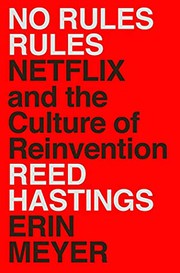
No Rules Rules

No Rules Rules

How Netflix built talent density and candour so it could remove controls.

Reed Hastings, Erin Meyer
2020
T2 320 pages · about 5h 20m to read Open Librarygoodreads

Insider account by the co-founder and CEO of the Netflix culture.

Summary

Hastings, Netflix's co-founder, writes alternating chapters with Erin Meyer, a business school professor who interviewed employees and adds outside perspective and cross-cultural analysis. The structure is a sequence in which each step becomes possible only after the previous ones are in place.

The sequence begins with talent density, achieved by paying top of market and by removing adequate performers, which Hastings argues is the precondition for everything else. It proceeds to candour, implemented through explicit feedback norms including live feedback in meetings and written 360 reviews. Only after both are established does he introduce the removal of controls: no vacation policy, no expense approval, no spending limits, replaced by the instruction to act in Netflix's best interest.

The most discussed practice is the keeper test, in which managers ask whether they would fight to retain each person and remove those they would not, with a substantial severance payment. Hastings defends this directly and Meyer reports the effect on employees, including the fear it produces, which Hastings acknowledges as a cost.

Other practices include context rather than control, meaning that leaders provide the information for decisions rather than making them; the dispersed decision-making model in which no approval is required and the person closest to the information decides; sunshining, meaning that failed decisions are shared publicly by the person who made them; and paying personal top of market rather than using salary bands. The model works at a company with extraordinary margins and the ability to select from an enormous applicant pool. Meyer's chapters note that several practices transfer badly to other national cultures. The book is written by an interested party and the employees who were removed are not interviewed.

Key takeaways 8

  1. Talent density is the precondition for everything else, and removing adequate performers raises the performance of those who remain.
  2. Paying top of market for every role, and adjusting proactively rather than at review time, removes both retention risk and negotiation.
  3. Candour must be built deliberately through explicit norms and practice, because it does not emerge from a stated value.
  4. Controls including vacation policies, expense approval and spending limits can be removed once talent density and candour are established, and not before.
  5. The keeper test asks whether a manager would fight to keep each person, and those who fail it are removed with substantial severance.
  6. Leaders should provide context rather than make decisions, so that the person closest to the information decides.
  7. Failed decisions should be shared publicly by the person who made them, which is what allows risk-taking to continue after a failure.
  8. The model depends on extraordinary margins and an enormous applicant pool, and several practices transfer badly across national cultures.

Who should read it

Executives considering removing controls and process, who need the preconditions stated explicitly before adopting any of the practices.

Who recommended it 5 · 1 direct

Ben Horowitzreported
Guy Spierreported
Reid Hoffmanreported

Similar books 6

Chosen by shared topics, the entries that hold them, and the people who recommended both.
Ed Catmull, Amy Wallace · 2014

How Pixar kept a creative company working after success, and the habits it used.

“His book, Creativity, Inc.; an amazing, amazing book.” — Ezra Klein

Source: The Tim Ferriss Show Transcripts: Ezra Klein (#208)

Recommended by: Ezra Klein, Jim Collins, Michael Mauboussin and 11 others
Laszlo Bock · 2015

How Google hires, manages and pays its people, with the data behind each choice.

Fred Kofman · 2002

Seven qualities, such as unconditional responsibility, of people who make firms work.

Recommended by: Sheryl Sandberg, Reid Hoffman
Patty McCord · 2018

How Netflix built its culture of recruiting, motivating and building teams.

Ray Dalio · 2017

Decision rules from building Bridgewater: radical truth and radical transparency.

“Several people recommended Ray Dalio’s book Principles to me.” — Brad Feld

Source: Book: Principles by Ray Dalio — Feld Thoughts

Recommended by: Alfred Lin, Brad Feld, Doug McMillon and 29 others

Where it sits in the reference 4

Companies
Business themes
Industries
Business themes

Topics 3

Business and ManagementLeadershipCompany Histories