Non-Life Insurance-Linked Securities
Risk and pricing analysis of property-catastrophe insurance-linked securities.
Risk-and-pricing analysis of the property-catastrophe end.
Summary
The reference has not verified this book in detail; the summary states only what the title, author and subject establish.
Thomas Nowak and Andreas Richter edited this volume on insurance-linked securities covering property and casualty risk, as distinct from life-related structures. The instruments concerned transfer catastrophe and other non-life insurance exposures from insurers and reinsurers to capital market investors.
The subject matter covers catastrophe bond structure and pricing, the modelling of natural catastrophe risk, trigger design, the regulatory and accounting treatment of risk transfer, and the position of these instruments in an institutional portfolio.
The reference has not verified this volume's contents in detail, and this entry describes the instrument class rather than the book's specific arguments. Readers should note that the market has grown substantially since 2014 and that loss experience from major hurricanes, wildfires and secondary perils has since tested the catastrophe models on which pricing depends.
Key takeaways 5
- Catastrophe bonds transfer defined insurance losses to investors, who lose principal only if the specified event occurs.
- Returns on these instruments are uncorrelated with financial markets because their trigger is a physical event rather than an economic one.
- Trigger design determines who bears basis risk, and indemnity, industry-index and parametric triggers allocate it differently.
- Pricing depends on catastrophe models whose frequency assumptions are contested and periodically revised upward.
- Secondary perils such as wildfire and severe convective storm have produced losses that the models systematically understated.
Who should read it
Institutional investors and insurance professionals wanting a technical reference on property catastrophe risk transfer, with the caveat that this entry is not verified in detail.
Similar books 6
Chosen by shared topics, the entries that hold them, and the people who recommended both.
How insurance and reinsurance risk is transferred to capital markets.
How cat bonds and other insurance-linked securities work and are priced.
How investors buy life insurance policies and price longevity risk.
Chapters on cat bonds and other insurance-linked securities: structure and triggers.
A reference on futures: mechanics, analysis, trading systems and portfolios.
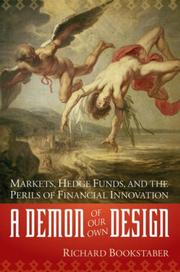
How financial innovation made markets more crisis-prone, from a risk manager.
“The New York Times of August 18 described A Demon of Our Own Design, by Richard Bookstaber (see “Investment Miscellany,” November 2000) as pointing out that “the proliferation of complex financial products like derivatives, combined with use of leverage to bolster returns, will inevitably mean that there will be a regular stream of market contagions like the one we’re having now – one of which, someday, could be calamitous.” 6” — Howard Marks
Source: Now It’s All Bad?, page 6
Recommended by: Howard Marks, Jeremy Grantham and 1 other