Updates

  1. Person pages list letters, writing, profiles and links as sortable tables with filters, and show each person's companies as links; Fund letters show each letter's description in its own column.
  2. Experts show a checked job title and a short description of each person; 30 more people have photographs.
  3. Every company, fund, university and publication the experts work for has a page listing the people there.
  4. Fund letters show each letter's thesis and filter by it; 225 person pages list the essays, columns and newsletter issues the person wrote.
  5. Person pages list every essay and newsletter issue a person wrote, and their own books as a table in List view.
  6. Recommends shows the five largest kinds of book and the rest under More; browse pictures load sooner.
  7. Podcasts and talks link the original episode, filter by Audio and video or Press, and list each publisher once.
  8. Pages are wider, Recommends has List and Grid, and a filter clicked again turns off.
  9. Book cards sit in a ruled grid with Open Library and Goodreads links and each book's one-line note.
  10. Funds is now Investors; each investor's styles are buttons that filter the table.
  11. Podcasts and talks on a person's page filter by year and publisher and show as a list or a grid of pictures.
  12. Quotes show only people's own words: 472 summaries written by list sites are gone.
  13. Country pages open from Browse again, and every link on the shelf lands on a page.
  14. Subject and person pages show their sections as tabs, and each book appears once on a person's page.
  15. Book cards show the quote, who said it and the source; grids show five cards to a row.
  16. On a phone, a menu holds the sections, search, Updates, Feedback and dark mode.
  17. Feedback takes a screenshot of the page with no browser prompt, opens a screenshot full size when you click it, and clears itself once sent.
  18. Book cards are centred, search names the topic each book sits in, and any text cut short shows whole on hover.
  19. Search groups its results by kind: people, companies, geographies, subjects, topics, books, funds, fund letters and papers.
  20. The Books table lists who recommended each book by name, and the browser tab names the section you are in.
  21. Feedback can take a screenshot of the page, or one you paste or choose, and opens in the corner beside Updates.
  22. Each rail button reopens its section where you left it, and Browse, Table and People show on every book and subject page.
  23. Filters grey out choices that hold nothing instead of hiding them, and Books › People filters by authors or recommenders.
  24. Feedback takes a subject line and up to three screenshots.
  25. Biographies are grouped by the person they are about: 41 new pages, from Abraham Lincoln to Lee Kuan Yew.
  26. Sport splits into 23 sports, and Religion into one topic per faith.
  27. Book lists show as cards: the cover, one recommendation quote and every recommender by name.
  28. Seventeen subjects that had two or three pages under different names now have one page each.
  29. Every page lists its Experts as authors and recommenders, with a link to them on the Experts tab.
  30. Economics, Financial history, Financial panics and Accounting are subjects of their own, with one page per financial crisis.
  31. Book, person and subject pages open inside the app, so the tabs stay in view.
  32. 996 more book covers, and photographs or logos for 227 more people and companies.
  33. Books › Browse shows every subject as cards, and the rail holds Fund letters, Papers, Experts, Books and Funds.
  34. Every topic over 150 books splits into narrower topics, each with a page of its own.

Send feedback

What is it?
Screenshots, up to 3 (optional)
or paste one with Ctrl+V

We use your email only to reply to you.

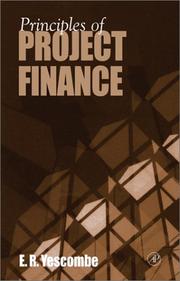
Principles of Project Finance

Principles of Project Finance

E. R. Yescombe
2002
T2 452 pages · about 7h 32m to read Open Librarygoodreads

The standard text on non-recourse financing of infrastructure projects.

Summary

Edward Yescombe worked in project finance for decades and wrote the standard practitioner reference on it. Project finance means lending against the cash flows of a specific project held in a separate company, with limited or no recourse to the sponsors, and the book explains every component of that structure.

The coverage is systematic. It sets out who the parties are and what each contributes, the project development process, the commercial contracts that create the revenue, including offtake agreements, power purchase agreements and concession agreements, and the construction contracts that allocate completion risk. It then covers the financial structuring: the debt sizing based on cover ratios, the security package, the intercreditor arrangements, the drawdown and repayment mechanics, hedging of interest rate and currency exposure, and the financial model that ties everything together. Separate chapters cover the roles of export credit agencies, development finance institutions and multilateral lenders, and the specific features of different sectors including power, transport, telecommunications and oil and gas.

The method throughout is to explain what each provision does and why lenders require it. Yescombe's argument, stated implicitly, is that project finance is a risk allocation exercise conducted through contracts, and that the financing is only viable when every material risk has been assigned to a party capable of bearing it. Later editions add material on public-private partnerships, on the financial crisis's effect on bank tenors, and on the growth of bond and institutional funding. It is a reference rather than a book to read through.

Key takeaways 7

  1. Project finance lends against a project's own cash flows with limited recourse to sponsors, which makes contractual risk allocation the entire analysis.
  2. Every material project risk must be assigned by contract to a party able to bear it, and an unallocated risk stops the financing.
  3. Debt is sized from cover ratios applied to projected cash flow, so the revenue contract determines the capital structure.
  4. Completion risk is transferred to a construction contractor through fixed-price date-certain contracts backed by liquidated damages and security.
  5. Offtake and concession agreements convert a project into a stream of contractual payments, which is what makes it financeable.
  6. Political and regulatory risk in cross-border projects is mitigated through multilateral lender participation rather than through contract alone.
  7. The financial model is the negotiating instrument as much as the analytical one, since every party's position is expressed through its assumptions.

Who should read it

Anyone financing, sponsoring or lending to infrastructure and energy projects who needs the complete structural and contractual framework in one reference.

Similar books 6

Chosen by shared topics, the entries that hold them, and the people who recommended both.
Stefano Gatti · 2007

How project finance deals are structured, with the theory and worked cases.

Barbara Weber, Mirjam Staub-Bisang, Hans Wilhelm Alfen · 2010

Infrastructure's risk, return and role in a portfolio, from an allocator's view.

Rajeev J. Sawant · 2010

Treats infrastructure as an asset class rather than a project-finance problem.

E. R. Yescombe · 2010

How PPP concessions are structured, priced and argued over.
Jack D. Schwager · 1984

Second edition 2017 with Mark Etzkorn, titled A Complete Guide to the Futures Market.

Vitaly S. Guzhva, Sunder Raghavan, Damon J. D'Agostino · 2018

The only book-length treatment of aircraft leasing; a textbook.

Where it sits in the reference 1

Assets

Topics

Finance and MarketsReference WorksFinance, accounting and economics references