Updates

  1. Person pages list letters, writing, profiles and links as sortable tables with filters, and show each person's companies as links; Fund letters show each letter's description in its own column.
  2. Experts show a checked job title and a short description of each person; 30 more people have photographs.
  3. Every company, fund, university and publication the experts work for has a page listing the people there.
  4. Fund letters show each letter's thesis and filter by it; 225 person pages list the essays, columns and newsletter issues the person wrote.
  5. Person pages list every essay and newsletter issue a person wrote, and their own books as a table in List view.
  6. Recommends shows the five largest kinds of book and the rest under More; browse pictures load sooner.
  7. Podcasts and talks link the original episode, filter by Audio and video or Press, and list each publisher once.
  8. Pages are wider, Recommends has List and Grid, and a filter clicked again turns off.
  9. Book cards sit in a ruled grid with Open Library and Goodreads links and each book's one-line note.
  10. Funds is now Investors; each investor's styles are buttons that filter the table.
  11. Podcasts and talks on a person's page filter by year and publisher and show as a list or a grid of pictures.
  12. Quotes show only people's own words: 472 summaries written by list sites are gone.
  13. Country pages open from Browse again, and every link on the shelf lands on a page.
  14. Subject and person pages show their sections as tabs, and each book appears once on a person's page.
  15. Book cards show the quote, who said it and the source; grids show five cards to a row.
  16. On a phone, a menu holds the sections, search, Updates, Feedback and dark mode.
  17. Feedback takes a screenshot of the page with no browser prompt, opens a screenshot full size when you click it, and clears itself once sent.
  18. Book cards are centred, search names the topic each book sits in, and any text cut short shows whole on hover.
  19. Search groups its results by kind: people, companies, geographies, subjects, topics, books, funds, fund letters and papers.
  20. The Books table lists who recommended each book by name, and the browser tab names the section you are in.
  21. Feedback can take a screenshot of the page, or one you paste or choose, and opens in the corner beside Updates.
  22. Each rail button reopens its section where you left it, and Browse, Table and People show on every book and subject page.
  23. Filters grey out choices that hold nothing instead of hiding them, and Books › People filters by authors or recommenders.
  24. Feedback takes a subject line and up to three screenshots.
  25. Biographies are grouped by the person they are about: 41 new pages, from Abraham Lincoln to Lee Kuan Yew.
  26. Sport splits into 23 sports, and Religion into one topic per faith.
  27. Book lists show as cards: the cover, one recommendation quote and every recommender by name.
  28. Seventeen subjects that had two or three pages under different names now have one page each.
  29. Every page lists its Experts as authors and recommenders, with a link to them on the Experts tab.
  30. Economics, Financial history, Financial panics and Accounting are subjects of their own, with one page per financial crisis.
  31. Book, person and subject pages open inside the app, so the tabs stay in view.
  32. 996 more book covers, and photographs or logos for 227 more people and companies.
  33. Books › Browse shows every subject as cards, and the rail holds Fund letters, Papers, Experts, Books and Funds.
  34. Every topic over 150 books splits into narrower topics, each with a page of its own.

Send feedback

What is it?
Screenshots, up to 3 (optional)
or paste one with Ctrl+V

We use your email only to reply to you.

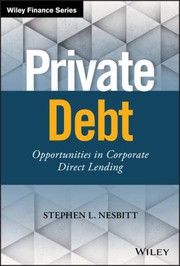
Private Debt

Private Debt

Stephen L. Nesbitt
2018
T3 256 pages · about 4h 16m to read Open Librarygoodreads

The first book-length case for corporate direct lending as an asset class.

Summary

Stephen Nesbitt runs Cliffwater, an institutional consulting firm, and wrote this as an argument for direct lending to middle-market companies as a distinct institutional asset class. His audience is pension funds and endowments considering an allocation.

His case rests on the structural shift after 2008. Banks retreated from middle-market lending under new capital rules, and the syndicated loan market serves larger borrowers, which left companies with earnings in the tens of millions dependent on non-bank lenders. Nesbitt argues that these loans offer a yield premium over syndicated loans, that the premium reflects illiquidity and complexity rather than credit risk, that the loans are senior and secured with maintenance covenants that broadly syndicated loans have largely abandoned, and that the floating rate structure removes duration exposure.

He supports this with return and loss data, primarily from business development companies, which are the publicly reported vehicles in the space, and constructs index series from them. The book is written by someone whose firm sells advice on this asset class, and readers should weigh that. The analysis also predates the enormous growth of private credit through 2020 to 2025, which has compressed spreads, moved the asset class up-market into competition with syndicated loans, and raised questions about valuation practices and about what happens in a genuine default cycle. The framework for evaluating the asset class is sound; the numbers are historical.

Key takeaways 7

  1. Bank retreat from middle-market lending after 2008 created the borrower demand that direct lending funds serve.
  2. The yield premium on direct loans over syndicated loans compensates for illiquidity and origination work rather than for additional credit risk.
  3. Direct loans typically carry maintenance covenants that broadly syndicated loans have abandoned, which gives lenders an early right to renegotiate.
  4. Floating rate structures remove interest rate duration, so the exposure is credit rather than rates.
  5. Business development company data provides the only long public return series for the asset class, and it carries its own biases.
  6. Manager selection matters more in private credit than in liquid credit because origination access and underwriting differ substantially between firms.
  7. Nesbitt argues that valuation in private credit is model-based, so reported volatility understates the economic variability of the assets.

Who should read it

Institutional allocators evaluating a private credit allocation who want the structural case, read with awareness of how much the market has changed since 2018.

Similar books 6

Chosen by shared topics, the entries that hold them, and the people who recommended both.

Robert Kricheff · 2012

How a credit analyst measures leverage and coverage in high-yield bonds and loans.
Stephen J. Antczak, Douglas J. Lucas, Frank J. Fabozzi · 2009

High-yield bonds, leveraged loans and the credit derivatives written on them.
William F. Maxwell, Mark Shenkman · 2010

A guide to leveraged loans and high-yield bonds, public cousins of private credit.

Glenn Yago · 1990

The revisionist defence of high yield as a financing innovation.

LSTA · 2006

LSTA reference on how leveraged loans are originated, syndicated and traded.
Jack D. Schwager · 1984

Second edition 2017 with Mark Etzkorn, titled A Complete Guide to the Futures Market.

Where it sits in the reference 1

Assets

Topics

InvestingFinance and Markets