Updates

  1. Person pages list letters, writing, profiles and links as sortable tables with filters, and show each person's companies as links; Fund letters show each letter's description in its own column.
  2. Experts show a checked job title and a short description of each person; 30 more people have photographs.
  3. Every company, fund, university and publication the experts work for has a page listing the people there.
  4. Fund letters show each letter's thesis and filter by it; 225 person pages list the essays, columns and newsletter issues the person wrote.
  5. Person pages list every essay and newsletter issue a person wrote, and their own books as a table in List view.
  6. Recommends shows the five largest kinds of book and the rest under More; browse pictures load sooner.
  7. Podcasts and talks link the original episode, filter by Audio and video or Press, and list each publisher once.
  8. Pages are wider, Recommends has List and Grid, and a filter clicked again turns off.
  9. Book cards sit in a ruled grid with Open Library and Goodreads links and each book's one-line note.
  10. Funds is now Investors; each investor's styles are buttons that filter the table.
  11. Podcasts and talks on a person's page filter by year and publisher and show as a list or a grid of pictures.
  12. Quotes show only people's own words: 472 summaries written by list sites are gone.
  13. Country pages open from Browse again, and every link on the shelf lands on a page.
  14. Subject and person pages show their sections as tabs, and each book appears once on a person's page.
  15. Book cards show the quote, who said it and the source; grids show five cards to a row.
  16. On a phone, a menu holds the sections, search, Updates, Feedback and dark mode.
  17. Feedback takes a screenshot of the page with no browser prompt, opens a screenshot full size when you click it, and clears itself once sent.
  18. Book cards are centred, search names the topic each book sits in, and any text cut short shows whole on hover.
  19. Search groups its results by kind: people, companies, geographies, subjects, topics, books, funds, fund letters and papers.
  20. The Books table lists who recommended each book by name, and the browser tab names the section you are in.
  21. Feedback can take a screenshot of the page, or one you paste or choose, and opens in the corner beside Updates.
  22. Each rail button reopens its section where you left it, and Browse, Table and People show on every book and subject page.
  23. Filters grey out choices that hold nothing instead of hiding them, and Books › People filters by authors or recommenders.
  24. Feedback takes a subject line and up to three screenshots.
  25. Biographies are grouped by the person they are about: 41 new pages, from Abraham Lincoln to Lee Kuan Yew.
  26. Sport splits into 23 sports, and Religion into one topic per faith.
  27. Book lists show as cards: the cover, one recommendation quote and every recommender by name.
  28. Seventeen subjects that had two or three pages under different names now have one page each.
  29. Every page lists its Experts as authors and recommenders, with a link to them on the Experts tab.
  30. Economics, Financial history, Financial panics and Accounting are subjects of their own, with one page per financial crisis.
  31. Book, person and subject pages open inside the app, so the tabs stay in view.
  32. 996 more book covers, and photographs or logos for 227 more people and companies.
  33. Books › Browse shows every subject as cards, and the rail holds Fund letters, Papers, Experts, Books and Funds.
  34. Every topic over 150 books splits into narrower topics, each with a page of its own.

Send feedback

What is it?
Screenshots, up to 3 (optional)
or paste one with Ctrl+V

We use your email only to reply to you.

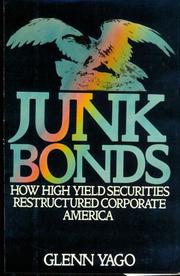
Junk Bonds

Junk Bonds

Glenn Yago
1990
T3 256 pages · about 4h 16m to read Open Librarygoodreads

The revisionist defence of high yield as a financing innovation.

Summary

Yago, an economist then at the Milken Institute's precursor institutions, wrote an empirical defence of the high yield bond market against the political and regulatory attack it faced after the Drexel collapse. His argument is that the market financed growth companies that could not access investment grade credit, and that the political reaction destroyed a useful institution.

His evidence concerns what high yield issuance actually funded. Yago analyses the use of proceeds across issues and argues that the majority financed capital investment, expansion and refinancing rather than hostile takeovers, which were a small share of volume though they dominated coverage. He documents the employment and investment records of high yield issuers relative to comparable investment grade firms and argues the issuers grew faster and added more employment. He also examines default rates and argues that returns to high yield investors, after defaults, exceeded investment grade returns.

He attributes the market's collapse to regulatory action, specifically the requirement that savings institutions divest high yield holdings, which forced simultaneous selling into a market with no other buyers, rather than to any deterioration in credit quality.

The book is advocacy from an institution funded by the market's principal figure, and readers should weight it accordingly. Subsequent research has confirmed parts of the argument, particularly that takeover financing was a minority of issuance and that forced divestiture worsened the collapse, while the claims about issuer performance rest on comparisons whose selection is disputed.

Key takeaways 7

  1. The majority of high yield bond issuance financed capital investment, expansion and refinancing rather than hostile takeovers.
  2. High yield financing gave growth companies without investment grade ratings access to long-term capital that bank lending would not provide.
  3. Returns to high yield investors after accounting for defaults exceeded returns on investment grade bonds over the period studied.
  4. Regulatory requirements forcing savings institutions to divest high yield holdings created simultaneous selling into a market with no other buyers.
  5. The market's collapse was caused by forced regulatory selling rather than by a deterioration in the underlying credit quality of issuers.
  6. Credit rating categories reflect firm size and asset tangibility as much as default risk, which excluded growing companies regardless of their prospects.
  7. The political reaction to the leveraged buyout period removed a financing channel that primarily served companies unrelated to takeovers.

Who should read it

Credit investors interested in the empirical defence of high yield financing, read with the author's institutional affiliation in mind.

Similar books 6

Chosen by shared topics, the entries that hold them, and the people who recommended both.
Connie Bruck · 1988

How Milken's Drexel junk-bond desk financed the 1980s buyouts and hostile takeovers.

Recommended by: Mohnish Pabrai
Niall Ferguson · 2010

Siegmund Warburg, who fled Germany and founded S.G. Warburg in London.

Recommended by: Mohnish Pabrai
Michael Lewis · 1989

Life on Salomon Brothers' bond trading floor in the 1980s mortgage-bond boom.

“I do believe, as Michael Lewis writes in his intriguing 1989 book, "Liar's Poker," that it is unlikely that an individual unable to buck convention in one's life will suddenly be able to buck…” — Michael Burry

Source: MSN Money Strategy Lab journal, March 2, 2001 — archived

Recommended by: Michael Burry, Mohnish Pabrai, Nat Eliason and 3 others
Moira Johnston · 1986

Contemporary reporting on the raiders, including his Phillips Petroleum fight.
Turney Duff · 2013

A trader's memoir of Wall Street's after-hours world of drugs, sex and commissions.

Recommended by: Mohnish Pabrai
Philip Augar · 2000

How Big Bang handed the City's investment banks to foreign owners.

Where it sits in the reference 3

Assets
Assets
Financial history

Topics

Finance and MarketsFinancial History