Updates

  1. Person pages list letters, writing, profiles and links as sortable tables with filters, and show each person's companies as links; Fund letters show each letter's description in its own column.
  2. Experts show a checked job title and a short description of each person; 30 more people have photographs.
  3. Every company, fund, university and publication the experts work for has a page listing the people there.
  4. Fund letters show each letter's thesis and filter by it; 225 person pages list the essays, columns and newsletter issues the person wrote.
  5. Person pages list every essay and newsletter issue a person wrote, and their own books as a table in List view.
  6. Recommends shows the five largest kinds of book and the rest under More; browse pictures load sooner.
  7. Podcasts and talks link the original episode, filter by Audio and video or Press, and list each publisher once.
  8. Pages are wider, Recommends has List and Grid, and a filter clicked again turns off.
  9. Book cards sit in a ruled grid with Open Library and Goodreads links and each book's one-line note.
  10. Funds is now Investors; each investor's styles are buttons that filter the table.
  11. Podcasts and talks on a person's page filter by year and publisher and show as a list or a grid of pictures.
  12. Quotes show only people's own words: 472 summaries written by list sites are gone.
  13. Country pages open from Browse again, and every link on the shelf lands on a page.
  14. Subject and person pages show their sections as tabs, and each book appears once on a person's page.
  15. Book cards show the quote, who said it and the source; grids show five cards to a row.
  16. On a phone, a menu holds the sections, search, Updates, Feedback and dark mode.
  17. Feedback takes a screenshot of the page with no browser prompt, opens a screenshot full size when you click it, and clears itself once sent.
  18. Book cards are centred, search names the topic each book sits in, and any text cut short shows whole on hover.
  19. Search groups its results by kind: people, companies, geographies, subjects, topics, books, funds, fund letters and papers.
  20. The Books table lists who recommended each book by name, and the browser tab names the section you are in.
  21. Feedback can take a screenshot of the page, or one you paste or choose, and opens in the corner beside Updates.
  22. Each rail button reopens its section where you left it, and Browse, Table and People show on every book and subject page.
  23. Filters grey out choices that hold nothing instead of hiding them, and Books › People filters by authors or recommenders.
  24. Feedback takes a subject line and up to three screenshots.
  25. Biographies are grouped by the person they are about: 41 new pages, from Abraham Lincoln to Lee Kuan Yew.
  26. Sport splits into 23 sports, and Religion into one topic per faith.
  27. Book lists show as cards: the cover, one recommendation quote and every recommender by name.
  28. Seventeen subjects that had two or three pages under different names now have one page each.
  29. Every page lists its Experts as authors and recommenders, with a link to them on the Experts tab.
  30. Economics, Financial history, Financial panics and Accounting are subjects of their own, with one page per financial crisis.
  31. Book, person and subject pages open inside the app, so the tabs stay in view.
  32. 996 more book covers, and photographs or logos for 227 more people and companies.
  33. Books › Browse shows every subject as cards, and the rail holds Fund letters, Papers, Experts, Books and Funds.
  34. Every topic over 150 books splits into narrower topics, each with a page of its own.

Send feedback

What is it?
Screenshots, up to 3 (optional)
or paste one with Ctrl+V

We use your email only to reply to you.

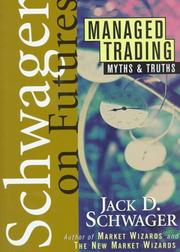
Schwager on Futures: Managed Trading Strateg

Schwager on Futures: Managed Trading Strategies

Jack D. Schwager
1996
T4 318 pages · about 5h 18m to read Open Librarygoodreads

Summary

Jack Schwager wrote this volume of his futures series on managed futures, meaning investment through commodity trading advisers who run systematic or discretionary programmes in futures markets. It is aimed at investors evaluating such programmes and at people building them.

The first part attacks common beliefs about the sector, which Schwager treats as myths: that managed futures returns are unusually risky, that past performance predicts future performance in any simple way, that the best measure of a programme is its return, that drawdowns should be judged against their historical maximum. He argues that risk and return must be assessed together, that the relevant question about a manager is what the return stream does inside a portfolio rather than in isolation, and that the low correlation between managed futures and equities is the reason to hold them.

The second part is technical. Schwager covers performance measurement and the problems with standard ratios, the construction of return and risk measures suited to non-normal distributions, the evaluation of track records including the length required to distinguish skill from chance, portfolio construction across multiple advisers, the effect of fees on realised returns, and the specific due diligence questions to ask. He also covers system development for those building programmes, including the dangers of over-optimisation. The book is honest about how little of the evaluation problem can be solved with data. It dates from 1996 and the sector has changed considerably, but the evaluation framework remains applicable.

Key takeaways 7

  1. Managed futures should be judged by what they contribute inside a portfolio rather than by their standalone return and volatility.
  2. A track record must be long enough to distinguish skill from chance, and most are not.
  3. Standard performance ratios assume normal distributions that managed futures returns do not follow.
  4. Past return alone is a poor selection criterion, and Schwager argues that risk-adjusted measures with drawdown analysis are the minimum.
  5. Over-optimisation in system development produces backtests that describe historical noise rather than any exploitable pattern.
  6. Low correlation with equities is the reason to hold managed futures, and it is also why holders abandon them during equity bull markets.
  7. Fee structures with incentive fees on gross rather than net-of-loss performance transfer more to the manager than investors realise.

Who should read it

Allocators evaluating systematic futures managers who want a framework for assessing track records and for judging what the strategy contributes to a portfolio.

About Jack D. Schwager

Futures research director and author; co-founder of FundSeeder; creator of the Market Wizards series

The Market Wizards interviews are a primary record of how top traders actually operate, cited across the field.

FundSeeder

Similar books 6

Chosen by shared topics, the entries that hold them, and the people who recommended both.
Jack D. Schwager · 1984

Second edition 2017 with Mark Etzkorn, titled A Complete Guide to the Futures Market.
John R. Stephenson, John F. Mauldin · 2010

A guide to commodity investing and to spotting its opportunities.

Recommended by: Mohnish Pabrai

George Kleinman · 2004

Practitioner primer on futures mechanics and hedging.

Where it sits in the reference 2

Investors
Assets

Topics

InvestingFinance and Markets