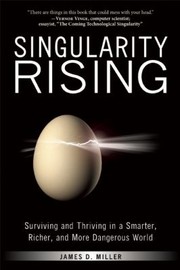
Singularity Rising: Surviving and Thriving in a Smarter, Richer, and More Dangerous World
How a future of abundant human and machine intelligence may change the world.
Summary
James D. Miller, an economics professor and speaker on the technological singularity, asks how a future of abundant human and artificial intelligence will affect ordinary people's jobs, families and wealth. He starts from Ray Kurzweil's The Singularity Is Near, which describes a future transformed by the growth of human and computing intelligence that follows from Moore's Law, and notes the movement's support among Silicon Valley figures such as Peter Thiel and Larry Page.
Miller argues that natural selection has been increasing human intelligence over the past few thousand years and speculates on how intelligence enhancement will shape civilisation over the next forty. His scenarios include a merger of human and machine that makes society fantastically rich and nearly immortal; businesses rethinking investment to prepare for a period of intense creative destruction; inequality falling as technology reduces the cognitive cost of growing up poor; and drugs designed against Alzheimer's disease or to keep soldiers alert that raise all users' IQ and add points to world economic growth. He closes with practical advice on careers and investment for the road to the Singularity.
Key takeaways 4
- Natural selection has raised human intelligence over recent millennia, Miller argues.
- Cognitive enhancement could add to world economic growth.
- Investors should prepare for intense creative destruction.
- Technology could reduce the cognitive harm of poverty.
Who should read it
Readers who want an economist's view of the singularity and how to prepare for it.
Who recommended it 1 · 1 direct
Similar books 6
Chosen by shared topics, the entries that hold them, and the people who recommended both.
Nearly two hundred thinkers on artificial intelligence.
Recommended by: Patrick Collison
How Hinton, LeCun and Bengio kept neural networks alive until deep learning took off.
Computer models of how minds make analogies and create.
Recommended by: Patrick Collison
A theory of how the human mind works and how thought arises.
Recommended by: Patrick Collison
A textbook on machine learning built around its algorithms.
Recommended by: Patrick Collison
An introduction to machine learning through case studies and algorithms.
Recommended by: Patrick Collison