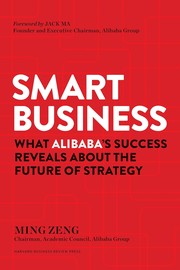
Smart Business: What Alibaba's Success Reveals about the Future of Strategy
Alibaba's former strategy chief on network coordination and data as strategy.
Insider account: Alibaba's chief strategy officer on platform design.
Summary
Zeng served as Alibaba's chief strategy officer and wrote this to generalise from what the company built into a theory of how businesses should be organised.
His two mechanisms are network coordination and data intelligence. Network coordination means the company organises a network of independent participants rather than performing activities inside its own boundaries. Taobao does not buy or sell products; it coordinates millions of merchants, payment providers, logistics firms, photographers, software developers and financing providers, each of which specialises. Data intelligence means the decisions inside that network are made by algorithms operating on data generated by the network's own activity, continuously and without human intervention: pricing, search ranking, credit decisions, inventory allocation and marketing spend are all set by machine.
His argument is that these two together produce what he calls smart business, and that the combination scales in a way that neither does alone. A network without automated decision-making cannot coordinate at scale. Automated decisions without a network have limited data and limited reach.
The operational implications he draws are specific. Business processes must be reconstructed so that every step generates machine-readable data, which he calls datafication. Decisions must be turned into algorithmic models with feedback loops. The firm's role changes from executing activities to setting the rules, incentives and infrastructure of the network. Strategy becomes about designing the network's architecture rather than about positioning.
The theory is derived from one company in one market and the generalisation is asserted. Zeng was an executive there, so the account presents Alibaba's structure as the outcome of design rather than of circumstance and competition. The book also predates the Chinese regulatory intervention that constrained platform companies from late 2020, which changed the environment the model depends on.
Key takeaways 7
- A platform coordinates independent specialised participants rather than performing the activities inside its own boundaries.
- Automated decision-making using data generated by the network's own activity is what allows coordination to scale beyond human management.
- Every business process must be redesigned to generate machine-readable data, or the decisions cannot be automated.
- The firm's role in a network business is to set rules, incentives and infrastructure rather than to execute transactions.
- Taobao's merchants are served by an ecosystem of specialised service providers that the platform enabled but does not own.
- Credit and pricing decisions made algorithmically on transaction data can serve customers that conventional underwriting cannot reach.
- Strategy in a network business means designing the architecture of participation rather than choosing a market position.
Who should read it
Founders and operators building platform or marketplace businesses who want a framework connecting network design to automated decision-making.
Similar books 6
Chosen by shared topics, the entries that hold them, and the people who recommended both.
How corporate governance brought down Nortel Networks, the Canadian technology firm.
“You may understand why I say this if you read the recent book on Nortel’s bankruptcy ‘‘100 Days: The rush to judgment that killed Nortel’’, by James Bagnall.” — Prem Watsa
Source: Chairman's Letter to Shareholders 2013, page 6
Recommended by: Mohnish Pabrai, Prem Watsa

An eyewitness account of how Ford and the American car industry undid themselves.
Recommended by: Mohnish Pabrai

The story of the Walgreens drugstore chain and the American history around it.
Recommended by: Mohnish Pabrai
How Alan Mulally turned Ford around and saved it without bankruptcy.
Recommended by: Mohnish Pabrai
How General Motors succeeded in China: its people, decisions and breaks.
Recommended by: Mohnish Pabrai

Aldi's hard-discount method: radical simplicity as the way to keep costs low.