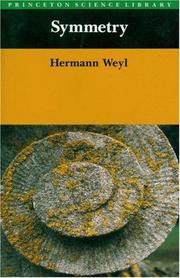
Symmetry
Symmetry in art, nature, mathematics and the sciences.
Summary
Hermann Weyl, one of the leading mathematicians of the twentieth century, surveys symmetry in mathematics, the sciences, nature and art. He begins with symmetry as harmony of proportions and moves step by step to its more abstract forms: bilateral, translatory, rotational, ornamental and crystallographic.
Weyl examines the use of symmetry in sculpture, painting, architecture, ornament and design, and its appearance in organic and inorganic nature, before setting out the general mathematical idea that underlies all these special forms and its philosophical significance. The text is supported by many illustrations. The chapters follow that progression from visible examples to the general abstract idea, with illustrations supporting each step. It was published in 1952, and Scientific American called it a masterful survey of the principle's applications in art, nature, philosophy and mathematics.
Key takeaways 4
- Symmetry begins as a sense of balanced proportion and extends to precise mathematical structure.
- Bilateral, translatory, rotational, ornamental and crystal symmetries are special cases of one idea.
- Art and architecture use the same symmetries that appear in living things and crystals.
- The abstract notion of symmetry has philosophical as well as mathematical meaning.
Who should read it
Readers with an interest in mathematics, science or art who want a great mathematician's short account of one unifying idea.
Who recommended it 1
Similar books 6
Chosen by shared topics, the entries that hold them, and the people who recommended both.
An elementary introduction to gauge theory in physics.
Recommended by: Eric Weinstein
A graduate reference on the analysis and geometry used in mathematical physics.
Recommended by: Eric Weinstein
General relativity presented for mathematicians.
Recommended by: Eric Weinstein
The textbook on Einstein's general theory of relativity.
Recommended by: Eric Weinstein
A graduate tutorial on superstring theory and its attempt to unify physics.
Recommended by: Eric Weinstein
Lectures that teach group theory and Lie algebras for use in particle physics.
Recommended by: Eric Weinstein