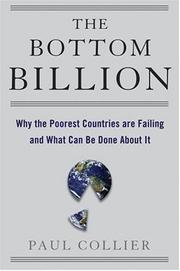
The Bottom Billion
Why about sixty poor countries are stuck, caught in traps such as conflict.
The four traps framework; the most cited analytic account of why growth fails to start.
Summary
Paul Collier, an Oxford development economist and former World Bank research director, argues that the development problem is no longer about poor countries generally. Most of the developing world has been converging on rich-country incomes; roughly a billion people live in about sixty countries that have not, and those countries are the actual problem.
His explanation is four traps, each supported by his own econometric work. The conflict trap: civil war destroys income and low income raises the probability of civil war, producing a cycle, and post-conflict countries have high relapse rates. The natural resource trap: resource revenues undermine governance, distort the exchange rate against other exports, and raise the value of capturing the state. The trap of being landlocked with bad neighbours: a landlocked country's growth depends on its neighbours' infrastructure and policy, which it cannot control. The trap of bad governance in a small country: reform requires a critical mass of educated people and a scale of market that small failing states lack.
His policy proposals go beyond aid: military intervention under specified conditions, international charters governing resource revenue, budget transparency and post-conflict conduct, trade preferences designed to help these countries specifically, and better-targeted aid. The book is written for a general audience and states its findings more confidently than the underlying econometrics support; Collier's methods have been criticised, particularly the identification in the conflict work. The framing of a distinct bottom group with specific structural problems has been widely adopted.
Key takeaways 7
- Most developing countries have been converging on rich-country incomes, and the development problem concerns the roughly sixty that have not.
- Civil war and low income cause each other, and post-conflict countries relapse at high rates.
- Resource revenues undermine governance and distort exchange rates against other exports, which is why resource-rich countries frequently grow slowly.
- Landlocked countries with poorly governed neighbours depend on infrastructure and policy they cannot influence.
- Small failing states lack the educated population and market scale that reform requires.
- Collier argues for instruments beyond aid, including conditional military intervention and international charters on resource revenue and budget transparency.
- Trade preferences designed for developing countries generally do not help the bottom group, which needs preferences targeted at it specifically.
Who should read it
Investors and policymakers working in frontier markets who want a structural diagnosis of why a specific group of countries has not converged.
Similar books 6
Chosen by shared topics, the entries that hold them, and the people who recommended both.
The case that aid has harmed Africa and that bond markets should replace it.
How Africa's GDP figures are produced, and why they are weaker than they look.
Recommended by: Bill Gates
Rich countries urge poor ones to adopt the opposite of the policies they once used.
How resource-rich developing countries can avoid the harm resource wealth brings.

How to do the most good with limited money: global problems ranked.
Recommended by: Bill Gates
The poor hold assets but lack the property records that turn them into capital.
Recommended by: Mohnish Pabrai, Marc Andreessen