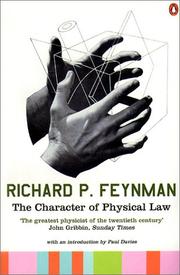
The Character of Physical Law
Seven lectures on the nature of the laws of physics.
Summary
Richard Feynman gave the Messenger Lectures at Cornell University in 1964, seven talks on the nature of the laws of physics. The BBC recorded them and published the book the following year; MIT Press reissued it in 2017 with a new foreword by Frank Wilczek.
The seven lectures cover the law of gravitation as an example of physical law, the relation of mathematics and physics, the great conservation principles, symmetry in physical law, the distinction between past and future, probability and uncertainty in the quantum-mechanical view of nature, and how new laws are found. Feynman also discusses how to reconcile physical problems that give infinite results with their real-world manifestations. His conversational style and simple pencil drawings carry the ideas. On finding new laws, he says the process begins with a guess. The Physics Teacher recommended the book to scientists and non-scientists alike, saying it was complete in itself even though it began as a companion to the recordings.
Key takeaways 4
- Physical laws are written in mathematics, and the relation between the two is itself a subject.
- Conservation principles and symmetries underlie the particular laws.
- Quantum mechanics replaces certainty with probability.
- New laws begin with a guess that is then tested against experiment.
Who should read it
General readers and students who want physics explained from first principles by Feynman.
Who recommended it 1 · 1 direct
Similar books 6
Chosen by shared topics, the entries that hold them, and the people who recommended both.
Whether the universe embodies beautiful ideas, from a Nobel physicist.
Recommended by: Patrick Collison
Answers to the Fermi paradox: why we have found no aliens.
Recommended by: Patrick Collison, Elon Musk
A popular account of the history, uses and interpretations of quantum mechanics.
Recommended by: Patrick Collison
The six numbers on which all physical reality rests, from atoms to human tissue.
Recommended by: Patrick Collison
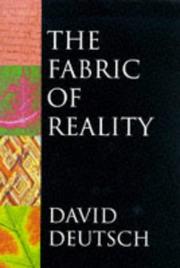
Reality through four strands: many-worlds physics, computation, evolution, Popper.
Recommended by: Naval Ravikant, Patrick Collison and 4 others
How string theory rose to dominate physics, and what happens if it is wrong.
Recommended by: Patrick Collison