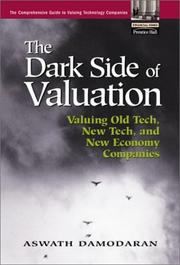
The Dark Side of Valuation
How to value companies where standard methods break down, from start-ups to tech.
Summary
Damodaran addresses valuation in the cases where standard methods break down: young companies with no history, technology companies whose assets are intangible, cyclical and commodity companies whose current earnings are meaningless, financial firms where debt is raw material, companies in emerging markets with unreliable data and unstable currencies, and distressed companies with a real probability of failure.
His approach in each case is to identify why the standard method fails and to adapt it rather than to abandon valuation. For young companies with no history, build the valuation from the total addressable market, an expected market share and a target operating margin, then work backward to the required revenue and reinvestment. For cyclical companies, normalise earnings across a full cycle rather than using current results. For financial firms, value the equity directly rather than the enterprise, since debt is an input to the business. For emerging markets, address country risk explicitly in the discount rate or the cash flows rather than in an arbitrary premium, and be consistent about currency. For distressed companies, value the going concern and then adjust for the probability of failure and the proceeds in that event, which the standard model implicitly assumes away.
His general position is that every valuation contains assumptions and the analyst's job is to make them explicit and defensible rather than to produce a number.
The editions were written after the technology bubble and updated afterwards. The examples date but the methods do not. It is technical and assumes familiarity with standard valuation.
Key takeaways 7
- Young companies with no history should be valued from total addressable market, expected share and target margin, working backward to required revenue and reinvestment.
- Cyclical and commodity companies must be valued on earnings normalised across a full cycle, since current earnings reflect only the cycle position.
- Financial firms require valuing equity directly rather than the enterprise, because debt is their raw material rather than a financing choice.
- Distressed companies require valuing the going concern and then adjusting explicitly for the probability of failure, which standard models assume away.
- Country risk in emerging market valuations should be addressed explicitly in the cash flows or the discount rate rather than through an arbitrary premium.
- Intangible-heavy companies require capitalising research and development, since accounting treats value-creating investment as an expense.
- Every valuation contains assumptions, and the analyst's task is to make them explicit and defensible rather than to produce a single number.
Who should read it
Analysts and investors valuing young, cyclical, distressed, financial or emerging market companies where standard methods fail.
About Aswath Damodaran
Kerschner Family Chair Professor of Finance, NYU Stern School of Business
His valuation textbooks and freely published datasets are the default reference used across academia, banking and investing.
Who recommended it 1 · 1 direct
Similar books 6
Chosen by shared topics, the entries that hold them, and the people who recommended both.
Advanced valuation for the cases where the standard methods break down.
“We adapted this from Aswath Damodaran, Damodaran on Valuation (New York: John Wiley & Sons, 1994), 56-58” — Michael Mauboussin
Source: M&M on Valuation, page 13
Recommended by: Michael Mauboussin
Why a valuation needs both a business story and numbers, and how to join them.
“Aswath Damodaran, Narrative and Numbers: The Value of Stories in Business (New York: Columbia Business School Publishing, 2017)” — Michael Mauboussin
Source: Trading Stages in the Company Life Cycle, page 18
Recommended by: Michael Mauboussin
Risk as a source of value: how firms measure it and take the risks they suit.
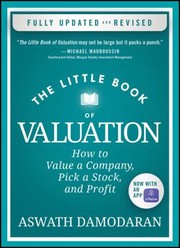
Intrinsic and relative valuation of stocks, explained for general readers.
Recommended by: Mohnish Pabrai
Corporate finance built around three decisions: investing, financing and dividends.
A full corporate finance textbook built around investing, financing and dividends.