Updates

  1. Person pages list letters, writing, profiles and links as sortable tables with filters, and show each person's companies as links; Fund letters show each letter's description in its own column.
  2. Experts show a checked job title and a short description of each person; 30 more people have photographs.
  3. Every company, fund, university and publication the experts work for has a page listing the people there.
  4. Fund letters show each letter's thesis and filter by it; 225 person pages list the essays, columns and newsletter issues the person wrote.
  5. Person pages list every essay and newsletter issue a person wrote, and their own books as a table in List view.
  6. Recommends shows the five largest kinds of book and the rest under More; browse pictures load sooner.
  7. Podcasts and talks link the original episode, filter by Audio and video or Press, and list each publisher once.
  8. Pages are wider, Recommends has List and Grid, and a filter clicked again turns off.
  9. Book cards sit in a ruled grid with Open Library and Goodreads links and each book's one-line note.
  10. Funds is now Investors; each investor's styles are buttons that filter the table.
  11. Podcasts and talks on a person's page filter by year and publisher and show as a list or a grid of pictures.
  12. Quotes show only people's own words: 472 summaries written by list sites are gone.
  13. Country pages open from Browse again, and every link on the shelf lands on a page.
  14. Subject and person pages show their sections as tabs, and each book appears once on a person's page.
  15. Book cards show the quote, who said it and the source; grids show five cards to a row.
  16. On a phone, a menu holds the sections, search, Updates, Feedback and dark mode.
  17. Feedback takes a screenshot of the page with no browser prompt, opens a screenshot full size when you click it, and clears itself once sent.
  18. Book cards are centred, search names the topic each book sits in, and any text cut short shows whole on hover.
  19. Search groups its results by kind: people, companies, geographies, subjects, topics, books, funds, fund letters and papers.
  20. The Books table lists who recommended each book by name, and the browser tab names the section you are in.
  21. Feedback can take a screenshot of the page, or one you paste or choose, and opens in the corner beside Updates.
  22. Each rail button reopens its section where you left it, and Browse, Table and People show on every book and subject page.
  23. Filters grey out choices that hold nothing instead of hiding them, and Books › People filters by authors or recommenders.
  24. Feedback takes a subject line and up to three screenshots.
  25. Biographies are grouped by the person they are about: 41 new pages, from Abraham Lincoln to Lee Kuan Yew.
  26. Sport splits into 23 sports, and Religion into one topic per faith.
  27. Book lists show as cards: the cover, one recommendation quote and every recommender by name.
  28. Seventeen subjects that had two or three pages under different names now have one page each.
  29. Every page lists its Experts as authors and recommenders, with a link to them on the Experts tab.
  30. Economics, Financial history, Financial panics and Accounting are subjects of their own, with one page per financial crisis.
  31. Book, person and subject pages open inside the app, so the tabs stay in view.
  32. 996 more book covers, and photographs or logos for 227 more people and companies.
  33. Books › Browse shows every subject as cards, and the rail holds Fund letters, Papers, Experts, Books and Funds.
  34. Every topic over 150 books splits into narrower topics, each with a page of its own.

Send feedback

What is it?
Screenshots, up to 3 (optional)
or paste one with Ctrl+V

We use your email only to reply to you.

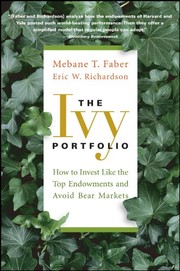
The Ivy Portfolio: How to Invest Like the To

The Ivy Portfolio: How to Invest Like the Top Endowments and Avoid Bear Markets

Meb Faber, Eric W. Richardson
2009
T3 240 pages · about 4h to read Open Librarygoodreads

Wiley. Confirmed on mebfaber.com/books

Summary

Faber and Richardson set out to reverse-engineer the investment approach of the Yale and Harvard endowments and to build a version an individual investor could implement.

The first part describes the endowment model as David Swensen developed it at Yale: heavy allocation to equity-like assets, substantial diversification across asset classes with low correlation, large positions in illiquid alternatives including private equity, venture capital, real assets and absolute return strategies, a very long time horizon, and the argument that the illiquidity premium is available to investors who genuinely do not need liquidity. The authors reconstruct the endowments' allocations from their public reports and from thirteen-F filings.

The second part is their implementable version. They argue that an individual cannot access top-quartile private managers and that the manager selection, not the asset allocation, is where the endowments' returns actually come from. Their substitute uses liquid exchange-traded funds across five asset classes: domestic equities, foreign equities, bonds, real estate and commodities, held in equal weight.

The third part is the timing model that the book became known for. They apply a simple rule: hold an asset class when its price is above its ten-month simple moving average and hold cash otherwise, evaluated monthly. They present long backtests showing that this rule produces returns similar to buy and hold with substantially lower drawdowns, because it exits during sustained declines. Faber published the underlying research separately as a widely circulated paper.

The timing rule's backtested performance depends heavily on the period tested, and its out-of-sample record since 2009 has been weaker, with whipsaw losses in choppy markets. The endowment model itself has also underperformed simple index portfolios for many institutions since publication, and the illiquidity premium argument is now contested.

Key takeaways 7

  1. The endowment model allocates heavily to equity-like and illiquid assets on the argument that a genuinely long horizon earns an illiquidity premium.
  2. The endowments' returns came substantially from access to top-quartile private managers, which individual investors cannot replicate.
  3. An equal-weight allocation across domestic equities, foreign equities, bonds, real estate and commodities approximates the diversification without the access.
  4. Holding an asset only when its price exceeds its ten-month moving average produced similar returns with much smaller drawdowns in backtests.
  5. The timing rule works by avoiding sustained declines, not by predicting them, and it necessarily lags at turning points.
  6. Trend-following rules suffer repeated small losses in markets that oscillate around the moving average without trending.
  7. Backtested timing results depend heavily on the period tested, and this rule's out-of-sample record has been weaker.

Who should read it

Individual investors and small institutions who want a liquid implementation of diversified allocation with an explicit drawdown-control rule, tested against its out-of-sample record.

About Meb Faber

Co-founder and Chief Investment Officer, Cambria Investment Management; host of The Meb Faber Show

A Quantitative Approach to Tactical Asset Allocation is one of the most downloaded papers on SSRN and his short books popularised trend following and global value for retail investors.

Cambria Investment Management

Similar books 6

Chosen by shared topics, the entries that hold them, and the people who recommended both.
Vitaliy N. Katsenelson · 2007

Katsenelson on buying and selling inside range-bound markets.
Adam Butler, Michael Philbrick, Rodrigo Gordillo · 2015

Rule-based momentum and volatility allocation, tested rather than asserted.
Russell Napier · 2005

What markets looked like at the US stock bottoms of 1921, 1932, 1949 and 1982.
Roger C. Gibson · 1990

How to divide a client's portfolio across asset classes to balance long-term risk.
Ted Seides · 2021

How institutional allocators select, size and monitor the managers they hire.

Campbell R. Harvey, Claude B. Erb, Tadas E. Viskanta · 1998

Research Foundation of the CFA Institute monograph.

Where it sits in the reference 3

Investors
Portfolio & risk
Portfolio & risk

Topics

Investing