Updates

  1. Person pages list letters, writing, profiles and links as sortable tables with filters, and show each person's companies as links; Fund letters show each letter's description in its own column.
  2. Experts show a checked job title and a short description of each person; 30 more people have photographs.
  3. Every company, fund, university and publication the experts work for has a page listing the people there.
  4. Fund letters show each letter's thesis and filter by it; 225 person pages list the essays, columns and newsletter issues the person wrote.
  5. Person pages list every essay and newsletter issue a person wrote, and their own books as a table in List view.
  6. Recommends shows the five largest kinds of book and the rest under More; browse pictures load sooner.
  7. Podcasts and talks link the original episode, filter by Audio and video or Press, and list each publisher once.
  8. Pages are wider, Recommends has List and Grid, and a filter clicked again turns off.
  9. Book cards sit in a ruled grid with Open Library and Goodreads links and each book's one-line note.
  10. Funds is now Investors; each investor's styles are buttons that filter the table.
  11. Podcasts and talks on a person's page filter by year and publisher and show as a list or a grid of pictures.
  12. Quotes show only people's own words: 472 summaries written by list sites are gone.
  13. Country pages open from Browse again, and every link on the shelf lands on a page.
  14. Subject and person pages show their sections as tabs, and each book appears once on a person's page.
  15. Book cards show the quote, who said it and the source; grids show five cards to a row.
  16. On a phone, a menu holds the sections, search, Updates, Feedback and dark mode.
  17. Feedback takes a screenshot of the page with no browser prompt, opens a screenshot full size when you click it, and clears itself once sent.
  18. Book cards are centred, search names the topic each book sits in, and any text cut short shows whole on hover.
  19. Search groups its results by kind: people, companies, geographies, subjects, topics, books, funds, fund letters and papers.
  20. The Books table lists who recommended each book by name, and the browser tab names the section you are in.
  21. Feedback can take a screenshot of the page, or one you paste or choose, and opens in the corner beside Updates.
  22. Each rail button reopens its section where you left it, and Browse, Table and People show on every book and subject page.
  23. Filters grey out choices that hold nothing instead of hiding them, and Books › People filters by authors or recommenders.
  24. Feedback takes a subject line and up to three screenshots.
  25. Biographies are grouped by the person they are about: 41 new pages, from Abraham Lincoln to Lee Kuan Yew.
  26. Sport splits into 23 sports, and Religion into one topic per faith.
  27. Book lists show as cards: the cover, one recommendation quote and every recommender by name.
  28. Seventeen subjects that had two or three pages under different names now have one page each.
  29. Every page lists its Experts as authors and recommenders, with a link to them on the Experts tab.
  30. Economics, Financial history, Financial panics and Accounting are subjects of their own, with one page per financial crisis.
  31. Book, person and subject pages open inside the app, so the tabs stay in view.
  32. 996 more book covers, and photographs or logos for 227 more people and companies.
  33. Books › Browse shows every subject as cards, and the rail holds Fund letters, Papers, Experts, Books and Funds.
  34. Every topic over 150 books splits into narrower topics, each with a page of its own.

Send feedback

What is it?
Screenshots, up to 3 (optional)
or paste one with Ctrl+V

We use your email only to reply to you.

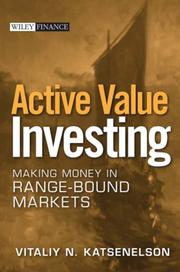
Active Value Investing

Active Value Investing

Vitaliy N. Katsenelson
2007
T3 304 pages · about 5h 4m to read Open Librarygoodreads

Katsenelson on buying and selling inside range-bound markets.

Summary

Katsenelson, a money manager at Investment Management Associates, argues that long secular bull markets are followed not by bear markets but by extended range-bound markets, and that the strategy appropriate to a range-bound market differs from buy and hold.

The historical claim comes from examining American equity market history in long segments. He identifies periods such as 1966 to 1982 and 1937 to 1950 where the index went essentially nowhere for many years while experiencing large swings within the range. His explanation is valuation rather than earnings: secular bull markets end at high price-to-earnings multiples, and the subsequent period consists of earnings growing while multiples contract, which produces flat prices. He argued in 2007 that the market was in such a period, having peaked on valuation in 2000.

The strategy he proposes is what he calls active value investing: buy quality companies when they are cheap within the range and sell them when they approach fair value rather than holding indefinitely, because in a range-bound market the multiple expansion that rewards holding does not arrive. He sets out a framework he abbreviates as quality, valuation and growth, requiring high returns on capital, competitive position and balance sheet strength on the quality side, an explicit valuation discipline with a sell target, and growth assessed conservatively. He is explicit that this raises turnover and tax cost relative to buy and hold and argues that the range-bound environment justifies it.

The framework's central prediction was reasonable when written and the period from 2000 to 2013 fits it. The subsequent decade, in which multiples expanded again and buy and hold outperformed active selling, does not. The book also does not resolve how an investor identifies which regime they are in except after the fact, which is the binding practical problem.

Key takeaways 7

  1. Secular bull markets are followed by extended range-bound markets rather than by sharp bear markets.
  2. Range-bound markets occur because earnings continue to grow while valuation multiples contract from a high starting point.
  3. Buy and hold underperforms in a range-bound market because the multiple expansion that rewards patience does not occur.
  4. An investor in a range-bound market should set explicit sell targets and act on them rather than holding for the long term.
  5. Quality, meaning high return on capital and balance sheet strength, protects against the drawdowns that range-bound markets produce.
  6. The starting valuation of a market predicts its long-run return more reliably than any forecast of economic growth.
  7. Higher turnover imposes tax and transaction costs that the strategy must overcome, so it suits taxable investors poorly.

Who should read it

Investors who want a valuation-driven framework for markets that go sideways for a decade, with the caveat that regime identification remains unsolved.

Similar books 6

Chosen by shared topics, the entries that hold them, and the people who recommended both.
Howard Marks · 2018

Cycles can't be timed, but knowing where you stand in one lets you adjust risk.

Lars Tvede · 1997

The history of business cycle theory and how credit cycles drive asset prices.

Vitaliy N. Katsenelson · 2010

Shorter restatement of active value investing for flat markets.

Recommended by: Mohnish Pabrai
Howard Marks · 2012

Second-level thinking on risk and cycles, with notes by Klarman and Greenblatt.

“…books I've recommended, highlighted to death, or forced on friends.” — Andrew Wilkinson

Source: Andrew Wilkinson's Bookshelf, neverenough.com

Recommended by: Andrew Wilkinson, Mohnish Pabrai and 3 others
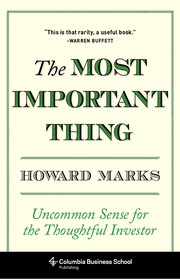
Howard Marks · 2011

Second-level thinking, risk and market cycles, drawn from Oaktree's client memos.

Thomas P. Au · 2004

Updates Graham and Dodd's valuation method for modern financial statements

Recommended by: Mohnish Pabrai

Where it sits in the reference 3

Portfolio & risk
Investment styles
Mental models

Topics

Investing