Updates

  1. Person pages list letters, writing, profiles and links as sortable tables with filters, and show each person's companies as links; Fund letters show each letter's description in its own column.
  2. Experts show a checked job title and a short description of each person; 30 more people have photographs.
  3. Every company, fund, university and publication the experts work for has a page listing the people there.
  4. Fund letters show each letter's thesis and filter by it; 225 person pages list the essays, columns and newsletter issues the person wrote.
  5. Person pages list every essay and newsletter issue a person wrote, and their own books as a table in List view.
  6. Recommends shows the five largest kinds of book and the rest under More; browse pictures load sooner.
  7. Podcasts and talks link the original episode, filter by Audio and video or Press, and list each publisher once.
  8. Pages are wider, Recommends has List and Grid, and a filter clicked again turns off.
  9. Book cards sit in a ruled grid with Open Library and Goodreads links and each book's one-line note.
  10. Funds is now Investors; each investor's styles are buttons that filter the table.
  11. Podcasts and talks on a person's page filter by year and publisher and show as a list or a grid of pictures.
  12. Quotes show only people's own words: 472 summaries written by list sites are gone.
  13. Country pages open from Browse again, and every link on the shelf lands on a page.
  14. Subject and person pages show their sections as tabs, and each book appears once on a person's page.
  15. Book cards show the quote, who said it and the source; grids show five cards to a row.
  16. On a phone, a menu holds the sections, search, Updates, Feedback and dark mode.
  17. Feedback takes a screenshot of the page with no browser prompt, opens a screenshot full size when you click it, and clears itself once sent.
  18. Book cards are centred, search names the topic each book sits in, and any text cut short shows whole on hover.
  19. Search groups its results by kind: people, companies, geographies, subjects, topics, books, funds, fund letters and papers.
  20. The Books table lists who recommended each book by name, and the browser tab names the section you are in.
  21. Feedback can take a screenshot of the page, or one you paste or choose, and opens in the corner beside Updates.
  22. Each rail button reopens its section where you left it, and Browse, Table and People show on every book and subject page.
  23. Filters grey out choices that hold nothing instead of hiding them, and Books › People filters by authors or recommenders.
  24. Feedback takes a subject line and up to three screenshots.
  25. Biographies are grouped by the person they are about: 41 new pages, from Abraham Lincoln to Lee Kuan Yew.
  26. Sport splits into 23 sports, and Religion into one topic per faith.
  27. Book lists show as cards: the cover, one recommendation quote and every recommender by name.
  28. Seventeen subjects that had two or three pages under different names now have one page each.
  29. Every page lists its Experts as authors and recommenders, with a link to them on the Experts tab.
  30. Economics, Financial history, Financial panics and Accounting are subjects of their own, with one page per financial crisis.
  31. Book, person and subject pages open inside the app, so the tabs stay in view.
  32. 996 more book covers, and photographs or logos for 227 more people and companies.
  33. Books › Browse shows every subject as cards, and the rail holds Fund letters, Papers, Experts, Books and Funds.
  34. Every topic over 150 books splits into narrower topics, each with a page of its own.

Send feedback

What is it?
Screenshots, up to 3 (optional)
or paste one with Ctrl+V

We use your email only to reply to you.

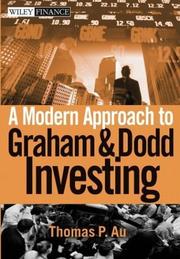
A Modern Approach to Graham and Dodd Investi

A Modern Approach to Graham and Dodd Investing

Thomas P. Au
2004
T3 352 pages · about 5h 52m to read Open Librarygoodreads

Updates Graham and Dodd's valuation method for modern financial statements

Summary

Au, a portfolio manager, updates the Graham and Dodd framework for markets in which most companies have few tangible assets and where the original net current asset screens produce almost no candidates.

His approach retains the Graham foundations of intrinsic value, margin of safety and treating market price as separate from value, and adds methods for handling growth companies and intangible-heavy businesses. He works through dividend discount and earnings power valuation, the use of sustainable growth rates derived from return on equity and retention ratios, and a set of adjustments intended to make balance sheet analysis useful for companies whose assets are not physical. He also covers economic cycle positioning, arguing that Graham and Dodd's criteria should be applied differently at different points in a cycle, and includes material on international and emerging market application.

The reference has not verified the specific screens, thresholds and case examples in this book. It is a practitioner's adaptation rather than a work with an established following, and it should be read alongside rather than instead of the original Security Analysis or of Greenwald's Value Investing, which addresses the same problem of adapting Graham's framework to modern balance sheets with more rigour and a clearer method. Au's contribution is the attempt to make the classical criteria operational for a market Graham would not recognise.

Key takeaways 7

  1. Graham's net current asset screens produce almost no candidates in modern markets, which requires adapting the criteria rather than abandoning the framework.
  2. Intrinsic value, margin of safety and separating price from value remain applicable regardless of how a company's assets are composed.
  3. Sustainable growth derived from return on equity and the retention ratio constrains what growth assumption a valuation can defensibly use.
  4. Balance sheet analysis requires adjustment for companies whose principal assets are intangible and therefore not recorded.
  5. Valuation criteria should be applied differently at different points in the economic cycle, since the same multiple means different things at different stages.
  6. An investor should be able to state the specific assumption on which their valuation depends and what would refute it.
  7. The reference has not verified the specific screens and thresholds this book proposes.

Who should read it

Value investors interested in adapting Graham's criteria to intangible-heavy businesses, read alongside Greenwald's more rigorous treatment of the same problem.

Who recommended it 1

Similar books 6

Chosen by shared topics, the entries that hold them, and the people who recommended both.
Benjamin Graham, David L. Dodd · 1934

How to read financial statements sceptically and value bonds and stocks.

“I've spent more time with all of the editions of Benjamin Graham and David Dodd's Security Analysis than with any other book” — Christopher Bloomstran

Source: Semper Augustus 2024 Letter to Clients, 'Books and Tunes for Walking', p. 95

Recommended by: Christopher Bloomstran, Howard Marks and 11 others
Warren Buffett, Lawrence A. Cunningham · 1997

Berkshire's shareholder letters arranged by topic: governance, valuation, mergers.

“The resource is as valuable as Larry Cunningham's The Essays of Warren Buffett, which similarly organizes by subject matter” — Christopher Bloomstran

Source: Semper Augustus 2024 Letter to Clients, 'Books and Tunes for Walking', p. 96

Recommended by: Christopher Bloomstran, Francois Rochon and 11 others
Philip L. Carret, Philip Carret · 1995

A fund manager of sixty years on investing, business and a long life.

Recommended by: Mohnish Pabrai
Burton G. Malkiel · 1973

Stock prices follow a random walk, so a low-cost index fund beats stock picking.

Recommended by: Nat Eliason, Mohnish Pabrai

Where it sits in the reference 2

Investment styles
Accounting

Topics

Investing