Updates

  1. Person pages list letters, writing, profiles and links as sortable tables with filters, and show each person's companies as links; Fund letters show each letter's description in its own column.
  2. Experts show a checked job title and a short description of each person; 30 more people have photographs.
  3. Every company, fund, university and publication the experts work for has a page listing the people there.
  4. Fund letters show each letter's thesis and filter by it; 225 person pages list the essays, columns and newsletter issues the person wrote.
  5. Person pages list every essay and newsletter issue a person wrote, and their own books as a table in List view.
  6. Recommends shows the five largest kinds of book and the rest under More; browse pictures load sooner.
  7. Podcasts and talks link the original episode, filter by Audio and video or Press, and list each publisher once.
  8. Pages are wider, Recommends has List and Grid, and a filter clicked again turns off.
  9. Book cards sit in a ruled grid with Open Library and Goodreads links and each book's one-line note.
  10. Funds is now Investors; each investor's styles are buttons that filter the table.
  11. Podcasts and talks on a person's page filter by year and publisher and show as a list or a grid of pictures.
  12. Quotes show only people's own words: 472 summaries written by list sites are gone.
  13. Country pages open from Browse again, and every link on the shelf lands on a page.
  14. Subject and person pages show their sections as tabs, and each book appears once on a person's page.
  15. Book cards show the quote, who said it and the source; grids show five cards to a row.
  16. On a phone, a menu holds the sections, search, Updates, Feedback and dark mode.
  17. Feedback takes a screenshot of the page with no browser prompt, opens a screenshot full size when you click it, and clears itself once sent.
  18. Book cards are centred, search names the topic each book sits in, and any text cut short shows whole on hover.
  19. Search groups its results by kind: people, companies, geographies, subjects, topics, books, funds, fund letters and papers.
  20. The Books table lists who recommended each book by name, and the browser tab names the section you are in.
  21. Feedback can take a screenshot of the page, or one you paste or choose, and opens in the corner beside Updates.
  22. Each rail button reopens its section where you left it, and Browse, Table and People show on every book and subject page.
  23. Filters grey out choices that hold nothing instead of hiding them, and Books › People filters by authors or recommenders.
  24. Feedback takes a subject line and up to three screenshots.
  25. Biographies are grouped by the person they are about: 41 new pages, from Abraham Lincoln to Lee Kuan Yew.
  26. Sport splits into 23 sports, and Religion into one topic per faith.
  27. Book lists show as cards: the cover, one recommendation quote and every recommender by name.
  28. Seventeen subjects that had two or three pages under different names now have one page each.
  29. Every page lists its Experts as authors and recommenders, with a link to them on the Experts tab.
  30. Economics, Financial history, Financial panics and Accounting are subjects of their own, with one page per financial crisis.
  31. Book, person and subject pages open inside the app, so the tabs stay in view.
  32. 996 more book covers, and photographs or logos for 227 more people and companies.
  33. Books › Browse shows every subject as cards, and the rail holds Fund letters, Papers, Experts, Books and Funds.
  34. Every topic over 150 books splits into narrower topics, each with a page of its own.

Send feedback

What is it?
Screenshots, up to 3 (optional)
or paste one with Ctrl+V

We use your email only to reply to you.

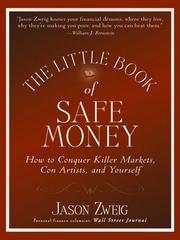
The Little Book of Safe Money

The Little Book of Safe Money

Jason Zweig
2009
T4 230 pages · about 3h 50m to read Open Librarygoodreads

Summary

Zweig, a financial journalist and later the editor of the revised Intelligent Investor, wrote this in the aftermath of 2008 to argue that most products sold as safe are not. His method is to take each supposedly conservative choice and examine how it actually behaved when stressed.

He covers money market funds that broke the buck, auction rate securities that stopped auctioning, ultra-short bond funds that held mortgage paper, structured notes with principal protection that depended on the issuer's solvency, commodity exchange-traded funds whose returns diverged from spot prices because of futures roll costs, and hedge fund replication products. He also examines annuities, arguing that a plain immediate annuity is useful for guaranteeing lifetime income while variable annuities with riders are usually not worth their fees.

The positive recommendations are conventional and defensible: hold genuine cash in insured deposits or Treasury funds, use Treasury inflation-protected securities for inflation risk, keep costs low, size positions so that a total loss in any one is survivable, and separate the money you cannot afford to lose from the money you can.

The book is a product of its moment and some specifics have aged. Interest rates, annuity pricing and the exchange-traded fund market have all changed substantially since 2009. The general method, which is to ask what a product holds and who bears the loss when it fails, has not.

Key takeaways 7

  1. Products marketed as cash equivalents frequently hold credit risk that only appears when markets stop functioning.
  2. Commodity exchange-traded funds track futures curves rather than spot prices, so they can lose money while the commodity rises.
  3. Principal protection in a structured note is only as good as the credit of the bank that issued it.
  4. A plain immediate annuity is a defensible way to insure longevity risk, while variable annuities with riders usually are not.
  5. Reaching for a slightly higher yield in a cash account has repeatedly produced losses far larger than the extra yield.
  6. Investors should size every position so that losing all of it would not change their life.
  7. Inflation-protected Treasury securities are the only instrument that directly hedges inflation for a retail investor.

Who should read it

Individual investors and anyone advising them who needs a checklist for interrogating conservative-sounding products before buying them.

About Jason Zweig

Columnist, 'The Intelligent Investor', The Wall Street Journal; previously Money, Time and Forbes

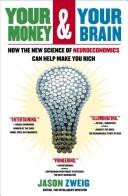
Your Money and Your Brain brought neuroeconomics to a general investing audience, and his annotated edition of Benjamin Graham keeps a canonical text usable for modern readers.

The Wall Street Journal, Money, Time, Forbes

Who recommended it 1 · 1 direct

Similar books 6

Chosen by shared topics, the entries that hold them, and the people who recommended both.
Jason Zweig · 2007

Neuroscience of investing decisions, written by Graham's modern editor.

Recommended by: Mohnish Pabrai
Where it sits in the reference 1

Journalists

Topics

Finance and MarketsProductivity and HabitsPersonal finance and money habits