Updates

  1. Person pages list letters, writing, profiles and links as sortable tables with filters, and show each person's companies as links; Fund letters show each letter's description in its own column.
  2. Experts show a checked job title and a short description of each person; 30 more people have photographs.
  3. Every company, fund, university and publication the experts work for has a page listing the people there.
  4. Fund letters show each letter's thesis and filter by it; 225 person pages list the essays, columns and newsletter issues the person wrote.
  5. Person pages list every essay and newsletter issue a person wrote, and their own books as a table in List view.
  6. Recommends shows the five largest kinds of book and the rest under More; browse pictures load sooner.
  7. Podcasts and talks link the original episode, filter by Audio and video or Press, and list each publisher once.
  8. Pages are wider, Recommends has List and Grid, and a filter clicked again turns off.
  9. Book cards sit in a ruled grid with Open Library and Goodreads links and each book's one-line note.
  10. Funds is now Investors; each investor's styles are buttons that filter the table.
  11. Podcasts and talks on a person's page filter by year and publisher and show as a list or a grid of pictures.
  12. Quotes show only people's own words: 472 summaries written by list sites are gone.
  13. Country pages open from Browse again, and every link on the shelf lands on a page.
  14. Subject and person pages show their sections as tabs, and each book appears once on a person's page.
  15. Book cards show the quote, who said it and the source; grids show five cards to a row.
  16. On a phone, a menu holds the sections, search, Updates, Feedback and dark mode.
  17. Feedback takes a screenshot of the page with no browser prompt, opens a screenshot full size when you click it, and clears itself once sent.
  18. Book cards are centred, search names the topic each book sits in, and any text cut short shows whole on hover.
  19. Search groups its results by kind: people, companies, geographies, subjects, topics, books, funds, fund letters and papers.
  20. The Books table lists who recommended each book by name, and the browser tab names the section you are in.
  21. Feedback can take a screenshot of the page, or one you paste or choose, and opens in the corner beside Updates.
  22. Each rail button reopens its section where you left it, and Browse, Table and People show on every book and subject page.
  23. Filters grey out choices that hold nothing instead of hiding them, and Books › People filters by authors or recommenders.
  24. Feedback takes a subject line and up to three screenshots.
  25. Biographies are grouped by the person they are about: 41 new pages, from Abraham Lincoln to Lee Kuan Yew.
  26. Sport splits into 23 sports, and Religion into one topic per faith.
  27. Book lists show as cards: the cover, one recommendation quote and every recommender by name.
  28. Seventeen subjects that had two or three pages under different names now have one page each.
  29. Every page lists its Experts as authors and recommenders, with a link to them on the Experts tab.
  30. Economics, Financial history, Financial panics and Accounting are subjects of their own, with one page per financial crisis.
  31. Book, person and subject pages open inside the app, so the tabs stay in view.
  32. 996 more book covers, and photographs or logos for 227 more people and companies.
  33. Books › Browse shows every subject as cards, and the rail holds Fund letters, Papers, Experts, Books and Funds.
  34. Every topic over 150 books splits into narrower topics, each with a page of its own.

Send feedback

What is it?
Screenshots, up to 3 (optional)
or paste one with Ctrl+V

We use your email only to reply to you.

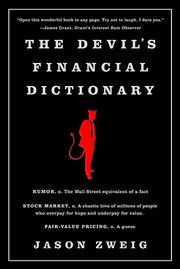
The Devil's Financial Dictionary

The Devil's Financial Dictionary

Jason Zweig
2015
T4 256 pages · about 4h 16m to read Open Librarygoodreads

Summary

Jason Zweig, who writes the Intelligent Investor column for the Wall Street Journal, produced this in the form of Ambrose Bierce's Devil's Dictionary: satirical definitions of financial terms. The satire carries real content.

Each entry states what a term is claimed to mean and then what it means in practice, and many include genuine etymology and market history. Zweig traces words back to their origins, frequently showing that a term now used as marketing began as a description of something disreputable. The definitions accumulate into a coherent position: that the financial industry's vocabulary exists substantially to conceal costs, to make ordinary outcomes sound like skill, and to persuade clients to transact.

His recurring targets are fees and their presentation, the language of forecasting and its false precision, the reclassification of risk as opportunity, the marketing of complexity, and the conflation of activity with value. The book is short, funny and quotable, and it is more useful than most straightforward investment books because the definitions are memorable in a way that arguments are not. It is not a reference and does not teach finance; it teaches scepticism about a vocabulary.

Key takeaways 7

  1. Financial vocabulary is constructed substantially to conceal costs and to make ordinary outcomes appear to be the result of skill.
  2. Many respectable financial terms began as descriptions of disreputable practices and were rehabilitated by usage.
  3. Forecasts are presented with a precision that their accuracy has never justified.
  4. Complexity in a financial product usually exists to prevent the buyer from computing what they are paying.
  5. Activity in a portfolio is presented as value creation and is more reliably a source of cost.
  6. Zweig argues that a term describing risk as opportunity is doing marketing rather than analysis.
  7. The industry's language treats the investor's money and the manager's money as though the interests attached to each were the same.

Who should read it

Investors who want a memorable inoculation against financial marketing language, and anyone who enjoys etymology attached to a serious point.

About Jason Zweig

Columnist, 'The Intelligent Investor', The Wall Street Journal; previously Money, Time and Forbes

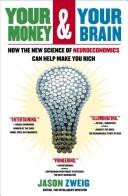
Your Money and Your Brain brought neuroeconomics to a general investing audience, and his annotated edition of Benjamin Graham keeps a canonical text usable for modern readers.

The Wall Street Journal, Money, Time, Forbes

Similar books 6

Chosen by shared topics, the entries that hold them, and the people who recommended both.

Jason Zweig · 2009

How 'safe' products, from money funds to principal-protected notes, failed in 2008.

Recommended by: Mohnish Pabrai
Jason Zweig · 2007

Neuroscience of investing decisions, written by Graham's modern editor.

Recommended by: Mohnish Pabrai

Jack D. Schwager · 1984

Second edition 2017 with Mark Etzkorn, titled A Complete Guide to the Futures Market.

Frank J. Fabozzi · 1989

The standard text on bonds: instruments, valuation, risk and portfolio strategy.

Edward I. Altman, Edith Hotchkiss · 1993

Predicting corporate failure with models like the Z-score, and how bankruptcy works.

Where it sits in the reference 1

Journalists

Topics

InvestingFinance and MarketsReference WorksFinance, accounting and economics referencesPersonal finance and money habitsProductivity and Habits