Updates

  1. Every US-listed company has a page with its SEC filings. Company pages list their experts and their management, past and present. Fund managers sit under Investors. Each show has a page of its episodes, and an episode page names its guests and hosts. Biographies lists groups, then people. Breadcrumbs show where a page sits.
  2. Media lists every podcast episode, video, interview and talk, over 10,000, by person, company, publisher and event; each filter searches its own choices. Books opens on its table, then Browse, then Authors and Recommenders. A filter's count no longer covers its arrow.
  3. A book that no company, country or subject page lists shows its topics under Where it sits in the reference. On a phone, a page's tabs scroll sideways only. Descriptions read the same on every page. See them in the Experts tab lists every expert the page names.
  4. Every podcast episode, video and interview has its own page with a video or audio player and a link to the source. Investor pages show each company's sector and market cap; firms such as Berkshire Hathaway have one page that holds their letters and their company tabs. Letters tabs filter by company and search the theses. Companies filter by Public, Private and Defunct and link each company's website.
  5. Every tab, view and search has its own address, such as /books/table/asset or /letters/companies, so Back works and a link opens the same place. Page addresses no longer end in .html. Fund letters, Investors, Companies and Papers load about a fifth of the data they did.
  6. Fund letters has a Companies tab: every company the letters name, with its market cap, sector, country, and how many letters and investors name it. Investor pages link each investor's website. Lists in table cells end with “… and N more” at every width.
  7. 1,120 more book summaries; descriptions for 373 papers; pages for 137 more companies, each with the fund letters that discuss it; 215 official photographs; search has its own page.
  8. 411 more books have a summary; person pages list 930 more of the books they wrote; 147 people show their official photograph.
  9. Every investor has a page with its letters and the companies they discuss; company pages list the investors whose letters name them.
  10. A Companies section at the top of the rail lists every company the books, experts and fund letters name.
  11. Person pages list letters, writing, profiles and links as sortable tables with filters, and show each person's companies as links; Fund letters show each letter's description in its own column.
  12. Experts show a checked job title and a short description of each person; 30 more people have photographs.
  13. Every company, fund, university and publication the experts work for has a page listing the people there.
  14. Fund letters show each letter's thesis and filter by it; 225 person pages list the essays, columns and newsletter issues the person wrote.
  15. Person pages list every essay and newsletter issue a person wrote, and their own books as a table in List view.
  16. Recommends shows the five largest kinds of book and the rest under More; browse pictures load sooner.
  17. Podcasts and talks link the original episode, filter by Audio and video or Press, and list each publisher once.
  18. Pages are wider, Recommends has List and Grid, and a filter clicked again turns off.
  19. Book cards sit in a ruled grid with Open Library and Goodreads links and each book's one-line note.
  20. Funds is now Investors; each investor's styles are buttons that filter the table.
  21. Podcasts and talks on a person's page filter by year and publisher and show as a list or a grid of pictures.
  22. Quotes show only people's own words: 472 summaries written by list sites are gone.
  23. Country pages open from Browse again, and every link on the shelf lands on a page.
  24. Subject and person pages show their sections as tabs, and each book appears once on a person's page.
  25. Book cards show the quote, who said it and the source; grids show five cards to a row.
  26. On a phone, a menu holds the sections, search, Updates, Feedback and dark mode.
  27. Feedback takes a screenshot of the page with no browser prompt, opens a screenshot full size when you click it, and clears itself once sent.
  28. Book cards are centred, search names the topic each book sits in, and any text cut short shows whole on hover.
  29. Search groups its results by kind: people, companies, geographies, subjects, topics, books, funds, fund letters and papers.
  30. The Books table lists who recommended each book by name, and the browser tab names the section you are in.
  31. Feedback can take a screenshot of the page, or one you paste or choose, and opens in the corner beside Updates.
  32. Each rail button reopens its section where you left it, and Browse, Table and People show on every book and subject page.
  33. Filters grey out choices that hold nothing instead of hiding them, and Books › People filters by authors or recommenders.
  34. Feedback takes a subject line and up to three screenshots.
  35. Biographies are grouped by the person they are about: 41 new pages, from Abraham Lincoln to Lee Kuan Yew.
  36. Sport splits into 23 sports, and Religion into one topic per faith.
  37. Book lists show as cards: the cover, one recommendation quote and every recommender by name.
  38. Seventeen subjects that had two or three pages under different names now have one page each.
  39. Every page lists its Experts as authors and recommenders, with a link to them on the Experts tab.
  40. Economics, Financial history, Financial panics and Accounting are subjects of their own, with one page per financial crisis.
  41. Book, person and subject pages open inside the app, so the tabs stay in view.
  42. 996 more book covers, and photographs or logos for 227 more people and companies.
  43. Books › Browse shows every subject as cards, and the rail holds Fund letters, Papers, Experts, Books and Funds.
  44. Every topic over 150 books splits into narrower topics, each with a page of its own.

Send feedback

What is it?
Screenshots, up to 3 (optional)
or paste one with Ctrl+V

We use your email only to reply to you.

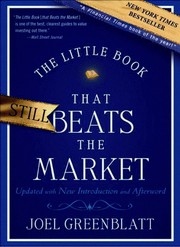
The Little Book That Still Beats the Market

The Little Book That Still Beats the Market

The magic formula: buy cheap stocks with high returns on capital, mechanically.

Joel Greenblatt
2010
T2 196 pages · about 3h 16m to read Open Librarygoodreads

Revised and updated edition of the 2005 book.

Summary

Greenblatt presents what he calls the magic formula, a mechanical stock selection method using two variables: return on capital, calculated as earnings before interest and taxes divided by net working capital plus net fixed assets, and earnings yield, calculated as earnings before interest and taxes divided by enterprise value. Companies are ranked on each measure separately, the ranks are combined, and the top-ranked companies are purchased.

The reasoning is that return on capital identifies good businesses and earnings yield identifies cheap ones, and that buying good businesses at cheap prices produces returns above the market. He reports backtested returns of around thirty percent annually from 1988 to 2004 against a market return around twelve percent.

The book is written for a non-professional reader in deliberately simple language, and Greenblatt explains why the method should continue to work: it underperforms for extended periods, sometimes several years in a row, which causes most investors to abandon it, and this is what prevents the returns from being competed away. He includes specific implementation instructions covering how many positions to hold, the annual turnover, the tax treatment of gains and losses, and the exclusion of financial companies and utilities where the calculations do not apply.

The backtested results have been challenged on survivorship bias, on the treatment of small companies with limited liquidity, and on transaction costs. Live results since publication have been substantially weaker than the backtest. The two-factor combination is a version of quality and value factors that academic finance had already documented. The argument about why a mechanical method survives, because investors will not hold it through underperformance, is the most durable part.

Key takeaways 8

  1. The method ranks companies on return on capital and on earnings yield, combines the ranks and buys the top-ranked names.
  2. Return on capital identifies businesses that convert capital into earnings efficiently, and earnings yield identifies businesses priced cheaply relative to those earnings.
  3. Buying good businesses at cheap prices is the whole of the argument, stated mechanically so that judgment is removed.
  4. The method underperforms for years at a time, which is what causes investors to abandon it and what prevents the returns from being arbitraged away.
  5. Enterprise value rather than market capitalisation is the correct denominator, because it accounts for debt and cash.
  6. Financial companies and utilities must be excluded, since the calculations do not apply to their balance sheets.
  7. A mechanical approach held consistently outperforms discretionary decisions for investors who cannot do sustained fundamental work.
  8. Live results since publication have been substantially weaker than the reported backtest, which readers should weigh against the historical figures.

Who should read it

Individual investors wanting a mechanical value method they can apply without fundamental analysis, with the backtest treated sceptically.

About Joel Greenblatt

Founder of Gotham Capital (1985) and Managing Principal of Gotham Asset Management; long-time adjunct professor at Columbia Business School

You Can Be a Stock Market Genius is the standard text on special-situations investing, and the Magic Formula books turned quantitative value into a method ordinary investors can follow.

Who recommended it 3 · 2 direct

Similar books 6

Chosen by shared topics, the entries that hold them, and the people who recommended both.
Peter Lynch, John Rothchild · 1989

The amateur's edge argument from the Magellan record.

“I strongly recommend all of Peter Lynch's book esp. this one and One up on Wall Street.” — Mohnish Pabrai

Source: Mohnish's Bookshelf — Books on Investing & Capital Allocation, entry 26

Recommended by: David Rolfe, Francisco Garcia Parames and 9 others
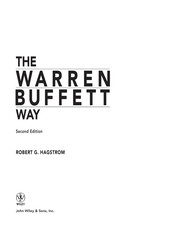
Robert G. Hagstrom · 1994

Buffett's method as tests of the business, its managers, its finances and price.

Philip Fisher · 1958

Buy a few outstanding growth companies, research them by scuttlebutt, and hold.

“if you read Philip Fisher's book, Common Stocks and Uncommon Profits, which is a terrific read, the scuttlebutt is good” — Mohnish Pabrai

Source: Mohnish Pabrai's Q&A Session with Francis Chou at Harvard University, April 7, 2020

Recommended by: Arnold Van Den Berg, Bill Stewart and 10 others
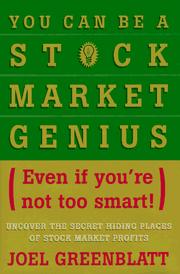
Joel Greenblatt · 1997

Where to find mispriced stocks: spinoffs, mergers, bankruptcies and restructurings.

Tobias E. Carlisle · 2014

Traces the method from Graham through Icahn to the acquirer's multiple.

Pat Dorsey · 2008

How to spot a durable economic moat from public information, and what isn't one.

Recommended by: Mohnish Pabrai

Where it sits in the reference 5

Investors
Investment styles
Investment styles
Investment styles
Investment styles

Topics 1

Investing