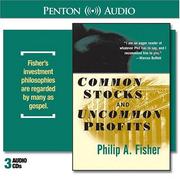
Common Stocks and Uncommon Profits
Buy a few outstanding growth companies, research them by scuttlebutt, and hold.
Later reissued with the three shorter works as Collected Works.
Summary
Fisher argues for buying a small number of outstanding growth companies and holding them for very long periods, which was a direct alternative to the statistical bargain-hunting that dominated when he published in 1958. He was a working investment counsellor in San Francisco from 1931, and the method comes from his own practice.
The operational core is the scuttlebutt method. Fisher argues that the information needed to assess a company comes from talking to its customers, suppliers, competitors, former employees and trade association people, and that the picture assembled this way is more reliable than what appears in financial statements. He gives fifteen points to look for in a company, covering the market for its products, the research effort, the sales organisation, profit margins, labour and executive relations, depth of management, accounting controls, the long-range outlook on profits, future equity dilution, and the honesty of management with shareholders when things go wrong.
He also gives three reasons to sell, which are that the original purchase was a mistake, that the company no longer meets the fifteen points, or that a clearly better opportunity exists. He rejects selling because a stock has risen, because the market looks high, or because of expected recessions. His view on dividends is that a company able to reinvest at high returns should retain earnings.
The book is short and repetitive in places, and the examples are anonymised, which weakens them. Scuttlebutt is harder now under disclosure regulations that restrict what company insiders can tell an investor. The fifteen points remain the best published checklist for qualitative business assessment, and Buffett has said his approach is part Graham and part Fisher.
Key takeaways 8
- An investor should hold a small number of outstanding companies rather than many adequate ones, because the research required to know a business well limits how many anyone can follow.
- The most reliable information about a company comes from its customers, suppliers, competitors and former employees rather than from its reports.
- A company worth owning must have products with several years of sales growth ahead and a management committed to developing the next generation of products.
- Management honesty toward shareholders when results disappoint is a testable trait and a necessary condition for ownership.
- Depth of management matters more than the quality of any individual executive, because a company dependent on one person cannot compound for decades.
- An investor should sell only when the original analysis was wrong, when the company deteriorates, or when a clearly superior opportunity appears, and never because the price has risen.
- Retained earnings are preferable to dividends when the company can reinvest them at high rates of return.
- Buying a genuinely outstanding company at a slightly high price beats buying an ordinary company cheaply, because the growth outruns the entry price.
Who should read it
Investors who want to assess business quality directly rather than through screens, and who need a structured qualitative checklist and a research method.
About Philip Fisher
Founder, Fisher & Company, 1931-1999
Common Stocks and Uncommon Profits defined qualitative growth investing and the scuttlebutt method, and Buffett credits him as one of his two intellectual sources.
Who recommended it 14 · 11 direct
“In his book « Common stocks and Uncommon Profits », the legendary investor Philip Fisher devoted a complete chapter on “when to buy”.”
“Philip A. Fisher, Common Stocks and Uncommon Profits (New York: Harper & Brothers, 1958)”
“if you read Philip Fisher's book, Common Stocks and Uncommon Profits, which is a terrific read, the scuttlebutt is good”
“Phil Fisher was a well-known advocate of "growth" investing who influenced Warren Buffett's thinking, so reading Fisher's Common Stocks and Uncommon Profits is essential.”
“Phil Fisher put it wonderfully 54 years ago in Chapter 7 of his Common Stocks and Uncommon Profits, a book that ranks behind only The Intelligent Investor and the 1940 edition of Security Analysis in the all-time-best list for the serious investor.”
Similar books 6
Chosen by shared topics, the entries that hold them, and the people who recommended both.
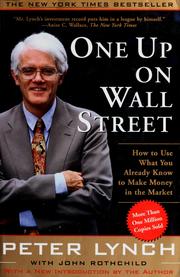
How individual investors can use what they know to find stocks before professionals.
“In November 1992, after juggling with all sorts of investing approaches, I read “One Up on Wall Street” by Peter Lynch.” — Francois Rochon
Source: Giverny Capital Annual Letter to Partners 2011, page 6
Recommended by: David Rolfe, Francisco Garcia Parames and 10 others
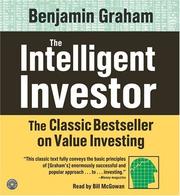
Treat stocks as parts of businesses and buy only with a margin of safety.
“Although I’ve been reading The Intelligent Investor on a regular basis over the years, I never reread the 1958 speech, until I came across a Latin quote from Ben Graham and searched far and wide for its origin.” — Francois Rochon
Source: Giverny Capital Annual Letter to Partners 2018, page 9
Recommended by: Benjamin Graham, Christopher Bloomstran and 32 others
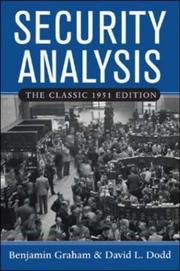
How to read financial statements sceptically and value bonds and stocks.
“I am reminded once again of the quote that sits in the front of Ben Graham’s Security Analysis, from Horace’s Ars Poetica: “Many shall be restored that now are fallen and many shall fall that now are in honor.” — Bill Miller
Source: 2007 Q3 Market Commentary
Recommended by: Bill Miller, Christopher Bloomstran and 18 others
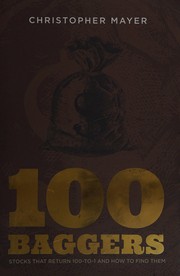
What stocks that rose a hundredfold had in common, and how to find them.
Recommended by: Mohnish Pabrai
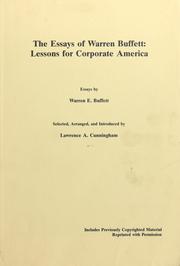
Berkshire's shareholder letters arranged by topic: governance, valuation, mergers.
“The resource is as valuable as Larry Cunningham's The Essays of Warren Buffett, which similarly organizes by subject matter” — Christopher Bloomstran
Source: Semper Augustus 2024 Letter to Clients, 'Books and Tunes for Walking', p. 96
Recommended by: Christopher Bloomstran, Francois Rochon and 11 others
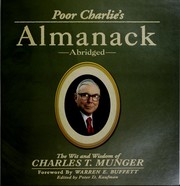
Speeches making the case for a latticework of mental models from many fields.
“…books I've recommended, highlighted to death, or forced on friends.” — Andrew Wilkinson
Source: Andrew Wilkinson's Bookshelf, neverenough.com
Recommended by: Andrew Wilkinson, Charlie Munger and 26 others
Where it sits in the reference 7
Topics 1
As an Amazon Associate I earn from qualifying purchases.