Updates

  1. Fund letters lists 118 more letters, each with its own page: 44 weekly commentaries by Jeremy Siegel from 2026, 31 issues of Van Tharp's newsletter from 2018, 23 Pabrai Investment Funds letters from 2021 to Q3 2026, 13 Efficient Frontier essays by William Bernstein, Oakmark's three 3Q 2026 commentaries, two Lindsell Train reports, a John Hussman comment and Third Point's Q3 2026 letter.
  2. 2,027 more books carry a one-line description in the Books table and on their pages; 7,067 of 7,715 have one, every tier 1, 2 and 3 book among them.
  3. Fund letters lists 187 more letters from 19 firms, among them Permanent Equity, Social Capital, Lux Capital, Square Peg, Bestinver, Cobas, Sequoia Fund, Marketfield and EquityCompass; each shows on its investor's page and has a page of its own.
  4. 2,928 more books carry a one-line description in the Books table and on their pages, so every tier 1, 2 and 3 book has one; 5,040 in all.
  5. Every publication on Newsletters has its own page: its writing, its writers, its staff and who recommends it. Investor pages have a Management tab; a company's Experts tab now leaves out its own people, who list under Management. Tabs on a phone move sideways only.
  6. Every fund letter and research paper has its own page: the thesis, the PDF, the companies and books it names, and for 176 letters and 24 papers so far a summary, key insights and quotes with their page.
  7. 99 books that no page listed now sit under their topics in Books, among them Caste, American Prometheus and Pale Blue Dot.
  8. Newsletters lists every newspaper, magazine, investment newsletter, journal and blog the reference holds, 442 in all, with the people who write there. The search box keeps your last 20 searches. You can create an account.
  9. 283 books that fund managers recommend in their letters are on the shelf, each with the letter's own words and page; investor pages have a Recommends tab.
  10. Person, company, investor and show pages link their own accounts on X, Threads, Instagram, LinkedIn, YouTube and Substack: 275 people, 552 companies and organisations, 88 investors and 478 shows.
  11. 716 more book recommendations name their source: the person's own reading list, letter, blog post, speech or interview, or an article that reports it. 232 of them quote the person's own words about the book, on the book card and on the book's page.
  12. Every US-listed company has a page with its SEC filings. Company pages list their experts and their management, past and present. Fund managers sit under Investors. Each show has a page of its episodes, and an episode page names its guests and hosts. Biographies lists groups, then people. Breadcrumbs show where a page sits.
  13. Media lists every podcast episode, video, interview and talk, over 10,000, by person, company, publisher and event; each filter searches its own choices. Books opens on its table, then Browse, then Authors and Recommenders. A filter's count no longer covers its arrow.
  14. A book that no company, country or subject page lists shows its topics under Where it sits in the reference. On a phone, a page's tabs scroll sideways only. Descriptions read the same on every page. See them in the Experts tab lists every expert the page names.
  15. Every podcast episode, video and interview has its own page with a video or audio player and a link to the source. Investor pages show each company's sector and market cap; firms such as Berkshire Hathaway have one page that holds their letters and their company tabs. Letters tabs filter by company and search the theses. Companies filter by Public, Private and Defunct and link each company's website.
  16. Every tab, view and search has its own address, such as /books/table/asset or /letters/companies, so Back works and a link opens the same place. Page addresses no longer end in .html. Fund letters, Investors, Companies and Papers load about a fifth of the data they did.
  17. Fund letters has a Companies tab: every company the letters name, with its market cap, sector, country, and how many letters and investors name it. Investor pages link each investor's website. Lists in table cells end with “… and N more” at every width.
  18. 1,120 more book summaries; descriptions for 373 papers; pages for 137 more companies, each with the fund letters that discuss it; 215 official photographs; search has its own page.
  19. 411 more books have a summary; person pages list 930 more of the books they wrote; 147 people show their official photograph.
  20. Every investor has a page with its letters and the companies they discuss; company pages list the investors whose letters name them.
  21. A Companies section at the top of the rail lists every company the books, experts and fund letters name.
  22. Person pages list letters, writing, profiles and links as sortable tables with filters, and show each person's companies as links; Fund letters show each letter's description in its own column.
  23. Experts show a checked job title and a short description of each person; 30 more people have photographs.
  24. Every company, fund, university and publication the experts work for has a page listing the people there.
  25. Fund letters show each letter's thesis and filter by it; 225 person pages list the essays, columns and newsletter issues the person wrote.
  26. Person pages list every essay and newsletter issue a person wrote, and their own books as a table in List view.
  27. Recommends shows the five largest kinds of book and the rest under More; browse pictures load sooner.
  28. Podcasts and talks link the original episode, filter by Audio and video or Press, and list each publisher once.
  29. Pages are wider, Recommends has List and Grid, and a filter clicked again turns off.
  30. Book cards sit in a ruled grid with Open Library and Goodreads links and each book's one-line note.
  31. Funds is now Investors; each investor's styles are buttons that filter the table.
  32. Podcasts and talks on a person's page filter by year and publisher and show as a list or a grid of pictures.
  33. Quotes show only people's own words: 472 summaries written by list sites are gone.
  34. Country pages open from Browse again, and every link on the shelf lands on a page.
  35. Subject and person pages show their sections as tabs, and each book appears once on a person's page.
  36. Book cards show the quote, who said it and the source; grids show five cards to a row.
  37. On a phone, a menu holds the sections, search, Updates, Feedback and dark mode.
  38. Feedback takes a screenshot of the page with no browser prompt, opens a screenshot full size when you click it, and clears itself once sent.
  39. Book cards are centred, search names the topic each book sits in, and any text cut short shows whole on hover.
  40. Search groups its results by kind: people, companies, geographies, subjects, topics, books, funds, fund letters and papers.
  41. The Books table lists who recommended each book by name, and the browser tab names the section you are in.
  42. Feedback can take a screenshot of the page, or one you paste or choose, and opens in the corner beside Updates.
  43. Each rail button reopens its section where you left it, and Browse, Table and People show on every book and subject page.
  44. Filters grey out choices that hold nothing instead of hiding them, and Books › People filters by authors or recommenders.
  45. Feedback takes a subject line and up to three screenshots.
  46. Biographies are grouped by the person they are about: 41 new pages, from Abraham Lincoln to Lee Kuan Yew.
  47. Sport splits into 23 sports, and Religion into one topic per faith.
  48. Book lists show as cards: the cover, one recommendation quote and every recommender by name.
  49. Seventeen subjects that had two or three pages under different names now have one page each.
  50. Every page lists its Experts as authors and recommenders, with a link to them on the Experts tab.
  51. Economics, Financial history, Financial panics and Accounting are subjects of their own, with one page per financial crisis.
  52. Book, person and subject pages open inside the app, so the tabs stay in view.
  53. 996 more book covers, and photographs or logos for 227 more people and companies.
  54. Books › Browse shows every subject as cards, and the rail holds Fund letters, Papers, Experts, Books and Funds.
  55. Every topic over 150 books splits into narrower topics, each with a page of its own.

Send feedback

What is it?
Screenshots, up to 3 (optional)
or paste one with Ctrl+V

We use your email only to reply to you.

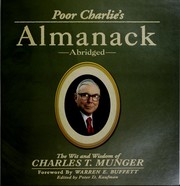
Poor Charlie's Almanack

Poor Charlie's Almanack

Speeches making the case for a latticework of mental models from many fields.

Charlie Munger
2005
T1 512 pages · about 8h 32m to read Open LibrarygoodreadsAmazon

Edited by Peter Kaufman; expanded Stripe Press edition published 2023.

Summary

The book collects Munger's speeches, talks and writings, edited by Peter Kaufman, with Munger's own commentary added. The centrepiece is the argument for a latticework of mental models drawn from many disciplines. Munger says that a person who knows only finance will force every problem into finance, and that competence requires the big ideas from psychology, mathematics, physics, biology, engineering and accounting held together well enough to be used.

The most cited section is The Psychology of Human Misjudgment, a talk that lists twenty-five standard causes of human error, including incentive-caused bias, liking and disliking distortion, doubt avoidance, inconsistency avoidance, deprival superreaction, social proof and what Munger calls lollapalooza effects, where several biases act at once in the same direction. He built the list from observation rather than from academic psychology, and he criticises academic psychology for not teaching the interactions.

The investing material argues for extreme concentration in a few understandable businesses bought at sensible prices, for inverting problems, for using checklists, and for staying inside a circle of competence with a clearly marked edge. Munger's talks on worldly wisdom in business include his account of how Coca-Cola could have been built from first principles, which is the clearest published example of his reasoning method.

The book has real limits. It repeats itself, because the speeches were given to different audiences over decades. Its editions are expensive and physically large, though a free authorised version now exists. Munger's psychology list is not a research literature and some items overlap or lack evidence. His investment advice presupposes a temperament and a capital base most readers do not have. It works best as a source of reasoning habits rather than as a method to copy.

Key takeaways 8

  1. A person needs eighty to ninety models from multiple disciplines to think competently, because a single discipline forces every problem into the wrong shape.
  2. Incentives explain more behaviour than intelligence or intention does, and anyone analysing a situation should identify who is paid for what before anything else.
  3. Inverting a problem, by asking what would guarantee failure and then avoiding it, solves questions that direct reasoning cannot.
  4. Several psychological biases acting together in the same direction produce effects far larger than the sum of the individual biases.
  5. Extreme concentration in a few well-understood businesses beats diversification for an investor who does the work.
  6. A great business bought at a fair price beats a fair business bought at a great price, which is the change Munger pushed Buffett to make.
  7. Knowing the boundary of your competence matters more than the size of that competence.
  8. Avoiding standard stupidities produces better lifetime results than pursuing brilliance.

Who should read it

Investors who want the reasoning method behind Berkshire's decisions, and anyone building a checklist for their own recurring errors.

About Charlie Munger

Vice-chairman, Berkshire Hathaway 1978-2023; chairman, Wesco Financial and Daily Journal Corporation

His latticework-of-mental-models talks reframed investing as applied multidisciplinary psychology and are quoted as a primary source across fields.

Who recommended it 28 · 15 direct

“…books I've recommended, highlighted to death, or forced on friends.”

“if you want to get to know Charlie, you can't do it properly without reading Poor Charlie's Almanack... Get the book.”

“I've spent a decade slurping up everything I can find about Mental Models (starting with Poor Charlie's Almanack, continuing with Farnam Street, and recently Latticework).”

“is by far the most comprehensive publication that captures the essence of Charlie's philosophy... I treated the book as a treasure and read it cover to cover multiple times.”

“Some people, including me, consider Mr. Munger to be an even more interesting thinker and writer than Mr. Buffett, and recently a group of Mr. Munger's friends assembled a compilation book of his most interesting thoughts and speeches called Poor Charlie's Almanack, inspired by Ben Franklin's Poor Richard's Almanack.”

“Kaufman, Peter D., ed., Poor Charlie’s Almanack (Virginia Beach, VA: Donning Company, 2005)”

“If you’re looking for one book, Poor Charlie’s Almanack is loaded with a lot of wisdom.”

“In the room next door, I have Poor Charlie's Almanack. I love reading about mental models.”

“In addition, the shop will premiere Poor Charlie’s Almanack, a book compiled by Peter Kaufman.”

Josh Wolfereported

“This masquerades as a business book, but it's really just Charlie Munger's (of Berkshire Hathaway) advice on overcoming oneself to live a successful and virtuous life.”

Niki Scevakreported
Ramit Sethireported
Sam Altmanreported

Similar books 6

Chosen by shared topics, the entries that hold them, and the people who recommended both.
Peter Bevelin · 2007

Why people misjudge, with thinking tools from Munger, Buffett, Darwin and Feynman.

“…books I've recommended, highlighted to death, or forced on friends.” — Andrew Wilkinson

Source: Andrew Wilkinson's Bookshelf, neverenough.com

Recommended by: Andrew Wilkinson, Li Lu, Nat Eliason and 7 others
Tren Griffin · 2015

Charlie Munger's stated views, arranged as a system of value investing.

“…books I've recommended, highlighted to death, or forced on friends.” — Andrew Wilkinson

Source: Andrew Wilkinson's Bookshelf, neverenough.com

Recommended by: Andrew Wilkinson, Christopher Bloomstran and 8 others
Daniel Kahneman · 2011

How fast, automatic thought and slow, deliberate thought shape judgment and error.

“…books I've recommended, highlighted to death, or forced on friends.” — Andrew Wilkinson

Source: Andrew Wilkinson's Bookshelf, neverenough.com

Recommended by: Andrew Wilkinson, Charles de Vaulx and 33 others
Peter Bevelin · 2016

Munger's and Buffett's ideas on avoiding error, as a dialogue built from their words.

Nassim Nicholas Taleb · 2012

Why some things gain from volatility and disorder, and how to build them.

“Antifragile. Loved the first 1/3 and last 1/3 of this book.” — Andrew Chen

Source: Books I’m reading (2013)

Recommended by: Ana Fabrega, Andrew Chen, Mohnish Pabrai and 23 others
Nassim Nicholas Taleb · 2001

Why people mistake luck for skill, above all in markets.

“Fooled By Randomness was unquestionably the best non-fiction book I read in 2005.” — Brad Feld

Source: Book Review: Fooled By Randomness — Feld Thoughts

Recommended by: Barton Biggs, Brad Feld, Howard Marks and 12 others

Where it sits in the reference 10

Investors
Biographies
Investment philosophy
Portfolio & risk
Investment styles
Mental models
Mental models
Mental models
Mental models

Topics 2

Psychology and BehaviourCognitive biases, judgement and decisions

As an Amazon Associate I earn from qualifying purchases.