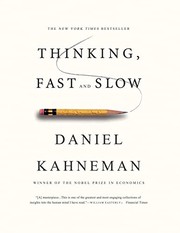
Thinking, Fast and Slow
How fast, automatic thought and slow, deliberate thought shape judgment and error.
Kahneman's synthesis of behavioral economics is the cognitive science underpinning every negotiation tactic. Anchoring, loss aversion, framing effects, and the planning fallacy — understanding why these biases operate, not just that they exist, makes you harder to exploit and more honest about your own irrationality.
Summary
Kahneman sets out two modes of thought. System 1 runs fast, automatically and without a sense of effort. System 2 runs slowly, allocates attention and is lazy about checking System 1. Most of the book shows how System 1 substitutes easy questions for hard ones, producing predictable errors that survive expertise, incentives and warnings.
The material rests on decades of experiments Kahneman ran with Amos Tversky, plus later work on prospect theory, the planning fallacy, and the difference between the experiencing self and the remembering self. Prospect theory, which won Kahneman the 2002 Nobel Prize in economics, states that people value outcomes relative to a reference point, feel losses roughly twice as strongly as equivalent gains, and overweight small probabilities. The book also covers regression to the mean, base rate neglect, anchoring, availability and overconfidence, each with the study that established it.
The chapters on overconfidence apply directly to investing. Kahneman describes the illusion of validity, in which confident forecasts persist despite records showing no skill, and reports his finding that a firm's stock pickers showed year-to-year correlations near zero. He recommends the outside view, reference class forecasting and the premortem as practical corrections. He is explicit that knowing about a bias does not remove it in yourself, and that institutions can improve decisions more reliably than individuals can.
The replication crisis hit parts of the book hard. The priming chapter is the weakest section, and Kahneman himself later conceded that he had placed too much confidence in underpowered studies. Ego depletion has largely failed to replicate. The core findings on prospect theory, anchoring and judgment under uncertainty have held up better. Read the priming material with suspicion and the loss aversion material as solid.
Key takeaways 8
- Judgment runs on two systems, and the fast automatic one produces answers that the slow deliberate one usually accepts without checking.
- People evaluate outcomes as gains and losses from a reference point rather than as final states of wealth.
- Losses hurt roughly twice as much as equivalent gains please, which explains why investors hold losers and sell winners.
- When a question is hard, the mind silently substitutes an easier one and answers that instead.
- Confidence in a judgment reflects the coherence of the story a person has constructed, not the amount or quality of the evidence behind it.
- Forecasters in many professional fields, including stock selection, show skill indistinguishable from chance while remaining certain of their ability.
- Simple statistical rules outperform expert intuition in noisy, low-validity environments.
- The remembering self judges an experience by its peak and its ending, not by its duration, so people choose experiences their experiencing self would reject.
Who should read it
Anyone making repeated decisions under uncertainty who wants the underlying research rather than a secondhand list of biases.
About Daniel Kahneman
Eugene Higgins Professor of Psychology Emeritus, Princeton University; Nobel laureate in economics 2002
Prospect theory and the heuristics-and-biases programme are the primary psychological foundation the whole of behavioral finance builds on.
Who recommended it 38 · 12 direct
“…books I've recommended, highlighted to death, or forced on friends.”
“If you liked “Predictably Irrational” or “Stumbling on Happiness” or any of those pop-psychology books, well, this is the Godfather of all of their work. Huge thorough book gives a great overview of much of his work. Read the other quotes on Amazon about it.”
“Successful investing isn't about outsmarting the next guy, but rather about minimizing your own stupidity. Psychologist Daniel Kahneman, who shared the Nobel Prize in Economics in 2002, probably understands how the human mind works better than anyone else alive. This book can make you think more deeply about how you think than you ever thought possible.”
“Currently, I’m shamelessly flogging Daniel Kahneman's Thinking Fast and Slow.”
“Here’s a classic example, which comes from Daniel Kahneman’s book, Thinking, Fast and Slow: 17 “A cab was involved in a hit-and-run accident at night.”
Similar books 6
Chosen by shared topics, the entries that hold them, and the people who recommended both.
How cognitive dissonance drives people to justify their mistakes, not admit them.
“We are wired for self-justification. We create fictions that absolve us of responsibility, restoring our belief that we are smart, moral, and right — a belief that often keeps us on a course that is dumb, immoral, and wrong.” — Derek Sivers
Source: Derek Sivers book notes (primary, rated list) · Rating: 3/10
Recommended by: Derek Sivers, Howard Marks, Mohnish Pabrai and 3 others
Six principles of compliance, from reciprocity to scarcity, and how sellers use them.
“…books I've recommended, highlighted to death, or forced on friends.” — Andrew Wilkinson
Source: Andrew Wilkinson's Bookshelf, neverenough.com
Recommended by: Andrew Wilkinson, Charlie Munger and 31 others
Why people misjudge, with thinking tools from Munger, Buffett, Darwin and Feynman.
“…books I've recommended, highlighted to death, or forced on friends.” — Andrew Wilkinson
Source: Andrew Wilkinson's Bookshelf, neverenough.com
Recommended by: Andrew Wilkinson, David Perell, Derek Sivers and 9 others
How Daniel Kahneman and Amos Tversky worked together on heuristics and biases.
Recommended by: Andrew Wilkinson, Mohnish Pabrai, Ray Dalio and 6 others
Speeches making the case for a latticework of mental models from many fields.
“…books I've recommended, highlighted to death, or forced on friends.” — Andrew Wilkinson
Source: Andrew Wilkinson's Bookshelf, neverenough.com
Recommended by: Andrew Wilkinson, Charlie Munger and 26 others
Why people mistake luck for skill, above all in markets.
“Fooled By Randomness was unquestionably the best non-fiction book I read in 2005.” — Brad Feld
Source: Book Review: Fooled By Randomness — Feld Thoughts
Recommended by: Barton Biggs, Brad Feld, Derek Sivers and 15 others
Where it sits in the reference 13
Topics 1
As an Amazon Associate I earn from qualifying purchases.