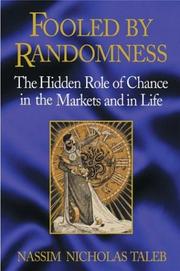
Fooled by Randomness
Why people mistake luck for skill, above all in markets.
Incerto volume 1
Summary
Taleb argues that people systematically mistake luck for skill, particularly in markets. The book was published in 2001 and precedes both The Black Swan and Antifragile, and it states the core of his thinking in the most accessible form. His targets are traders who confuse a good run with ability, investors who study returns without considering the distribution of unrealised outcomes, and anyone who reasons from a single realised history.
His main device is the alternative histories argument. A decision should be judged by the full distribution of outcomes it could have produced, not by the one that happened. He uses the example of Russian roulette to make the point that a large payoff from a low-probability catastrophic bet is not evidence of skill. He also describes survivorship bias in detail, using a simulation of monkey-like traders to show how many apparently skilled performers a large enough population produces by chance alone.
The book covers ergodicity, the difference between what happens to one person over time and what happens to a population at a point in time, and it introduces the asymmetry between probability and expectation, meaning that a person can be right most of the time and still lose money because the rare loss is large. Taleb's own strategy of buying deep out-of-the-money options follows from that asymmetry.
The writing is digressive and self-referential, and Taleb attacks named people freely. The book offers little constructive method beyond avoiding blow-up risk. Critics note that survivorship bias and luck-versus-skill were already documented in finance literature, and that Taleb offers assertion rather than measurement. It remains the clearest statement of the argument for anyone evaluating a track record.
Key takeaways 8
- A track record cannot distinguish skill from luck unless the sample is long enough for the underlying distribution to show itself.
- Decisions should be judged by the distribution of outcomes they could have produced, not by the single outcome that occurred.
- Survivorship bias guarantees that any large population of traders produces apparently skilled performers by chance alone.
- Being right frequently and being profitable are different things, because frequency of correctness says nothing about the size of outcomes.
- Rare events are underweighted because people reason from personal experience, and personal experience contains few of them.
- Someone whose strategy carries a small probability of ruin will eventually be ruined regardless of how good the intervening returns look.
- Media and journalism systematically produce noise that people mistake for information, which degrades rather than improves judgment.
- Nobody accepts randomness in their own successes and everyone accepts it in their failures.
Who should read it
Investors evaluating track records, including their own, who want the survivorship and alternative-histories arguments before the later books.
About Nassim Nicholas Taleb
Former options trader; Distinguished Professor of Risk Engineering, NYU Tandon; scientific adviser to Universa Investments
The Incerto is the primary source for how markets and institutions handle tail risk, and the accompanying technical work supplies the mathematics others cite.
Who recommended it 18 · 11 direct
“Fooled By Randomness was unquestionably the best non-fiction book I read in 2005.”
“Mr Black Swan sure does love the sound of his own voice. Interesting thoughts on investing and misjudging randomness inside lots of blather.”
“In his important book Fooled by Randomness, Nassim Nicholas Taleb points out how easily random events can make good decisions look wrong and bad decisions look right.”
“The second is a much more controversial author, but I would say ever since I was exposed to one of his early works, Fooled by Randomness and The Black Swan, I will probably always be a fan of Nassim Taleb and he is, you know, a writer who is not humble, who, you know, is not afraid of sprinkling tons of obscure references and non-obscure references.”
“In his wonderful book, Fooled by Randomness, Nassim Taleb relates an anecdote that beautifully drives home the 3 expected value message.”
“Finally, I enjoyed reading Fooled by Randomness by Nassim Nicholas Taleb.”
“Recently, I came across a much more facile explanation of the risk-aversion-myopia phenomenon in Nassim Nicholas Taleb's Fooled by Randomness.”
“He is also famous for The Black Swan: The Impact of the Highly Improbable, Antifragile: Things That Gain from Disorder, and Fooled by Randomness: The Hidden Role of Chance in Life and Markets, all of which are worth reading.”
Similar books 6
Chosen by shared topics, the entries that hold them, and the people who recommended both.
Rare, unforeseen, high-impact events drive history, explained only after the fact.
“The Black Swan U The best-known bird around today is The Black Swan, the second book from Nassim Nicolas Taleb.” — Howard Marks
Source: The Complete Collection, page 530
Recommended by: David Perell, Howard Marks, Marc Andreessen and 20 others
Why some things gain from volatility and disorder, and how to build them.
“Antifragile. Loved the first 1/3 and last 1/3 of this book.” — Andrew Chen
Source: Books I’m reading (2013)
Recommended by: Ana Fabrega, Andrew Chen, Derek Sivers and 24 others
How fast, automatic thought and slow, deliberate thought shape judgment and error.
“…books I've recommended, highlighted to death, or forced on friends.” — Andrew Wilkinson
Source: Andrew Wilkinson's Bookshelf, neverenough.com
Recommended by: Andrew Wilkinson, Charles de Vaulx and 36 others
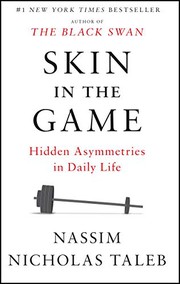
Why people who make decisions for others must share in the downside.
“Skin in the Game by @nntaleb is one of my all-time favorite books.” — Ana Fabrega
Source: Fab Fridays 88: How to Pick a Good Book - by Ana Lorena
Recommended by: Ana Fabrega, David Perell, Derek Sivers and 14 others

Experiments showing most cheating is many people cheating a little.
Recommended by: Mohnish Pabrai
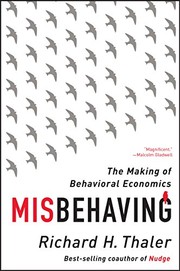
How behavioural economics was built against economists who assumed rational agents.
“He opens his new book, Misbehaving, with Vilfredo Pareto’s assertion that “the foundation of political economy and, in general, of every social science, is evidently psychology.” — Howard Marks
Source: On the Couch, page 1
Recommended by: Howard Marks, Michael Mauboussin and 2 others