The Black Swan
Rare, unforeseen, high-impact events drive history, explained only after the fact.
Incerto volume 2
Summary
Taleb argues that rare, unpredicted, high-impact events drive history and markets, and that people construct explanations after the fact that make those events look predictable. He defines a black swan by three properties: it lies outside regular expectations, it carries extreme impact, and human nature makes it explainable in hindsight. His target is any method that estimates the probability of extremes from past data.
He divides the world into Mediocristan, where no single observation changes the total, such as height or weight, and Extremistan, where a single observation can dominate, such as book sales, wealth or market returns. He argues that Gaussian tools apply only in Mediocristan and that financial risk models applying normal distributions to Extremistan produce numbers that are worse than useless because they generate false confidence. His attack on value at risk and on the Nobel-recognised portfolio theory of Markowitz, Sharpe and Merton is explicit and personal.
He also names supporting errors: the narrative fallacy, in which people compress facts into stories; silent evidence, in which survivors are visible and failures are not; and the ludic fallacy, in which the tidy probabilities of games are mistaken for real uncertainty. His constructive advice is limited by design: seek exposure to positive black swans through many cheap options, avoid exposure to negative ones, and do not attempt to predict.
The 2008 crisis raised the book's standing enormously, though Taleb had published in 2007 and the events fit his argument closely. Critics point out that the concept is hard to falsify, that the book is repetitive and hostile, and that some ideas restate earlier work by Mandelbrot and by Knight. The distinction between the two domains is the durable contribution.
Key takeaways 8
- Rare, high-impact and retrospectively explained events, not the ordinary distribution of outcomes, determine most historical and financial results.
- Some domains are scalable, where a single observation can dominate the total, and statistical tools built for non-scalable domains fail badly there.
- Applying normal distributions to financial returns understates tail risk severely enough to make risk models actively harmful.
- People construct causal narratives after events, which makes the past look far more predictable than it was and the future look more knowable than it is.
- Failures leave no record, so any study of successes overstates the role of skill and understates the role of luck.
- Absence of evidence for a rare event is not evidence that the event cannot occur, and long uneventful records can precede catastrophe.
- An investor should build exposure to positive rare events cheaply and eliminate exposure to negative ones, rather than attempt to forecast either.
- Expert forecasting in domains subject to rare events performs no better than chance while producing confident numbers.
Who should read it
Investors and risk managers who need the argument against extrapolating from historical distributions stated in full.
About Nassim Nicholas Taleb
Former options trader; Distinguished Professor of Risk Engineering, NYU Tandon; scientific adviser to Universa Investments
The Incerto is the primary source for how markets and institutions handle tail risk, and the accompanying technical work supplies the mathematics others cite.
Who recommended it 23 · 9 direct
“The Black Swan U The best-known bird around today is The Black Swan, the second book from Nassim Nicolas Taleb.”
“One more quote, this time from Nassim Nicholas Taleb in The Black Swan”
“The second is a much more controversial author, but I would say ever since I was exposed to one of his early works, Fooled by Randomness and The Black Swan, I will probably always be a fan of Nassim Taleb and he is, you know, a writer who is not humble, who, you know, is not afraid of sprinkling tons of obscure references and non-obscure references.”
“Nassim Taleb’s latest book, The Black Swan, is a treatise on the improbable events Buffett has in mind. 5 The term black swan comes from philosopher Karl Popper’s criticism of induction: We get closer to truth if we focus on falsification instead of verification.”
“He is also famous for The Black Swan: The Impact of the Highly Improbable, Antifragile: Things That Gain from Disorder, and Fooled by Randomness: The Hidden Role of Chance in Life and Markets, all of which are worth reading.”
Similar books 6
Chosen by shared topics, the entries that hold them, and the people who recommended both.
Why people mistake luck for skill, above all in markets.
“Fooled By Randomness was unquestionably the best non-fiction book I read in 2005.” — Brad Feld
Source: Book Review: Fooled By Randomness — Feld Thoughts
Recommended by: Barton Biggs, Brad Feld, Derek Sivers and 15 others
Why some things gain from volatility and disorder, and how to build them.
“Antifragile. Loved the first 1/3 and last 1/3 of this book.” — Andrew Chen
Source: Books I’m reading (2013)
Recommended by: Ana Fabrega, Andrew Chen, Derek Sivers and 24 others
Why people who make decisions for others must share in the downside.
“Skin in the Game by @nntaleb is one of my all-time favorite books.” — Ana Fabrega
Source: Fab Fridays 88: How to Pick a Good Book - by Ana Lorena
Recommended by: Ana Fabrega, David Perell, Derek Sivers and 14 others
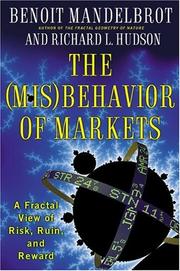
Why standard finance models understate market risk, from fractal geometry's creator.
“(Italics added.) Mandelbrot on Risk, Ruin, and Reward The abstract theories of Karl Popper and Frank Knight can be directly applied to the financial markets, which is exactly what Benoit Mandelbrot, the brilliant inventor of fractal geometry, has done with Richard Hudson in his book The (Mis)Behavior of Markets, ominously subtitled “A Fractal View of Risk, Ruin, and Reward.” — John C. Bogle
Source: Black Monday and Black Swans, page 3
Recommended by: John C. Bogle, Mohnish Pabrai and 2 others
How fast, automatic thought and slow, deliberate thought shape judgment and error.
“…books I've recommended, highlighted to death, or forced on friends.” — Andrew Wilkinson
Source: Andrew Wilkinson's Bookshelf, neverenough.com
Recommended by: Andrew Wilkinson, Charles de Vaulx and 36 others
What a four-year forecasting tournament showed about the best forecasters' habits.
“In a book many in our research department have enjoyed, Superforecasting: The Art and Science of Prediction, Philip Tetlock and Dan Gardner state: “The humility required for good judgment is not self-doubt—the sense that you are untalented, unintelligent, or unworthy.” — Bill Nygren
Source: Bill Nygren Market Commentary | 1Q17
Recommended by: Bill Nygren, Mark Leonard and 11 others