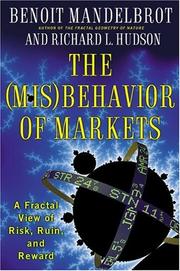
The Misbehavior of Markets
Why standard finance models understate market risk, from fractal geometry's creator.
Summary
Mandelbrot, who developed fractal geometry, argues that the standard models of finance are built on assumptions that the data contradicts, and that markets are far riskier than those models imply. The book is written with Richard Hudson for a general audience.
His attack concentrates on two assumptions. Price changes are assumed to be independent, which means past movements carry no information, and they are assumed to follow a normal distribution. Mandelbrot shows that neither holds. Price changes cluster, so large movements are followed by large movements, which he calls long memory or the Joseph effect. And the distribution has far heavier tails than the normal, so extreme events occur orders of magnitude more often than the models predict, which he calls the Noah effect. He documents specific cases where a movement that the standard model treats as effectively impossible occurred within a period of a few years.
His positive proposal is the use of fractal and multifractal models, which reproduce both the clustering and the heavy tails by construction, and which he had applied to cotton prices as early as 1963. He attacks the entire structure built on the standard assumptions, including the capital asset pricing model, modern portfolio theory and the Black-Scholes option pricing formula, arguing that all three understate risk systematically.
The critique is stronger than the alternative. Mandelbrot's models describe the observed behaviour better than the standard ones without providing the tractable pricing and hedging results that made the standard models useful. Practitioners have largely responded by keeping the standard models and adjusting for tails rather than replacing them. The critique remains correct.
Key takeaways 8
- Price changes are not independent, since large movements cluster together, which invalidates the assumption underlying most financial models.
- Return distributions have far heavier tails than the normal distribution, so extreme events occur orders of magnitude more often than models predict.
- Movements that standard models treat as occurring once in millions of years have occurred repeatedly within single decades.
- Volatility itself varies over time and clusters, which means a single volatility parameter cannot describe a market.
- Portfolio theory, the capital asset pricing model and Black-Scholes all rest on the same contradicted assumptions and understate risk systematically.
- Fractal and multifractal models reproduce both the clustering and the heavy tails by construction, which the standard models cannot.
- Timing rather than average return determines outcomes, since a small number of days account for most of the cumulative movement.
- The critique is stronger than the proposed alternative, since fractal models describe behaviour better without providing tractable pricing results.
Who should read it
Investors and risk managers who want the mathematical case against the assumptions underlying standard risk models, from the person who first documented the problem.
Who recommended it 4 · 3 direct
“(Italics added.) Mandelbrot on Risk, Ruin, and Reward The abstract theories of Karl Popper and Frank Knight can be directly applied to the financial markets, which is exactly what Benoit Mandelbrot, the brilliant inventor of fractal geometry, has done with Richard Hudson in his book The (Mis)Behavior of Markets, ominously subtitled “A Fractal View of Risk, Ruin, and Reward.”
Similar books 6
Chosen by shared topics, the entries that hold them, and the people who recommended both.
Rare, unforeseen, high-impact events drive history, explained only after the fact.
“The Black Swan U The best-known bird around today is The Black Swan, the second book from Nassim Nicolas Taleb.” — Howard Marks
Source: The Complete Collection, page 530
Recommended by: David Perell, Howard Marks, Marc Andreessen and 20 others
Self-organised criticality: why earthquakes and crashes come in all sizes.
“Mark Buchanan, Ubiquity: The Science of History . . . Or Why the World is Simpler Than We Think (New York: Crown Publishers, 2000)” — Michael Mauboussin
Source: Interdisciplinary Perspectives on Risk, page 5
Recommended by: Michael Mauboussin

A graduate text on power laws, fractals and critical points in complex systems.
Recommended by: Nassim Nicholas Taleb
The mathematics of fat-tailed distributions and what they do to statistics.
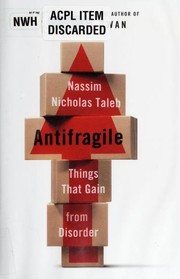
Why some things gain from volatility and disorder, and how to build them.
“Antifragile. Loved the first 1/3 and last 1/3 of this book.” — Andrew Chen
Source: Books I’m reading (2013)
Recommended by: Ana Fabrega, Andrew Chen, Derek Sivers and 24 others
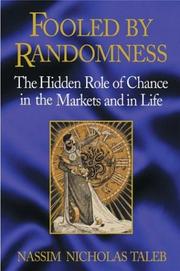
Why people mistake luck for skill, above all in markets.
“Fooled By Randomness was unquestionably the best non-fiction book I read in 2005.” — Brad Feld
Source: Book Review: Fooled By Randomness — Feld Thoughts
Recommended by: Barton Biggs, Brad Feld, Derek Sivers and 15 others