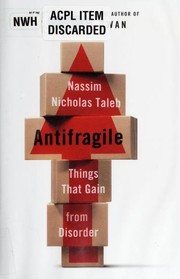
Antifragile
Why some things gain from volatility and disorder, and how to build them.
Incerto volume 4
Summary
Taleb proposes a three-way classification: fragile things lose from volatility and disorder, things indifferent to volatility are unaffected, and antifragile things gain from it. He argues that no word previously existed for the third category and that most institutional design ignores it. The property he cares about is convexity, meaning a payoff structure where the upside from a large move exceeds the downside.
The practical form is the barbell. Taleb recommends putting most capital in maximally safe assets and a small portion in maximally aggressive positions with capped downside and open upside, while avoiding the middle. He applies the same shape to careers, health and research. He also introduces via negativa, the argument that removing harmful things reliably improves outcomes while adding beneficial things often does not, and iatrogenics, the harm done by intervention itself.
He attacks what he calls the Soviet-Harvard delusion, the belief that theory precedes practice, and argues that most technological progress came from tinkering by practitioners rather than from academic science. He praises optionality, defined as the right without the obligation, and says that success comes from having many small options rather than from prediction. He insists that skin in the game is what makes a system antifragile, because it transfers the downside back to whoever creates it.
The book is polemical and repetitive. Taleb attacks named individuals at length and mixes argument with insult. The empirical claims about the history of technology are asserted rather than demonstrated, and historians dispute the account of the Industrial Revolution. The barbell and optionality arguments are the parts practitioners actually use. The concept resists measurement, which makes it hard to test.
Key takeaways 8
- Things divide into fragile, resistant and antifragile according to whether volatility harms them, leaves them unchanged or benefits them.
- A barbell allocation of extreme safety plus a small extreme risk beats a moderate middle position under uncertainty.
- Removing harmful elements improves outcomes more reliably than adding beneficial ones, because subtraction carries fewer unknown side effects.
- Intervention causes harm that is rarely counted, particularly in medicine, economic policy and management.
- Practical tinkering by people with skin in the game produced most technological progress, not the application of academic theory.
- Optionality substitutes for forecasting, because a person with many capped-downside options does not need to know what will happen.
- Suppressing small volatility in a system, such as forest fires or market corrections, accumulates hidden fragility and produces larger collapses later.
- Anyone who imposes risk on others without bearing it themselves makes the whole system fragile.
Who should read it
Investors and founders designing exposure under uncertainty, who want the convexity argument even if they skip the polemics.
About Nassim Nicholas Taleb
Former options trader; Distinguished Professor of Risk Engineering, NYU Tandon; scientific adviser to Universa Investments
The Incerto is the primary source for how markets and institutions handle tail risk, and the accompanying technical work supplies the mathematics others cite.
Who recommended it 27 · 9 direct
“Antifragile. Loved the first 1/3 and last 1/3 of this book.”
“Bold perspectives, unusual ideas, and surprisingly wise advice around an interesting subject of the “opposite of fragile.” Looking through that lens at health, education, governments, business, and life philosophy. Very inspiring, and sparks a lot of further discussion.”
“In Antifragile: Things That Gain from Disorder, Nassim Taleb describes the type of antifragile inventions and ideas that have lasted throughout history.”
“He is also famous for The Black Swan: The Impact of the Highly Improbable, Antifragile: Things That Gain from Disorder, and Fooled by Randomness: The Hidden Role of Chance in Life and Markets, all of which are worth reading.”
Similar books 6
Chosen by shared topics, the entries that hold them, and the people who recommended both.

Rare, unforeseen, high-impact events drive history, explained only after the fact.
“The Black Swan U The best-known bird around today is The Black Swan, the second book from Nassim Nicolas Taleb.” — Howard Marks
Source: The Complete Collection, page 530
Recommended by: David Perell, Howard Marks, Marc Andreessen and 20 others

Why people mistake luck for skill, above all in markets.
“Fooled By Randomness was unquestionably the best non-fiction book I read in 2005.” — Brad Feld
Source: Book Review: Fooled By Randomness — Feld Thoughts
Recommended by: Barton Biggs, Brad Feld, Derek Sivers and 15 others
Why people who make decisions for others must share in the downside.
“Skin in the Game by @nntaleb is one of my all-time favorite books.” — Ana Fabrega
Source: Fab Fridays 88: How to Pick a Good Book - by Ana Lorena
Recommended by: Ana Fabrega, David Perell, Derek Sivers and 14 others
How fast, automatic thought and slow, deliberate thought shape judgment and error.
“…books I've recommended, highlighted to death, or forced on friends.” — Andrew Wilkinson
Source: Andrew Wilkinson's Bookshelf, neverenough.com
Recommended by: Andrew Wilkinson, Charles de Vaulx and 36 others
Speeches making the case for a latticework of mental models from many fields.
“…books I've recommended, highlighted to death, or forced on friends.” — Andrew Wilkinson
Source: Andrew Wilkinson's Bookshelf, neverenough.com
Recommended by: Andrew Wilkinson, Charlie Munger and 26 others
Why people are bad at predicting what will make them happy, and how the errors arise.
“Not at all new-agey, as the title might suggest. Harvard professor of psychology has studied happiness for years, and shares factual findings that will change the way you look at the world.” — Derek Sivers
Source: Book notes by Derek Sivers
Recommended by: Andrew Wilkinson, Derek Sivers, Jim Collins and 4 others
Where it sits in the reference 8
Topics 1
As an Amazon Associate I earn from qualifying purchases.