Ubiquity: Why Catastrophes Happen
Self-organised criticality: why earthquakes and crashes come in all sizes.
Summary
Buchanan, a physicist turned science writer, explains the concept of self-organised criticality and argues that it accounts for the size distribution of events across many domains, including earthquakes, forest fires, extinctions, market crashes and wars.
The organising model is the sandpile experiment of Bak, Tang and Wiesenfeld. Grains of sand dropped onto a pile build slopes that reach a critical state, after which an added grain can trigger an avalanche of any size, and the distribution of avalanche sizes follows a power law rather than a normal distribution. The system organises itself into the critical state without any tuning, which is why the phenomenon is called self-organised criticality.
Buchanan applies this to earthquakes, where the Gutenberg-Richter law is a power law; to forest fires; to species extinctions in the fossil record; to city sizes; to the size distribution of wars, following Richardson's data; and to financial market movements, following Mandelbrot.
The conceptual consequence is the one that matters for investors. In a critical system the size of an event carries no information about the size of its cause, so searching for a proportionate explanation for a large event is a mistake. The distribution has no characteristic scale, which means averages and standard deviations describe nothing useful and extreme events are far more common than a normal distribution implies.
The book is popular science and the applications outside physics are argued by analogy rather than demonstrated. Whether social and economic systems are genuinely critical remains disputed. The distributional point is correct and consequential regardless.
Key takeaways 7
- Systems can organise themselves into a critical state in which a small disturbance triggers an event of any size, without any external tuning.
- In a critical system the size of an event carries no information about the size of its cause, so searching for a proportionate explanation is a mistake.
- Power law distributions have no characteristic scale, which means averages and standard deviations describe nothing useful about them.
- Extreme events are far more common in power law distributed systems than a normal distribution would predict, by orders of magnitude.
- Earthquakes, forest fires, extinctions, city sizes and war casualties all follow power law size distributions.
- Preventing small events in a critical system can increase the size of the eventual large one, which forest fire suppression demonstrates.
- The same statistical signature appears across physical, biological and social systems, which suggests a common structural cause rather than coincidence.
Who should read it
Investors and risk thinkers who want an accessible account of power law distributions and why large events do not require large causes.
Who recommended it 1 · 1 direct
“Mark Buchanan, Ubiquity: The Science of History . . . Or Why the World is Simpler Than We Think (New York: Crown Publishers, 2000)”
Similar books 6
Chosen by shared topics, the entries that hold them, and the people who recommended both.
Why standard finance models understate market risk, from fractal geometry's creator.
“(Italics added.) Mandelbrot on Risk, Ruin, and Reward The abstract theories of Karl Popper and Frank Knight can be directly applied to the financial markets, which is exactly what Benoit Mandelbrot, the brilliant inventor of fractal geometry, has done with Richard Hudson in his book The (Mis)Behavior of Markets, ominously subtitled “A Fractal View of Risk, Ruin, and Reward.” — John C. Bogle
Source: Black Monday and Black Swans, page 3
Recommended by: John C. Bogle, Mohnish Pabrai and 2 others
A graduate text on power laws, fractals and critical points in complex systems.
Recommended by: Nassim Nicholas Taleb
Rare, unforeseen, high-impact events drive history, explained only after the fact.
“The Black Swan U The best-known bird around today is The Black Swan, the second book from Nassim Nicolas Taleb.” — Howard Marks
Source: The Complete Collection, page 530
Recommended by: David Perell, Howard Marks, Marc Andreessen and 20 others
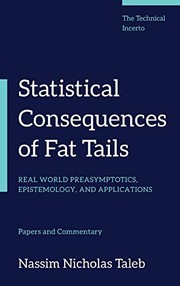
The mathematics of fat-tailed distributions and what they do to statistics.
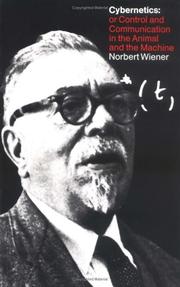
Control and communication in animals and machines run on the same principles.
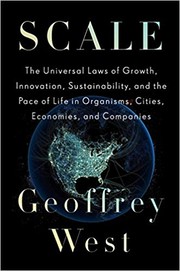
Why organisms, cities and companies follow power laws set by their supply networks.
“Geoffrey West, Scale: The Universal Laws of Growth, Innovation, Sustainability, and the Pace of Life in Organisms, Cities, Economies, and Companies (New York: Penguin Press, 2017), 26” — Michael Mauboussin
Source: Underestimating the Red Queen: Measuring Growth and Maintenance Investments, page 18
Recommended by: Michael Mauboussin, Nat Eliason and 4 others
Where it sits in the reference 4
Topics 4
As an Amazon Associate I earn from qualifying purchases.